


Ebola virus disease outbreak; the role of field epidemiology training programme in the fight against the epidemic, Liberia, 2014
- PMID: 26779298
- PMCID: PMC4709128
- DOI: 10.11694/pamj.supp.2015.22.1.6053
Ebola virus disease outbreak; the role of field epidemiology training programme in the fight against the epidemic, Liberia, 2014
Abstract
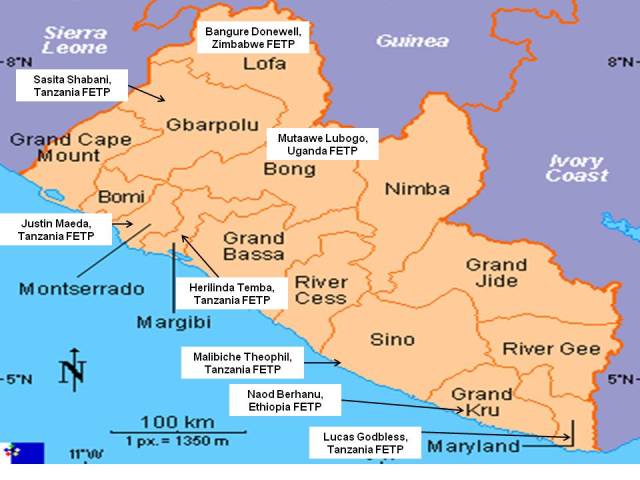
The African Field Epidemiology Network (AFENET) is a public health network established in 2005 as a non-profit networking alliance of Field Epidemiology and Laboratory Training Programs (FELTPs) and Field Epidemiology Training Programs (FETPs) in Africa. AFENET is dedicated to supporting Ministries of Health in Africa build strong, effective and sustainable programs and capacity to improve public health systems by partnering with global public health experts. The Network's goal is to strengthen field epidemiology and public health laboratory capacity to contribute effectively to addressing epidemics and other major public health problems in Africa. The goal for the establishment of FETP and FELTP was and still is to produce highly competent multi-disciplinary public health professionals who would assume influential posts in the public health structures and tackle emerging and re-emerging communicable and non-communicable diseases. AFENET currently networks 12 FELTPs and FETPs in sub-Saharan Africa with operations in 20 countries. During the Ebola Virus Disease (EVD) outbreak in West Africa, African Union Support for the Ebola Outbreak in West Africa (ASEOWA) supported FETP graduates from Uganda, Zimbabwe, Ethiopia and Tanzania for the investigation and control of the EVD outbreak in Liberia. The graduates were posted in different counties in Liberia where they lead teams of other experts conduct EVD outbreak investigations, Infection Control and Prevention trainings among health workers and communities, Strengthening integrated disease surveillance, developing Standard Operating Procedures for infection control and case notification in the Liberian setting as well as building capacity of local surveillance officers' conduct outbreak investigation and contact tracing. The team was also responsible for EVD data management at the different Counties in Liberia. The FETP graduates have been instrumental in the earlier successes registered in various counties in Liberia in the control of the Ebola virus disease. Such efforts should be sustained by supporting local authorities develop strong health systems that are able to respond to epidemic of such magnitude in the near future.
Keywords: EVD; Ebola; FETP; Liberia.
Figures
References
-
- WHO. EVD Virus in Guinea; 2014. http://www.afro.who.int/en/clusters-a-programmes/dpc/epidemic-a-pandemic.... 1(1): 4. 01 January 2015.
-
- WHO. EVD Virus disease situation report; 2014. November 2014-extracted from http://www.cdc.gov/vhf/EVD/outbreaks/2014-west-africa/previous-updates.html. 1(1): 1. 01 January 2015.
-
- David Mukanga, Mufuta Tshimanga, Frederick Wurapa, Fred Binka, David Serwada, William Bazeyo, George Pariyo, Fred Wabwire-Mangen, Sheba Gitta, Stella Chungong, Murray Trostle, Peter Nsubuga. The genesis and evolution of the African Field Epidemiology Network. Pan Afr Med J. 2011;10(Supp 1):2. - PMC - PubMed
-
- Evariste Mutabaruka, Mamadou Sawadogo, Zekiba Tarnagda, Lauren Ouédraogo, Lassana Sangare, Badolo Ousmane, Yassa Ndjakani, Olivia Namusisi, David Mukanga, Michele Evering-Watley, Sennen Hounton, Peter Nsubuga. The West Africa Field Epidemiology and Laboratory Training Program, a strategy to improve disease surveillance and epidemic control in West Africa. Pan Afr Med J. 2011;10(Supp 1):10. - PMC - PubMed
MeSH terms
LinkOut - more resources
Full Text Sources
Medical