Review
. 2016 Feb;12(2):117-24.
doi: 10.1038/nrneurol.2015.251. Epub 2016 Jan 18.

Suspected non-Alzheimer disease pathophysiology--concept and controversy

Affiliations
Review

Suspected non-Alzheimer disease pathophysiology--concept and controversy

Clifford R Jack Jr et al. Nat Rev Neurol. 2016 Feb.

Abstract

Suspected non-Alzheimer disease pathophysiology (SNAP) is a biomarker-based concept that applies to individuals with normal levels of amyloid-β biomarkers in the brain, but in whom biomarkers of neurodegeneration are abnormal. The term SNAP has been applied to clinically normal individuals (who do not meet criteria for either mild cognitive impairment or dementia) and to individuals with mild cognitive impairment, but is applicable to any amyloid-negative, neurodegeneration-positive individual regardless of clinical status, except when the pathology underlying neurodegeneration can be reliably inferred from the clinical presentation. SNAP is present in ∼23% of clinically normal individuals aged >65 years and in ∼25% of mildly cognitively impaired individuals. APOE*ε4 is underrepresented in individuals with SNAP compared with amyloid-positive individuals. Clinically normal and mildly impaired individuals with SNAP have worse clinical and/or cognitive outcomes than individuals with normal levels of neurodegeneration and amyloid-β biomarkers. In this Perspectives article, we describe the available data on SNAP and address topical controversies in the field.


Conflict of interest statement

Competing interests

C.R.J.Jr has provided consulting services for Eli Lilly and receives research funding from the NIH and the Alexander Family Alzheimer’s Disease Research Professorship of the Mayo Foundation. D.S.K. is a Deputy Editor for Neurology®.; is on a data safety monitoring board for Lundbeck Pharmaceuticals and for the Dominantly Inherited Alzheimer’s Disease Treatment Unit; is participating in clinical trials sponsored by Lilly Pharmaceuticals and TauRx Pharmaceuticals; and receives research support from the NIH. D.D. receives research support from the NIH (P50-AG016574; P50-NS072187; P01-AG003949) and CurePSP: Foundation for PSP/CBD and Related Disorders; is an Editorial Board Member of Acta Neuropathologica, Annals of Neurology, Brain, Brain Pathology and Neuropathology; and is Editor-in-Chief of the American Journal of Neurodegenerative Disease and the International Journal of Clinical and Experimental Pathology. A.M.F. has provided consulting services for Eli Lilly, Roche, AbbVie, IBL International and Novartis; and receives research funding from the NIH, the DIAN Pharma Consortium and the Alzheimer’s Association. W.J. is a consultant to Synarc–Bioclinica and to Banner Alzheimer’s Institute–Genentech. E.C.M. receives funding from the NIH. R.C.P. is on a data monitoring committee for Pfizer and Janssen Alzheimer Immunotherapy; is a consultant for Merck, Roche, and Genentech; receives royalties from publishing Mild Cognitive Impairment (Oxford University Press, 2003); and receives research support from the NIH. R.A.S. has been a consultant for Janssen Eisai, Lundbeck, Isis, Boehringer Ingelheim, Roche and Genentech; and receives research support from the Alzheimer’s Association, Fidelity Biosciences, Janssen, BrightFocus Foundation and the National Institute on Aging. W.M.v.d.F. has provided consulting services for Boehringer Ingelheim; receives research funding from the Netherlands Organisation for Scientific Research (NWO), ZonMw, Cardiovasculair Onderzoek Nederland, Boehringer Ingelheim, and European Union (EU) 7th Framework Programme (FP7). All funds are paid to her institution. The VUmc Alzheimer Center is supported by Alzheimer Nederland and Stichting VUmc Fonds. Research of the VUmc Alzheimer Center is part of the neurodegeneration research program of the Neuroscience Campus Amsterdam. V.L.V. has provided consulting services for Bayer Healthcare and Novartis; has received speaker’s honoraria from GE Healthcare, Piramal Imaging and Astra Zeneca; and is supported by a Senior Research Fellowship, and receives research funding, from the National Health Medical Research Council of Australia. P.J.V. has provided consulting services for Élan–Wyeth, Ipsen, Bristol–Myers Squibb, and Roche Diagnostics; and receives research funding from EU Joint Programme–Neurodegenerative Disease Research (JPND) and ZonMw, and from EU FP7 and Innovative Medicines Initiative joint resources, which are composed of financial contributions from EU FP7 (FP7/2007-2013) and in-kind contributions from the European Federation of Pharmaceutical Industries and Associations (EFPIA). S.J.B.V. receives research support from the Innovative Medicines Initiative Joint Undertaking under EMIF grant agreement n° 115372, resources that are composed of financial contributions from EU FP7 (FP7/2007-2013) and in-kind contributions from EFPIA. G.C. and G.B.F. declare no competing interests.

Figures

Figure 1
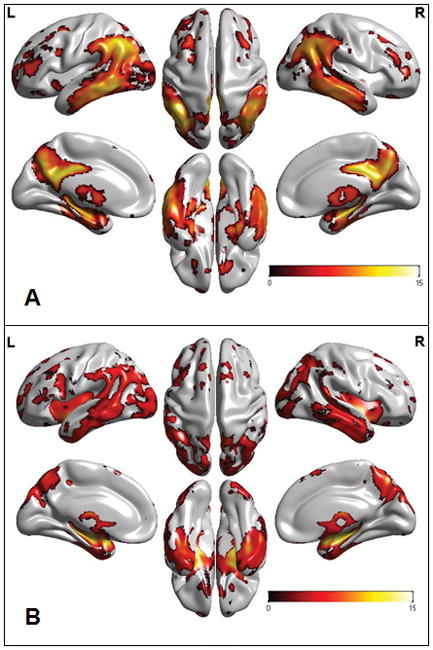
Figure 1. Signature patterns of AD
Individuals with AD dementia (n = 50) were age-matched and sex-matched with cognitively normal elderly individuals (n = 50). a | 18F-FDG–PET maps (FWE threshold set at P <0,001) illustrate decreased FDG uptake in the basal temporal, lateral temporal–parietal, lateral prefrontal, and posterior cingulate–precuneus areas in individuals with AD dementia compared with cognitively normal elderly individuals. This spatial pattern constitutes an “AD-signature” in FDG PET. b | Structural MRI maps (FWE threshold set at P <0.05) illustrate grey matter loss in the medial, basal and lateral temporal, lateral parietal, occipital, insula, and precuneus areas in individuals with AD dementia compared with cognitively normal elderly individuals. This spatial pattern constitutes an “AD-signature” in structural MRI. All voxel-based comparison images were generated with SPM5. 3D displays were generated by Brain Net Viewer. The colour bar scale indicates the t-test differences between the groups. Abbreviations: AD, Alzheimer disease; FEW, family-wise error; L, left; R, right; SPM5, statistical parametric mapping. From Jack et al. 2013 with permission.
Figure 2
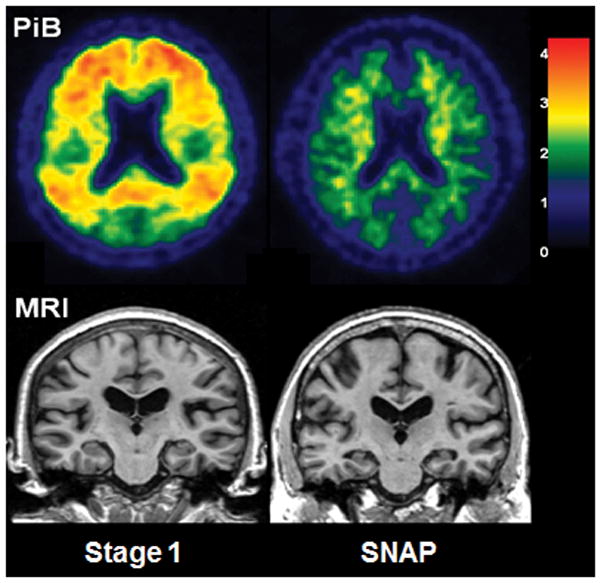
Figure 2. Imaging differences between preclinical AD stage 1 and SNAP
Left-hand column, clinically normal 75 years old woman with abnormal amyloid-β levels as seen by PET and normal brain structure as seen by MRI, who was diagnosed as having preclinical AD stage 1. Right-hand column, clinically normal 77 years old woman with normal amyloid-β levels as seen by PET and visually obvious atrophic hippocampi as seen by MRI, who was diagnosed as having SNAP. Abbreviations: AD, Alzheimer disease; SNAP, suspected non-AD pathophysiology.
Figure 3
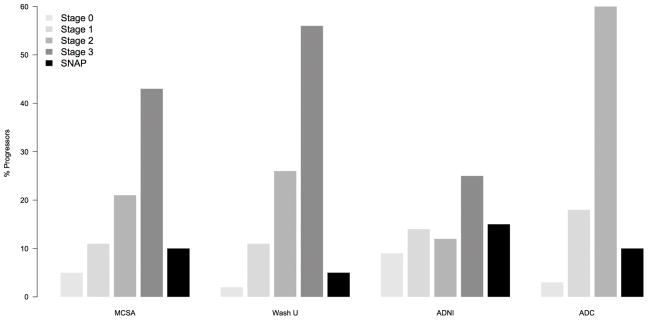
Figure 3. Comparisons of clinical outcomes of individuals with preclinical AD and SNAP across different cohorts
The percentages of individuals within each group who progressed clinically from being clinically normal to having mild cognitive impairment or dementia are shown for four different studies. Abbreviations: AD, Alzheimer disease; ADC, Amsterdam Dementia cohort; ADNI, Alzheimer’s Disease Neuroimaging Initiative; MCSA, Mayo Clinic Study on Aging; SNAP, suspected non-AD pathophysiology; Wash U, Washington University.
Figure 4
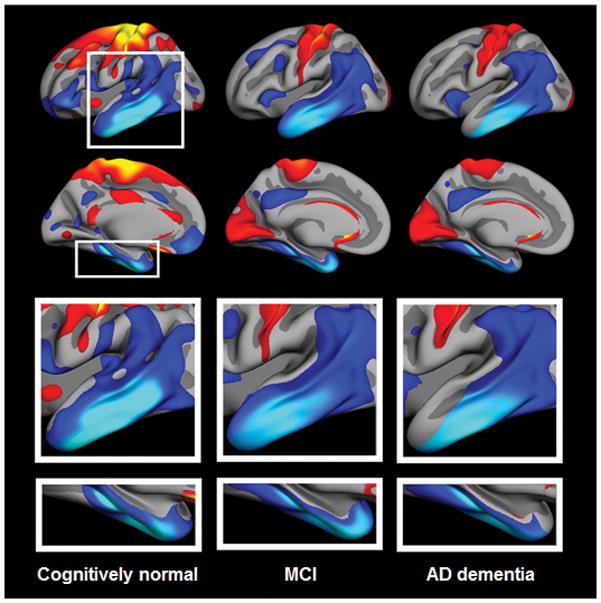
Figure 4. Topographic atrophy patterns
Patterns of atrophy rates in individuals enrolled in the Alzheimer Disease Neuroimaging Initiative, diagnosed as clinically normal, or with MCI or AD dementia. Left column, maps of atrophy rates from serial MRI in clinically normal elderly individuals who were amyloid-β-negative (as assessed by measurement of amyloid-β42 levels in the CSF) and APOE4 negative. Middle and right columns, similar maps from individuals with MCI and AD dementia, respectively. The top-row images are left lateral surface. The bottom-row images are left medial surface views. Atrophy rates are scaled within each group and changes are displayed relative to within-group means. A common topographic pattern of standardized rates of change is present in the lateral and medial temporal lobe across groups. The rates of loss of brain volume in AD-signature regions are not necessarily associated with amyloid-β, nor with APOE4 carrier status, and therefore cannot be ascribed solely to AD but rather seem to be a feature of normal ageing. Abbreviations: AD, Alzheimer disease; MCI, mild cognitive impairment. From Fjell et al. 2013 with permission.

References

    1. Jack CR, Jr, Knopman DS, Weigand SD, et al. An operational approach to NIA-AA crtiteria for preclinical Alzheimer’s disease. Ann Neurol. 2012;71:765–75. - PMC - PubMed
    1. Sperling RA, Aisen PS, Beckett LA, et al. Toward defining the preclinical stages of Alzheimer’s disease: recommendations from the National Institute on Aging-Alzheimer’s Assocation workgroups on diagnostic guidelines for Alzheimer’s disease. Alzheimers Dement. 2011;7:280–92. - PMC - PubMed
    1. Albert MS, DeKosky ST, Dickson D, et al. The diagnosis of mild cognitive impairment due to Alzheimer’s disease: Recommendations from the National Institute on Aging and Alzheimer’s Association Workgroup. Alzheimers Dement. 2011;7:270–9. - PMC - PubMed
    1. McKhann GM, Knopman DS, Chertkow H, et al. The diagnosis of dementia due to Alzheimer’s disease: Recommendations from the National Institute on Aging and the Alzheimer’s Assocation Workgroup. Alzheimers Dement. 2011;7:263–9. - PMC - PubMed
    1. Jack CR, Jr, Albert MS, Knopman DS, et al. Introduction to the recommendations from the National Institute on Aging-Alzheimer’s Association workgroups on diagnostic guidelines for Alzheimer’s disease. Alzheimers Dement. 2011;7:257–62. - PMC - PubMed

Publication types