


ASSOCIATION BETWEEN SOCIAL MEDIA USE AND DEPRESSION AMONG U.S. YOUNG ADULTS
- PMID: 26783723
- PMCID: PMC4853817
- DOI: 10.1002/da.22466
ASSOCIATION BETWEEN SOCIAL MEDIA USE AND DEPRESSION AMONG U.S. YOUNG ADULTS
Abstract
Background: Social media (SM) use is increasing among U.S. young adults, and its association with mental well-being remains unclear. This study assessed the association between SM use and depression in a nationally representative sample of young adults.
Methods: We surveyed 1,787 adults ages 19 to 32 about SM use and depression. Participants were recruited via random digit dialing and address-based sampling. SM use was assessed by self-reported total time per day spent on SM, visits per week, and a global frequency score based on the Pew Internet Research Questionnaire. Depression was assessed using the Patient-Reported Outcomes Measurement Information System (PROMIS) Depression Scale Short Form. Chi-squared tests and ordered logistic regressions were performed with sample weights.
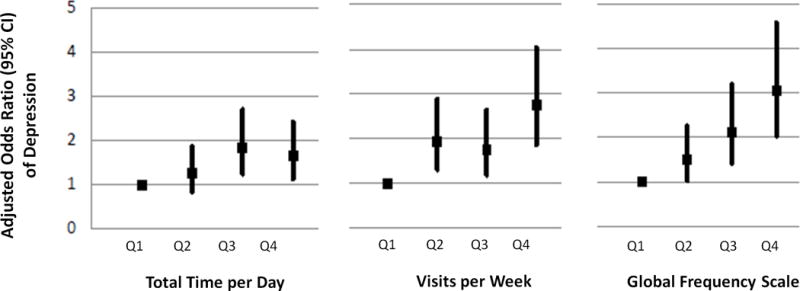
Results: The weighted sample was 50.3% female and 57.5% White. Compared to those in the lowest quartile of total time per day spent on SM, participants in the highest quartile had significantly increased odds of depression (AOR = 1.66, 95% CI = 1.14-2.42) after controlling for all covariates. Compared with those in the lowest quartile, individuals in the highest quartile of SM site visits per week and those with a higher global frequency score had significantly increased odds of depression (AOR = 2.74, 95% CI = 1.86-4.04; AOR = 3.05, 95% CI = 2.03-4.59, respectively). All associations between independent variables and depression had strong, linear, dose-response trends. Results were robust to all sensitivity analyses.
Conclusions: SM use was significantly associated with increased depression. Given the proliferation of SM, identifying the mechanisms and direction of this association is critical for informing interventions that address SM use and depression.
Keywords: communications media; depression; internet; social media; young adult.
© 2016 Wiley Periodicals, Inc.
Conflict of interest statement
Figures
References
-
- Murray CJL, Vos T, Lozano R, et al. Disability-adjusted life years (DALYs) for 291 diseases and injuries in 21 regions, 1990–2010: a systematic analysis for the Global Burden of Disease Study 2010. Lancet [Internet] 2012 Dec 15;380(9859):2197–223. [cited 2014 Jul 10]; Available from: http://www.ncbi.nlm.nih.gov/pubmed/23245608. - PubMed
-
- Mathers CD, Loncar D. Projections of global mortality and burden of disease from 2002 to 2030. PLoS Med [Internet] 2006 Nov;3(11):e442. [cited 2014 Jul 9]; Available from: http://www.pubmedcentral.nih.gov/articlerender.fcgi?artid=1664601&tool=p.... - PMC - PubMed
-
- Greenberg PE, Kessler RC, Birnbaum HG, et al. The economic burden of depression in the United States: How did it change between 1990 and 2000? J Clin Psychiatry. 2003 Dec;64(12):1465–75. - PubMed
Publication types
MeSH terms
Grants and funding
LinkOut - more resources
Full Text Sources
Other Literature Sources
