


Longitudinal Evaluation of Cognitive Functioning in Young Children with Type 1 Diabetes over 18 Months
- PMID: 26786245
- PMCID: PMC4856439
- DOI: 10.1017/S1355617715001289
Longitudinal Evaluation of Cognitive Functioning in Young Children with Type 1 Diabetes over 18 Months
Abstract
Objectives: Decrements in cognitive function may already be evident in young children with type 1 diabetes (T1D). Here we report prospectively acquired cognitive results over 18 months in a large cohort of young children with and without T1D.
Methods: A total of 144 children with T1D (mean HbA1c: 7.9%) and 70 age-matched healthy controls (mean age both groups 8.5 years; median diabetes duration 3.9 years; mean age of onset 4.1 years) underwent neuropsychological testing at baseline and after 18-months of follow-up. We hypothesized that group differences observed at baseline would be more pronounced after 18 months, particularly in those T1D patients with greatest exposure to glycemic extremes.
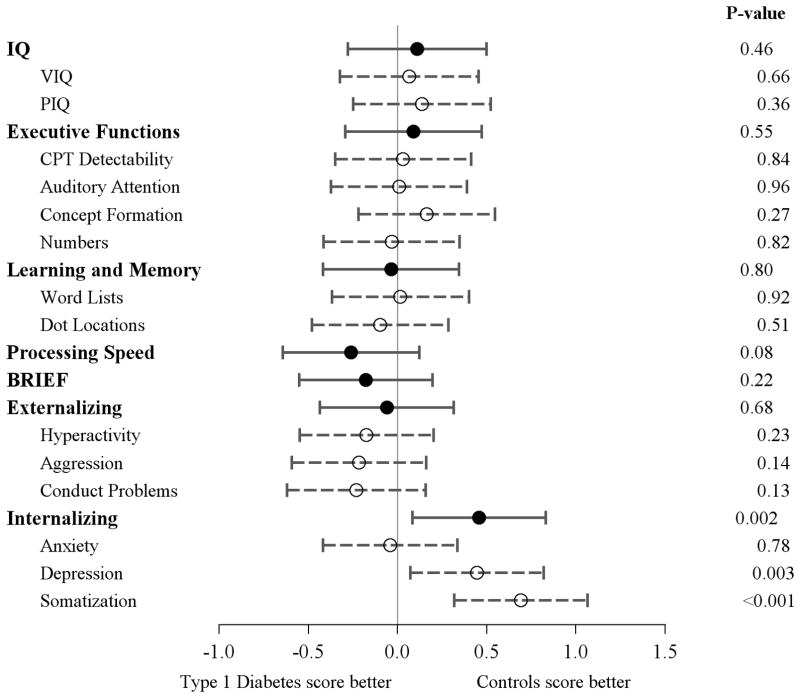
Results: Cognitive domain scores did not differ between groups at the 18 month testing session and did not change differently between groups over the follow-up period. However, within the T1D group, a history of diabetic ketoacidosis (DKA) was correlated with lower Verbal IQ and greater hyperglycemia exposure (HbA1c area under the curve) was inversely correlated to executive functions test performance. In addition, those with a history of both types of exposure performed most poorly on measures of executive function.
Conclusions: The subtle cognitive differences between T1D children and nondiabetic controls observed at baseline were not observed 18 months later. Within the T1D group, as at baseline, relationships between cognition (Verbal IQ and executive functions) and glycemic variables (chronic hyperglycemia and DKA history) were evident. Continued longitudinal study of this T1D cohort and their carefully matched healthy comparison group is planned.
Keywords: Children; Cognition; Early onset; Hyperglycemia; Longitudinal; T1D.
Figures
References
-
- Barnea-Goraly N, Raman M, Mazaika P, Marzelli M, Hershey T, Weinzimer SA, Aye T, Buckingham B, Mauras N, White NH, Fox LA, Tansey M, Beck RW, Ruedy KJ, Kollman C, Cheng P, Reiss AL for the Diabetes Research in Children N. Alterations in White Matter Structure in Young Children With Type 1 Diabetes. Diabetes Care. 2014;37(2):332–340. - PMC - PubMed
-
- Bjorgaas M, Gimse R, Vik T, Sand T. Cognitive function in type 1 diabetic children with and without episodes of severe hypoglycaemia. Acta Paediatr. 1997;86:148–153. - PubMed
-
- Blasetti A, Chiuri RM, Tocco AM, Giulio CD, Mattei PA, Ballone E, Chiarelli F, Verrotti A. The Effect of Recurrent Severe Hypoglycemia on Cognitive Performance in Children With Type 1 Diabetes: A Meta-analysis. J Child Neurol. 2011;26(11):1383–1391. - PubMed
-
- Cato MA, Crosson B. Stable and slowly progressive dementias. In: Attix DK, Welsh-Bohmer K, editors. Geriatric neuropsychological assessment and intervention. New York: Guilford Publications; 2006.
Publication types
MeSH terms
Substances
Grants and funding
- U10 HD041906/HD/NICHD NIH HHS/United States
- HD41908-10/HD/NICHD NIH HHS/United States
- U01HD41890/HD/NICHD NIH HHS/United States
- UL1 RR024992/RR/NCRR NIH HHS/United States
- U10 HD056526/HD/NICHD NIH HHS/United States
- HD41915/HD/NICHD NIH HHS/United States
- U01 HD041890/HD/NICHD NIH HHS/United States
- U10 HD041915/HD/NICHD NIH HHS/United States
- UL1 TR000448/TR/NCATS NIH HHS/United States
- P30 DK020579/DK/NIDDK NIH HHS/United States
- HD56526/HD/NICHD NIH HHS/United States
- R01 HD078463/HD/NICHD NIH HHS/United States
- U10 HD041918/HD/NICHD NIH HHS/United States
- HD41918/HD/NICHD NIH HHS/United States
- U10 HD041908/HD/NICHD NIH HHS/United States
- P30 DK045735/DK/NIDDK NIH HHS/United States
LinkOut - more resources
Full Text Sources
Other Literature Sources
Medical
