


Impact of Electronic Medical Record Use on the Patient-Doctor Relationship and Communication: A Systematic Review
- PMID: 26786877
- PMCID: PMC4835363
- DOI: 10.1007/s11606-015-3582-1
Impact of Electronic Medical Record Use on the Patient-Doctor Relationship and Communication: A Systematic Review
Abstract
Background: While Electronic Medical Record (EMR) use has increased dramatically, the EMR's impact on the patient-doctor relationship remains unclear. This systematic literature review sought to understand the impact of EMR use on patient-doctor relationships and communication.
Methods: Parallel searches in Ovid MEDLINE, PubMed, Scopus, PsycINFO, Cochrane Library, reference review of prior systematic reviews, meeting abstract reviews, and expert reviews from August 2013 to March 2015 were conducted. Medical Subject Heading terms related to EMR use were combined with keyword terms identifying face-to-face patient-doctor communication. English language observational or interventional studies (1995-2015) were included. Studies examining physician attitudes only were excluded. Structured data extraction compared study population, design, data collection method, and outcomes.
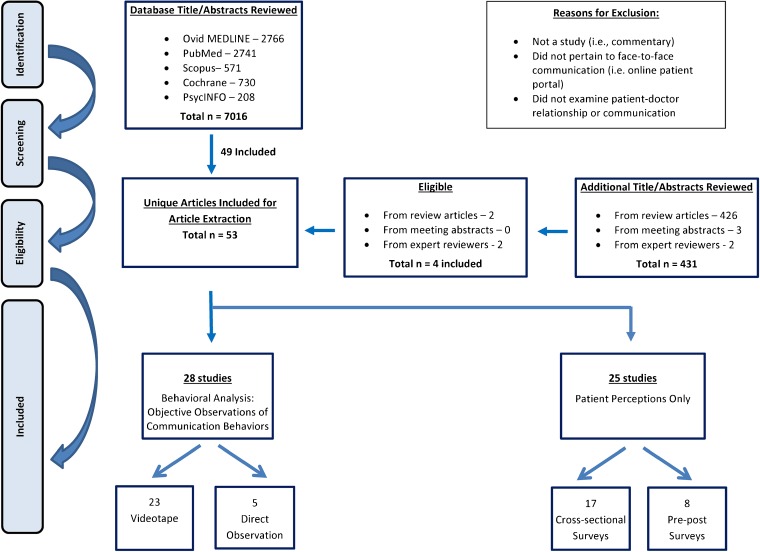
Results: Fifty-three of 7445 studies reviewed met inclusion criteria. Included studies used behavioral analysis (28) to objectively measure communication behaviors using video or direct observation and pre-post or cross-sectional surveys to examine patient perceptions (25). Objective studies reported EMR communication behaviors that were both potentially negative (i.e., interrupted speech, low rates of screen sharing) and positive (i.e., facilitating questions). Studies examining overall patient perceptions of satisfaction, communication or the patient-doctor relationship (n = 22) reported no change with EMR use (16); a positive impact (5) or showed mixed results (1). Study quality was not assessable. Small sample sizes limited generalizability. Publication bias may limit findings.
Discussion: Despite objective evidence that EMR use may negatively impact patient-doctor communication, studies examining patient perceptions found no change in patient satisfaction or patient-doctor communication. Therefore, our findings should encourage providers to adopt the EMR as a communication tool. Future research is needed to better understand how to enhance patient-doctor- EMR communication. This research should correlate observed physician behavior to patient satisfaction, focus on physician communication skills training, and explore inpatient experiences.
Keywords: EMR; communication; electronic medical records; patient–doctor relationship.
Conflict of interest statement
Compliance with Ethical Standards Funders Funding for this review was made possible from a grant from the Arnold P. Gold Foundation Research Institute Call for Reviews of Research on Humanistic Healthcare. Prior Presentations The results of our review were presented at the Arnold P. Gold Foundation Research Institute Symposium on Reviews of Research on Humanistic Healthcare, 2 May 2015 Conflict of Interest The authors declare that they have no conflict of interest, financial or otherwise, to disclose in relation to the content of this paper. Funding was provided by the Gold Foundation. The Gold Foundation had no role in the conduct of the review, management, analysis or interpretation of the data, or in the preparation of the manuscript.
Comment in
-
Capsule Commentary on Alkureishi et al., Impact of Electronic Medical Record Use on the Patient-Doctor Relationship and Communication: A Systematic Review.J Gen Intern Med. 2016 May;31(5):538. doi: 10.1007/s11606-016-3626-1. J Gen Intern Med. 2016. PMID: 26902240 Free PMC article. No abstract available.
References
Publication types
MeSH terms
Grants and funding
LinkOut - more resources
Full Text Sources
Other Literature Sources
Medical
Miscellaneous
