. 2016 Jan 19:9:24.
doi: 10.1186/s13071-016-1292-0.

Feasibility of eliminating visceral leishmaniasis from the Indian subcontinent: explorations with a set of deterministic age-structured transmission models

Affiliations

Feasibility of eliminating visceral leishmaniasis from the Indian subcontinent: explorations with a set of deterministic age-structured transmission models

Epke A Le Rutte et al. Parasit Vectors. .

Abstract

Background: Visceral leishmaniasis (VL) is a neglected tropical disease transmitted by sandflies. On the Indian subcontinent (ISC), VL is targeted for elimination as a public health problem by 2017. In the context of VL, the elimination target is defined as an annual VL incidence of <1 per 10,000 capita at (sub-)district level. Interventions focus on vector control, surveillance and on diagnosing and treating VL cases. Many endemic areas have not yet achieved optimal control due to logistical, biological as well as technical challenges. We used mathematical modelling to quantify VL transmission dynamics and predict the feasibility of achieving the VL elimination target with current control strategies under varying assumptions about the reservoir of infection in humans.

Methods: We developed three deterministic age-structured transmission models with different main reservoirs of infection in humans: asymptomatic infections (model 1), reactivation of infection after initial infection (model 2), and post kala-azar dermal leishmaniasis (PKDL; model 3). For each model, we defined four sub-variants based on different assumptions about the duration of immunity and age-patterns in exposure to sandflies. All 12 model sub-variants were fitted to data from the KalaNet study in Bihar (India) and Nepal, and the best sub-variant was selected per model. Predictions were made for optimal and sub-optimal indoor residual spraying (IRS) effectiveness for three different levels of VL endemicity.

Results: Structurally different models explained the KalaNet data equally well. However, the predicted impact of IRS varied substantially between models, such that a conclusion about reaching the VL elimination targets for the ISC heavily depends on assumptions about the main reservoir of infection in humans: asymptomatic cases, recovered (immune) individuals that reactivate, or PKDL cases.

Conclusions: Available data on the impact of IRS so far suggest one model is probably closest to reality (model 1). According to this model, elimination of VL (incidence of <1 per 10,000) by 2017 is only feasible in low and medium endemic settings with optimal IRS. In highly endemic settings and settings with sub-optimal IRS, additional interventions will be required.


Figures
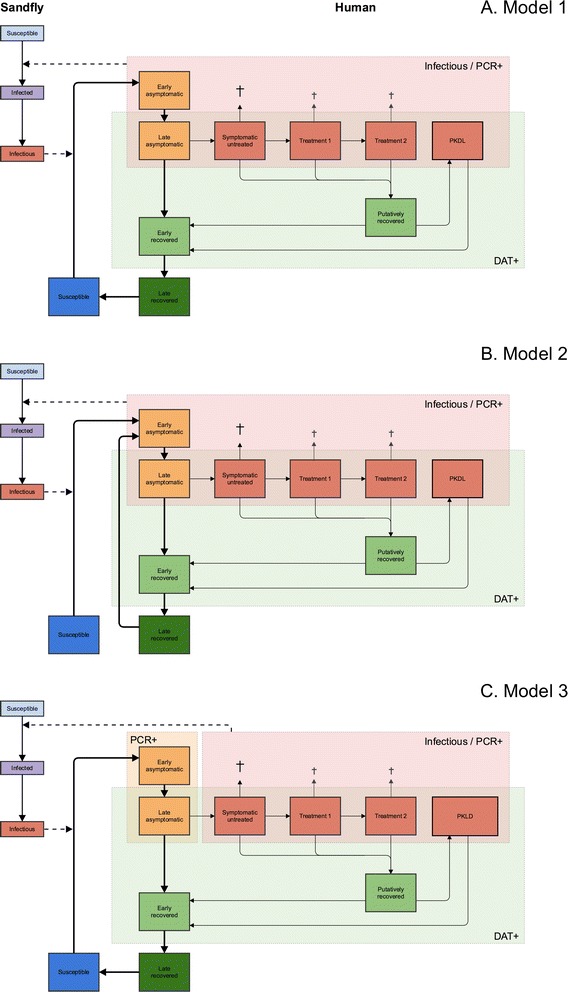
Fig. 1
Fig. 1
Schematic representation of three model structures. In model 1 (a), recovered individuals eventually lose their immunity and become susceptible again to infection through exposure to infective sandflies. In model 2 (b), recovered individuals may experience reactivation of their past infection such that they directly re-enter the stage of early asymptomatic infection without requiring exposure to infective sandflies. In model 3, which is identical in structure to model 1 (c), only cases of symptomatic infection and PKDL contribute to transmission of infection, and duration of PKDL is three times as long as in model 1
Fig. 2
Fig. 2
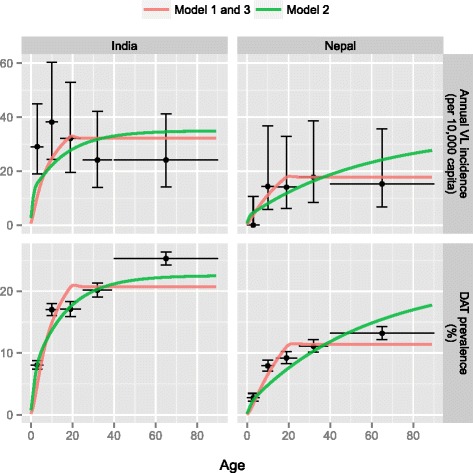
Predicted and observed age-patterns in VL incidence and DAT prevalence in India and Nepal. Coloured lines represent model predictions from the sub-variant of each of the three models that best fit age-patterns in human infection markers; black bullets represent the data per age group; horizontal lines indicate the age range for each data point; vertical lines represent 95 %-Bayesian credible intervals, given total raw sample sizes (i.e. not accounting for clustering, see Additional file 1 for sample sizes). See Additional file 2 for illustrations of the fit of all model sub-variants to all data types
Fig. 3
Fig. 3
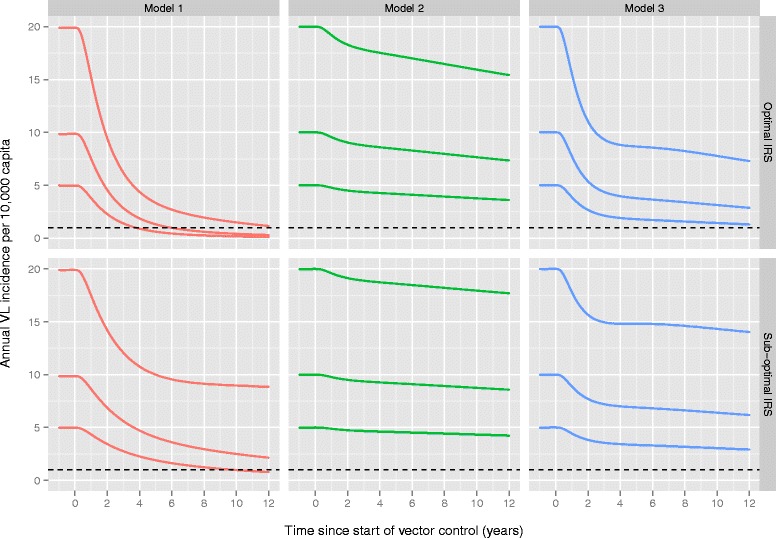
Predicted impact of optimal and sub-optimal IRS on VL incidence for three endemic settings. IRS is assumed to start in the year zero. Lines within plots represent different pre-IRS endemic settings (high: 20/10,000, medium: 10/10,000, low: 5/10,000); the dotted line represents the target VL incidence of <1 per 10,000 capita. Model predictions were made with the sub-variant of each of the three models that best fit age-patterns in human infection markers. See Additional file 3 for the short and long-term impact of optimal and sub-optimal IRS in low, medium, and highly endemic settings with all model sub-variants
Fig. 4
Fig. 4
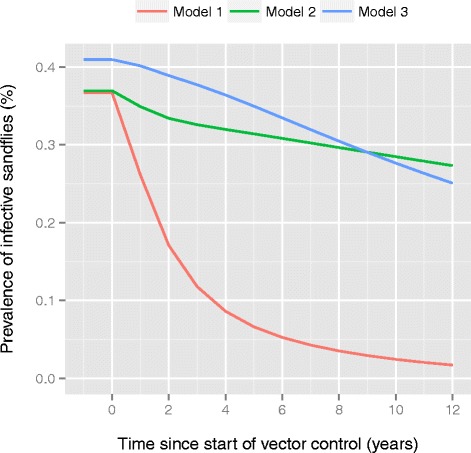
Predicted prevalence of infective sandflies during IRS. Pre-IRS prevalence levels of infective sandflies represent a setting with 10 annual VL cases per 10,000 capita. IRS is assumed to start in the year zero, and to be implemented optimally (63 % reduction in sandfly density). The three colored lines represent the sub-variant of each of the three models that best fit age-patterns in human infection markers. See Additional file 4 for low, medium and highly endemic settings with optimal and sub-optimal IRS

References

    1. Savioli L, Daumerie D, World Health Organization . First WHO report on neglected tropical diseases: working to overcome the global impact of neglected tropical diseases. Geneva Switzerland: World Health; 2010. pp. 1–184.
    1. Alvar J, Vélez ID, Bern C, Herrero M, Desjeux P, Cano J, et al. Leishmaniasis worldwide and global estimates of its incidence. PLoS One. 2012;7(5):e35671. doi: 10.1371/journal.pone.0035671. - DOI - PMC - PubMed
    1. World Health Organization . Leishmaniasis Fact sheet N°375. Geneva, Switzerland: WHO Media Centre; 2015.
    1. GBD Mortality and Causes of Death Collaborators (2015) Global, regional, and national age-sex specific all-cause and cause-specific mortality for 240 causes of death, 1990–2013: a systematic analysis for the Global Burden of Disease Study 2013. Lancet. 2013;385:117–171. - PMC - PubMed
    1. Ostyn B, Gidwani K, Khanal B, Picado A, Chappuis F, Singh SP, et al. Incidence of symptomatic and asymptomatic Leishmania donovani infections in High-Endemic foci in India and Nepal: a prospective study. PLoS Negl Trop Dis. 2011;5:1–7. doi: 10.1371/journal.pntd.0001284. - DOI - PMC - PubMed

Publication types

LinkOut - more resources