doi: 10.15252/emmm.201505965.
On the road to replication
Affiliations
- PMID: 26787652
- PMCID: PMC4734843
- DOI: 10.15252/emmm.201505965
Item in Clipboard
On the road to replication
EMBO Mol Med.
.
Abstract
The 2016 Louis‐Jeantet Prize for Medicine winner John Diffley tells the story of his path to characterise and understand DNA replication.
Figures
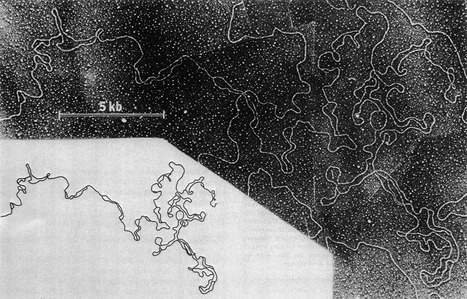
This figure, reproduced with permission from Kriegstein and Hogness (1974), shows an electron micrograph (and accompanying trace) of DNA purified from very early (< 1 h) fertilised Drosophila melanogaster embryos. This particular molecule shows 23 replication bubbles in a region of 119 kb.
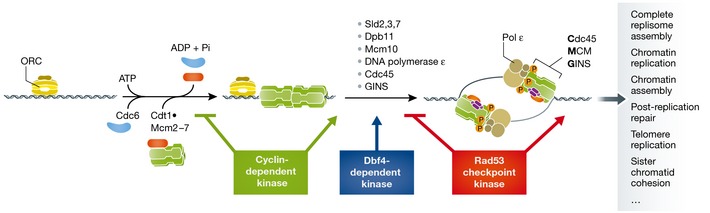
This model summarises some of our current understanding of how DNA replication initiates. In the first step, which is inhibited by CDK , ORC , Cdc6, and Cdt1 load the MCM helicase and an inactive double hexamer bound around double‐stranded DNA . In the second step, which is promoted by CDK , the listed firing factors, including the Dbf4‐dependent kinase, contribute to activating MCM by generating the Cdc4‐MCM ‐GINS (CMG ) holo‐helicase. This is followed by assembly of the complete replisome—the enzymes and other proteins that copy the genome. The DNA damage checkpoint kinase Rad53, when active, inhibits origin firing and stabilises stalled replication forks. Additional detail is found in the text.
References
-
- Bell SP, Stillman B (1992) ATP‐dependent recognition of eukaryotic origins of DNA replication by a multiprotein complex. Nature 357: 128–134 - PubMed
-
- Dahmann C, Diffley JFX, Nasmyth KA (1995) S‐phase‐promoting cyclin‐dependent kinases prevent re‐replication by inhibiting the transition of replication origins to a pre‐replicative state. Curr Biol 5: 1257–1269 - PubMed
-
- Diffley JFX, Cocker JH (1992) Protein‐DNA interactions at a yeast replication origin. Nature 357: 169–172 - PubMed
-
- Diffley JFX, Cocker JH, Dowell SJ, Rowley A (1994) Two steps in the assembly of complexes at yeast replication origins in vivo . Cell 78: 303–316 - PubMed
Publication types
MeSH terms
Substances
Grants and funding
LinkOut - more resources
Full Text Sources
Other Literature Sources