


A Randomized Study of the Effects of Additional Fruit and Nuts Consumption on Hepatic Fat Content, Cardiovascular Risk Factors and Basal Metabolic Rate
- PMID: 26788923
- PMCID: PMC4720287
- DOI: 10.1371/journal.pone.0147149
A Randomized Study of the Effects of Additional Fruit and Nuts Consumption on Hepatic Fat Content, Cardiovascular Risk Factors and Basal Metabolic Rate
Erratum in
-
Correction: A Randomized Study of the Effects of Additional Fruit and Nuts Consumption on Hepatic Fat Content, Cardiovascular Risk Factors and Basal Metabolic Rate.PLoS One. 2018 Dec 13;13(12):e0209450. doi: 10.1371/journal.pone.0209450. eCollection 2018. PLoS One. 2018. PMID: 30543702 Free PMC article.
Abstract
Background: Fruit has since long been advocated as a healthy source of many nutrients, however, the high content of sugars in fruit might be a concern.
Objectives: To study effects of an increased fruit intake compared with similar amount of extra calories from nuts in humans.
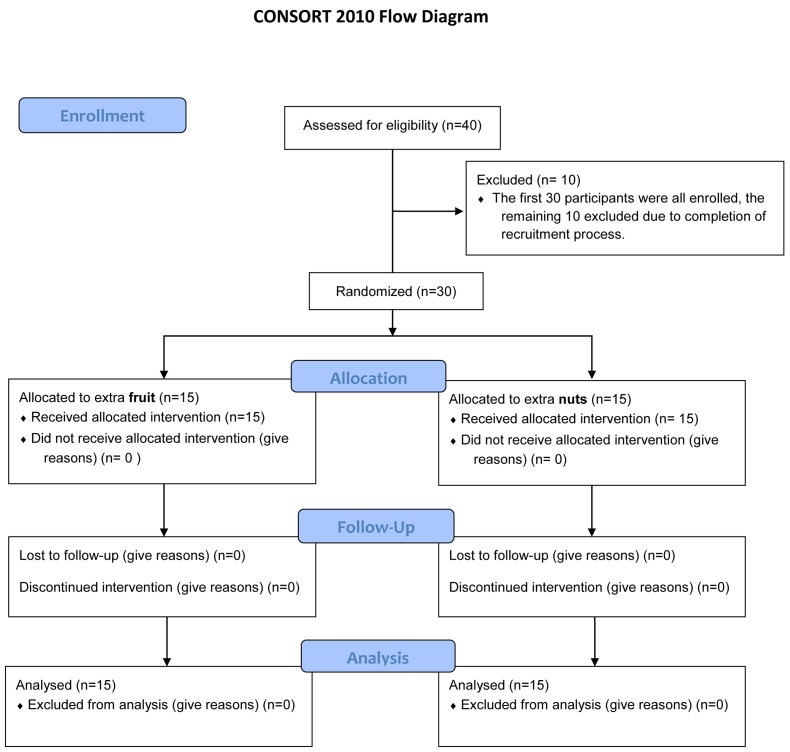
Methods: Thirty healthy non-obese participants were randomized to either supplement the diet with fruits or nuts, each at +7 kcal/kg bodyweight/day for two months. Major endpoints were change of hepatic fat content (HFC, by magnetic resonance imaging, MRI), basal metabolic rate (BMR, with indirect calorimetry) and cardiovascular risk markers.
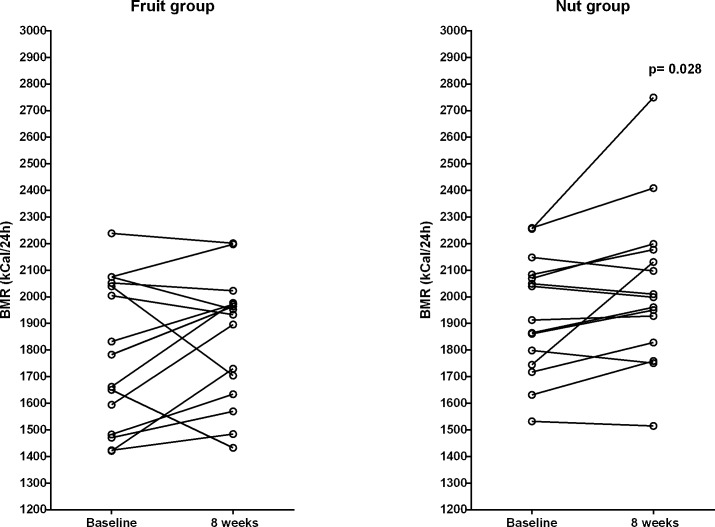
Results: Weight gain was numerically similar in both groups although only statistically significant in the group randomized to nuts (fruit: from 22.15 ± 1.61 kg/m(2) to 22.30 ± 1.7 kg/m(2), p = 0.24 nuts: from 22.54 ± 2.26 kg/m(2) to 22.73 ± 2.28 kg/m(2), p = 0.045). On the other hand BMR increased in the nut group only (p = 0.028). Only the nut group reported a net increase of calories (from 2519 ± 721 kcal/day to 2763 ± 595 kcal/day, p = 0.035) according to 3-day food registrations. Despite an almost three-fold reported increased fructose-intake in the fruit group (from 9.1 ± 6.0 gram/day to 25.6 ± 9.6 gram/day, p<0.0001, nuts: from 12.4 ± 5.7 gram/day to 6.5 ± 5.3 gram/day, p = 0.007) there was no change of HFC. The numerical increase in fasting insulin was statistically significant only in the fruit group (from 7.73±3.1 mIE/L to 8.81±2.9 mIE/L, p = 0.018, nuts: from 7.29±2.9 mIE/L to 8.62±3.0 mIE/L, p = 0.14). Levels of vitamin C increased in both groups while α-tocopherol/cholesterol-ratio increased only in the fruit group.
Conclusions: Although BMR increased in the nut-group only this was not linked with differences in weight gain between groups which potentially could be explained by the lack of reported net caloric increase in the fruit group. In healthy non-obese individuals an increased fruit intake seems safe from cardiovascular risk perspective, including measurement of HFC by MRI.
Trial registration: ClinicalTrials.gov NCT02227511.
Conflict of interest statement
Figures
References
-
- Bjelakovic G, Nikolova D, Gluud LL, Simonetti RG, Gluud C. Mortality in randomized trials of antioxidant supplements for primary and secondary prevention: systematic review and meta-analysis. JAMA: the journal of the American Medical Association. 2007;297(8):842–57. 10.1001/jama.297.8.842 . - DOI - PubMed
-
- Howard BV, Van Horn L, Hsia J, Manson JE, Stefanick ML, Wassertheil-Smoller S, et al. Low-fat dietary pattern and risk of cardiovascular disease: the Women's Health Initiative Randomized Controlled Dietary Modification Trial. JAMA: the journal of the American Medical Association. 2006;295(6):655–66. . - PubMed
-
- Lonn E, Bosch J, Yusuf S, Sheridan P, Pogue J, Arnold JM, et al. Effects of long-term vitamin E supplementation on cardiovascular events and cancer: a randomized controlled trial. JAMA: the journal of the American Medical Association. 2005;293(11):1338–47. Epub 2005/03/17. doi: 293/11/1338 [pii] 10.1001/jama.293.11.1338 . - DOI - PubMed
Publication types
MeSH terms
Associated data
LinkOut - more resources
Full Text Sources
Other Literature Sources
Medical
