. 2016 Jan 21:7:10382.
doi: 10.1038/ncomms10382.

Biochemical characterization of predicted Precambrian RuBisCO

Affiliations

Biochemical characterization of predicted Precambrian RuBisCO

Patrick M Shih et al. Nat Commun. .

Abstract

The antiquity and global abundance of the enzyme, RuBisCO, attests to the crucial and longstanding role it has played in the biogeochemical cycles of Earth over billions of years. The counterproductive oxygenase activity of RuBisCO has persisted over billions of years of evolution, despite its competition with the carboxylase activity necessary for carbon fixation, yet hypotheses regarding the selective pressures governing RuBisCO evolution have been limited to speculation. Here we report the resurrection and biochemical characterization of ancestral RuBisCOs, dating back to over one billion years ago (Gyr ago). Our findings provide an ancient point of reference revealing divergent evolutionary paths taken by eukaryotic homologues towards improved specificity for CO2, versus the evolutionary emphasis on increased rates of carboxylation observed in bacterial homologues. Consistent with these distinctions, in vivo analysis reveals the propensity of ancestral RuBisCO to be encapsulated into modern-day carboxysomes, bacterial organelles central to the cyanobacterial CO2 concentrating mechanism.


Figures

Figure 1
Figure 1. Evolution of RuBisCO and corresponding atmospheric concentrations.
Both CO2 and O2 concentrations are estimates based on biogeochemical models and proxy data. It is important to note that there is great uncertainty surrounding the reconstruction of atmospheric concentrations over these timescales. Estimated O2 concentrations (black line) over geologic time are based on the percent of PALs (%, v/v), with grey shaded boxes representing the range of possible O2 levels based on geological proxies. Estimated CO2 levels (red line) are represented in relation to present day concentrations (ratio past/present), primarily based on GEOCARB data. The red shaded area represents the extent of uncertainty surrounding the estimated Archaean and Proterozoic CO2 levels. The grey dashed line represents the Great Oxidation Event.
Figure 2
Figure 2. Alignment of ancestral RbcL sequences and extant Form 1A and Form 1B counterparts.
Extant Form 1B sequence from Synechococcus elongatus PCC6301. Extant Form 1A sequence from Halothiobacillus neapolitanus. Residues with darker shades indicate higher conservation, while lighter shades represent lower conservation. Secondary structure based on the Halothiobacillus neapolitanus Form 1A RuBisCO structure, 1SVD (PDB ID), from the Protein Data Bank is denoted below as green arrows (beta sheets) and yellow tubes (alpha helices).
Figure 3
Figure 3. Alignment of ancestral RbcS sequences and extant Form 1A and Form 1B counterparts.
Extant Form 1B sequence from Synechococcus elongatus PCC6301. Extant Form 1A sequence from Halothiobacillus neapolitanus. Residues with darker shades indicate higher conservation, while lighter shades represent lower conservation. Secondary structure based on the Halothiobacillus neapolitanus Form 1A RuBisCO structure, 1SVD (PDB ID), from the Protein Data Bank is denoted below as green arrows (beta sheets) and yellow tubes (alpha helices).
Figure 4
Figure 4. Maximum-likelihood phylogeny of RbcL.
A total 125 RbcL sequences were gathered to maximize the sampling of the entire Form 1AB RuBisCO clade. Sequences were aligned with structural data using PROMALS3D. The phylogenetic tree was constructed using maximum-likelihood methods using PhyML software. The outgroup consists of Form 1C and 1D RuBisCO sequences used to root the Form 1AB subclade. The nodes of interest are shown in red, for which ancestral sequences were reconstructed. Scale bar, substitutions per site.
Figure 5
Figure 5. Maximum-likelihood phylogeny of RbcS.
A total 131 RbcS sequences were gathered in order to maximize the sampling of the entire Form 1AB RuBisCO clade. Sequences were aligned with structural data using PROMALS3D. The phylogenetic tree was constructed using maximum-likelihood methods using PhyML software. The outgroup consists of Form 1C and 1D RuBisCO sequences used to root the Form 1AB subclade. The nodes of interest are shown in red, for which ancestral sequences were reconstructed. Scale bar, substitutions/site.
Figure 6
Figure 6. Distribution of substitutions mapped onto crystal structures of RuBisCO.
(a) Complex of one large (red) and one small (blue) subunit from the crystal structure of Form 1B RuBisCO of Synechococcus elongatus PCC6301 (PDB ID: 1RBC). Substitutions between the crystal structure and the β-MRCA RuBisCO are highlighted in yellow. (b) Complex of one large (red) and one small (blue) subunit from the crystal structure of Form 1A RuBisCO of Halothiobacillus neapolitanus (PDB ID: 1SVD). Substitutions between the crystal structure and the α-MRCA RuBisCO are highlighted in yellow. The two models are similarly oriented.
Figure 7
Figure 7. Comparison of ancestral and extant RuBisCO.
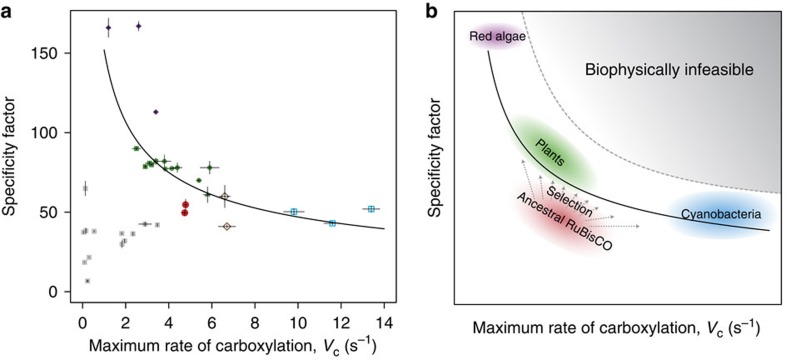
(a) Specificity factor (τ) versus carboxylation rate (Vc) for characterized RuBisCOs. The specificity factor is measured as the ratio of the catalytic efficiency of carboxylation to oxygenation, thus specificity factor=(VcKo)/(VoKc). The best-fit curve for extant RuBisCOs (black line) is as previously described. (Form 1A (brown open diamonds); Form 1B Cyanobacteria (blue open squares); eukaryotic non-green algae (purple filled diamonds); eukaryotic green algae (green filled triangles); C4 plants (green filled circles); C3 plants (green filled squares); ancestral (red filled circles); point mutant or chimeric (grey filled squares)). Values and error bars are summarized in Supplementary Table 3, and based on . (b) Model of selective pressures pushing properties of RuBisCO towards the hypothesized protein landscape optimum—upper limits of the kinetic parameters—represented by the best-fit curve (black line). Coloured regions correspond to part a: ancestral (red), plants (green), eukaryotic non-green algae (purple) and cyanobacteria (blue). The grey shaded area represents the theoretical enzyme space that is biophysically infeasible for RuBisCO.
Figure 8
Figure 8. Encapsulation of ancestral RuBisCO in carboxysomes of extant cyanobacteria.
Fluorescence microscopy of Synechococcus elongatus PCC 7942 mutants transformed with ancestral β-MRCA, α-MRCA and α/β-MRCA RbcL subunits fused to CFP (blue) and carboxysomal subunit, CcmN, fused to YFP (green). Ancestral RbcL colocalize to the carboxysome, based on CcmN-YFP fluorescence. Chlorophyll-a (Chl-a) fluorescence from the thylakoid membrane is shown in red. All the strains exhibit spatially distributed fluorescent puncta typical of carboxysome localization. Scale bars, 1 μm.

References

    1. Gaucher E. A., Govindarajan S. & Ganesh O. K. Palaeotemperature trend for Precambrian life inferred from resurrected proteins. Nature 451, 704–707 (2008) . - PubMed
    1. Tabita F. R. et al. Function, structure, and evolution of the RubisCO-like proteins and their RubisCO homologs. Microbiol. Mol. Biol. Rev. 71, 576–599 (2007) . - PMC - PubMed
    1. Shih P. M. & Matzke N. J. Primary endosymbiosis events date to the later Proterozoic with cross-calibrated phylogenetic dating of duplicated ATPase proteins. Proc. Natl Acad. Sci. USA 110, 12355–12360 (2013) . - PMC - PubMed
    1. Butterfield N. J., Knoll A. H. & Swett K. A bangiophyte red alga from the Proterozoic of arctic Canada. Science 250, 104–107 (1990) . - PubMed
    1. Douzery E. J. P., Snell E. A., Bapteste E., Delsuc F. & Philippe H. The timing of eukaryotic evolution: does a relaxed molecular clock reconcile proteins and fossils? Proc. Natl Acad. Sci. USA 101, 15386–15391 (2004) . - PMC - PubMed

Publication types

Substances

LinkOut - more resources