. 2016 Jan 21:6:18439.
doi: 10.1038/srep18439.

Scaling-up Fermentation of Pichia pastoris to demonstration-scale using new methanol-feeding strategy and increased air pressure instead of pure oxygen supplement

Affiliations

Scaling-up Fermentation of Pichia pastoris to demonstration-scale using new methanol-feeding strategy and increased air pressure instead of pure oxygen supplement

Wan-Cang Liu et al. Sci Rep. .

Abstract

Scaling-up of high-cell-density fermentation (HCDF) of Pichia pastoris from the lab or pilot scale to the demonstration scale possesses great significance because the latter is the final technological hurdle in the decision to go commercial. However, related investigations have rarely been reported. In this paper, we study the scaling-up processes of a recombinant P. pastoris from the pilot (10 to 100-L) to the demonstration (1,000-L) scales, which can be used to convert 7-β-xylosyl-10-deacetyltaxol into 10-deacetyltaxol by the β-xylosidase for semi-synthesis of Taxol. We demonstrated that a pure oxygen supplement can be omitted from the HCDF if the super atmospheric pressure was increased from 0.05 to 0.10 ± 0.05 MPa, and we developed a new methanol feeding biomass-stat strategy (0.035 mL/g/h) with 1% dissolved oxygen and 100 g/L initial induction biomass (dry cell weight). The scaling-up was reproducible, and the best results were obtained from the 1,000-L scale, featuring a shorter induction time and the highest enzyme activities and productions, respectively. The specific growth and specific production rates were also determined. This study lays a solid foundation for the commercial preparation of 10-deacetyltaxol through the recombinant yeast. It also provides a successful paradigm for scaling-up HCDF of P. pastoris to the demonstration scale.


Figures
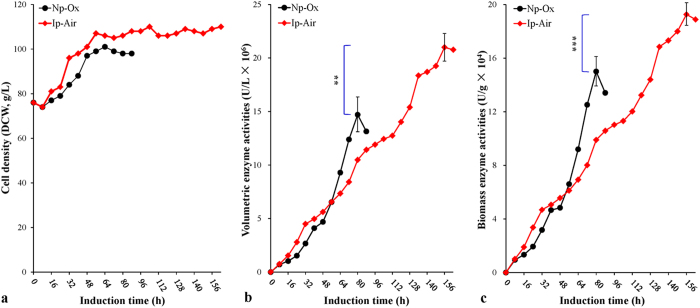
Figure 1
Figure 1. Time-course profiles of the HCDF under the two different conditions: Ip-Air (filled diamond) and Np-Ox (filled cycle).
(a) Cell density profiles (DCW, g/L). (b) Volumetric enzyme activity profiles (U/L). (c) Biomass enzyme activity profiles (U/g). Data are means ± SD of three parallel measurements (*P < 0.05, **P < 0.01, ***P < 0.001). Note, Ip-Air: increasing air pressure without pure oxygen supplement; Np-Ox: normal air pressure (0.05 MPa) with pure oxygen supplement (control).
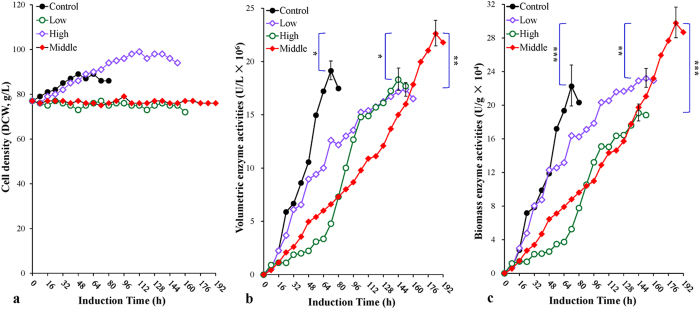
Figure 2
Figure 2. Time-course profiles of the biomass-stat fed-batch HCDF at low (open diamond, v = 0.025 mL/g/h), middle (filled diamond, v = 0.035 mL/g/h) and high (open cycle, v = 0.050 mL/g/h) methanol feeding rates and under Ip-Air condition.
(a) Cell density profiles (DCW, g/L). (b) Volumetric enzyme activity profiles (U/L). (c) Biomass enzyme activity profiles (U/g). Data are means ± SD of three parallel measurements (*P < 0.05, **P < 0.01, ***P < 0.001). Note: the control was under Np-Ox condition with 10 mL/L/h methanol feeding.
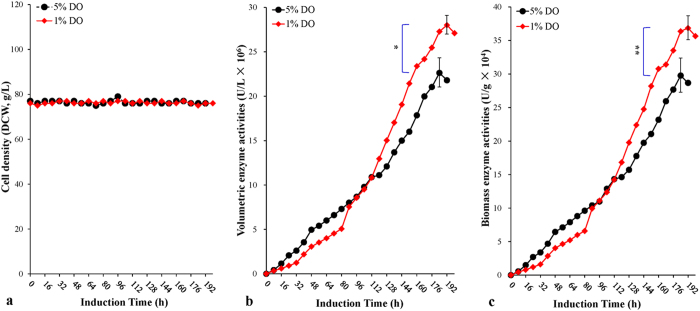
Figure 3
Figure 3. Time-course profiles of the two different induction DO values.
(a) Cell density profiles (DCW, g/L). (b) Volumetric enzyme activity profiles (U/L). (c) Biomass enzyme activity profiles (U/g). Note, 1% DO (filled diamond); 5% DO (filled cycle). Data are means ± SD of three parallel measurements (*P < 0.05, **P < 0.01, ***P < 0.001).
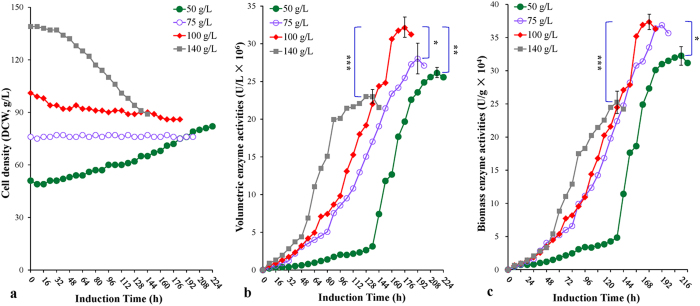
Figure 4
Figure 4. Effects of the initial induction biomass on the HCDF.
(a) Cell density profiles (DCW). (b) Volumetric enzyme activity profiles (U/L). (c) Biomass enzyme activity profiles (U/g). Data are means ± SD of three parallel measurements (*P < 0.05, **P < 0.01, ***P < 0.001). Note, the initial induction biomasses (g/L) were: 50 (filled cycle), 75 (open cycle), 100 (filled diamond) and 140 (filled square), respectively.
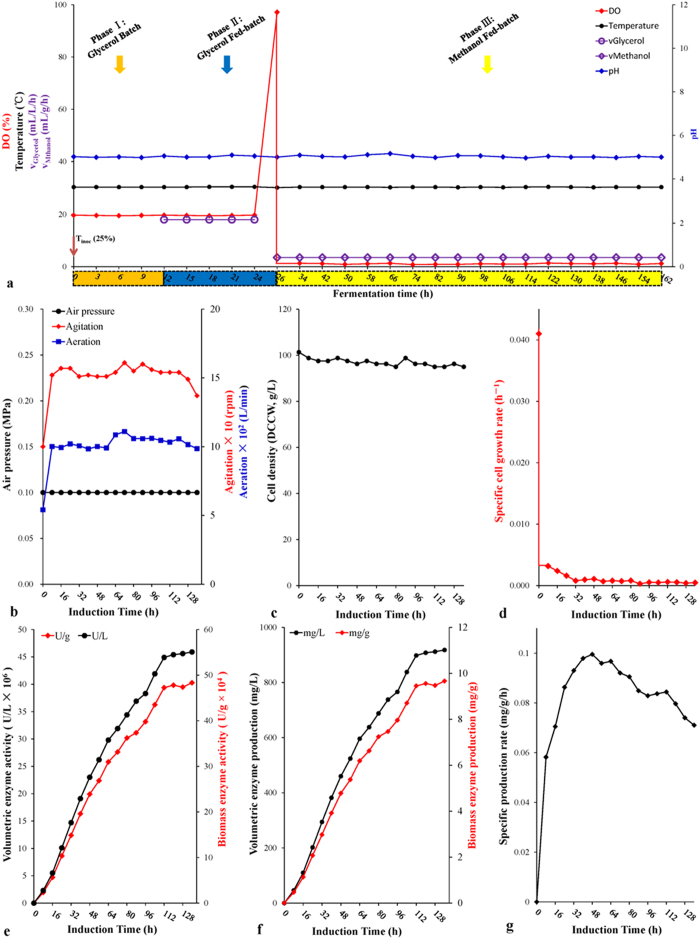
Figure 5
Figure 5. Fed-batch HCDF characterization of 1,000-L scale.
(a) Profiles of glycerol feeding rate, methanol feeding rate, DO level, temperature and pH during the whole process. (b) Air pressure, agitation and aeration profiles. (c) Cell density (DCW) profile. (d) Specific growth rate (μ, h−1) profile. (e) Volumetric enzyme activity (U/L) and biomass enzyme activity (U/g) profiles. (f) Volumetric enzyme production (g/L) and biomass enzyme production (mg/g) profiles. (g) Specific production rate (qP) profile. Data are means of three parallel measurements.
Figure 6
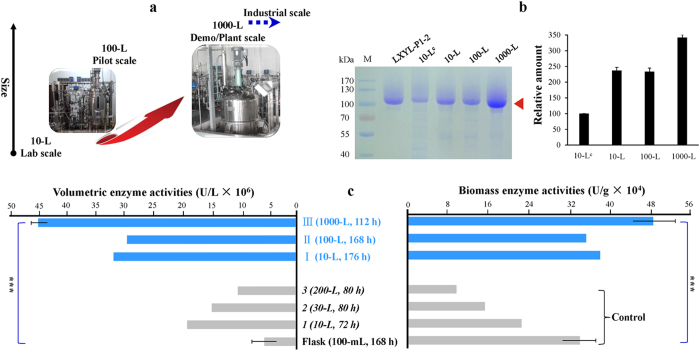
Figure 6. Scaling-up HCDF of P. pastoris under 10-L, 100-L and 1,000-L scales.
(a) Multi-size fermenters scaling-up graphics. (b) SDS-PAGE analysis. The arrow indicates the band of the recombinant enzyme. The relative protein amount (arbitrary unit) of each sample was quantified with Quantity One Software. The values are indicated as means ± SD (n = 3) of independent assays. M, the protein molecular marker; LXYL-P1-2, the purified recombinant enzyme (glycosylated protein) prepared by gel column choromatography (HPLC) in our lab; 10-LC, the sample before optimization (Np-Ox, as a control); 10-L, 100-L and 1,000-L, the samples after optimization. (c) Summary of the optimization and scaling-up processes with the controls of the flask fermentation (100-mL), the 10-L scale HCDF (Np-Ox), the 30-L scale HCDF (Np-Ox), and the 200-L scale HCDF (Np-Ox) before optimization, showing the volumetric and biomass enzyme activities at the peak time (except the 112 h in the 1,000-L scale). Error bars show means ± SD of triplicate independent assays.

References

    1. Athmaram T. N. et al. A simple Pichia pastoris fermentation and downstream processing strategy for making recombinant pandemic Swine Origin Influenza a virus Hemagglutinin protein. J. Ind. Microbio. Biotechnol. 40, 245–255 (2013). - PubMed
    1. Looser V. et al. Cultivation strategies to enhance productivity of Pichia pastoris: A review. Biotechnol. Adv. 33, 1177–1193 (2015). - PubMed
    1. Potgieter T. I. et al. Production of monoclonal antibodies by glycoengineered Pichia pastoris. J. Biotechnol. 139, 318–325 (2009). - PubMed
    1. Garcia-Ochoa F. & Gomez E. Bioreactor scale-up and oxygen transfer rate in microbial processes: an overview. Biotechnol. Adv. 27, 153–176 (2009). - PubMed
    1. Mate D. M., Gonzalez-Perez D., Kittl R., Ludwig R. & Alcalde M. Functional expression of a blood tolerant laccase in Pichia pastoris. BMC Biotechnol. 13, 38–49 (2013). - PMC - PubMed

Publication types