


Tranexamic acid in life-threatening military injury and the associated risk of infective complications
- PMID: 26791625
- PMCID: PMC4760875
- DOI: 10.1002/bjs.10055
Tranexamic acid in life-threatening military injury and the associated risk of infective complications
Abstract
Background: Tranexamic acid (TXA) has been shown to reduce mortality from severe haemorrhage. Although recent data suggest that TXA has anti-inflammatory properties, few analyses have investigated the impact of TXA on infectious complications in injured patients. The aim was to examine the association between TXA administration and infection risk among injured military personnel.
Methods: Patients who received TXA were matched by Injury Severity Score with patients who did not receive TXA. Conditional logistic regression was used to examine risk factors associated with infections within 30 days. A Cox proportional analysis evaluated risk factors in a time-to-first-infection model.
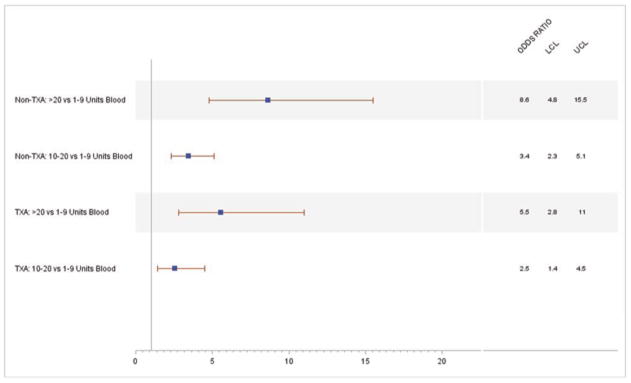
Results: A total of 335 TXA recipients were matched with 626 patients who did not receive TXA. A greater proportion of TXA recipients had an infection compared with the comparator group (P < 0·001). Univariable analysis estimated an unadjusted odds ratio (OR) of 2·47 (95 per cent c.i. 1·81 to 3·36) for the association between TXA and infection risk; however, TXA administration was not significant in multivariable analysis (OR 1·27, 0·85 to 1·91). Blast injuries, intensive care unit (ICU) admission, and receipt of 10 units or more of blood within 24 h after injury were independently associated with infection risk. The Cox proportional model confirmed the association with ICU admission and blood transfusion. Traumatic amputations were also significantly associated with a reduced time to first infection.
Conclusion: In life-threatening military injuries matched for injury severity, TXA recipients did not have a higher risk of having infections nor was the time to develop infections shorter than in non-recipients. Extent of blood loss, blast injuries, extremity amputations and ICU stay were associated with infection.
© 2016 BJS Society Ltd Published by John Wiley & Sons Ltd.
References
-
- Kauvar DS, Lefering R, Wade CE. Impact of hemorrhage on trauma outcome: an overview of epidemiology, clinical presentations, and therapeutic considerations. J Trauma. 2006;60(6 Suppl):S3–S11. - PubMed
-
- Sa-Ngasoongsong P, Channoom T, Kawinwonggowit V, Woratanarat P, Chanplakorn P, Wibulpolprasert B, et al. Postoperative blood loss reduction in computer-assisted surgery total knee replacement by low dose intra-articular tranexamic acid injection together with 2-hour clamp drain: a prospective triple-blinded randomized controlled trial. Orthop Rev (Pavia) 2011;3:e12. - PMC - PubMed
-
- Later AF, Bruggemans EF, Romijn FP, van Pelt J, Klautz RJ. A comparative study of the immune modulating properties of antifibrinolytics in cardiac surgery. Cytokine. 2013;61:438–444. - PubMed
-
- Senturk MB, Cakmak Y, Yildiz G, Yildiz P. Tranexamic acid for cesarean section: a double-blind, placebo-controlled, randomized clinical trial. Arch Gynecol Obstet. 2013;287:641–645. - PubMed
-
- Shakur H, Roberts I, Bautista R, Caballero J, Coats T, Dewan Y, et al. Effects of tranexamic acid on death, vascular occlusive events, and blood transfusion in trauma patients with significant haemorrhage (CRASH-2): a randomised, placebo-controlled trial. Lancet. 2010;376:23–32. - PubMed
Publication types
MeSH terms
Substances
Grants and funding
LinkOut - more resources
Full Text Sources
Other Literature Sources
Medical
Research Materials
