. 2016 Jan 5:9:159-70.
doi: 10.2147/OTT.S96983. eCollection 2016.

The role of induction and adjuvant chemotherapy in combination with concurrent chemoradiotherapy for nasopharyngeal cancer: a Bayesian network meta-analysis of published randomized controlled trials

Affiliations

The role of induction and adjuvant chemotherapy in combination with concurrent chemoradiotherapy for nasopharyngeal cancer: a Bayesian network meta-analysis of published randomized controlled trials

Hongliang Yu et al. Onco Targets Ther. .

Abstract

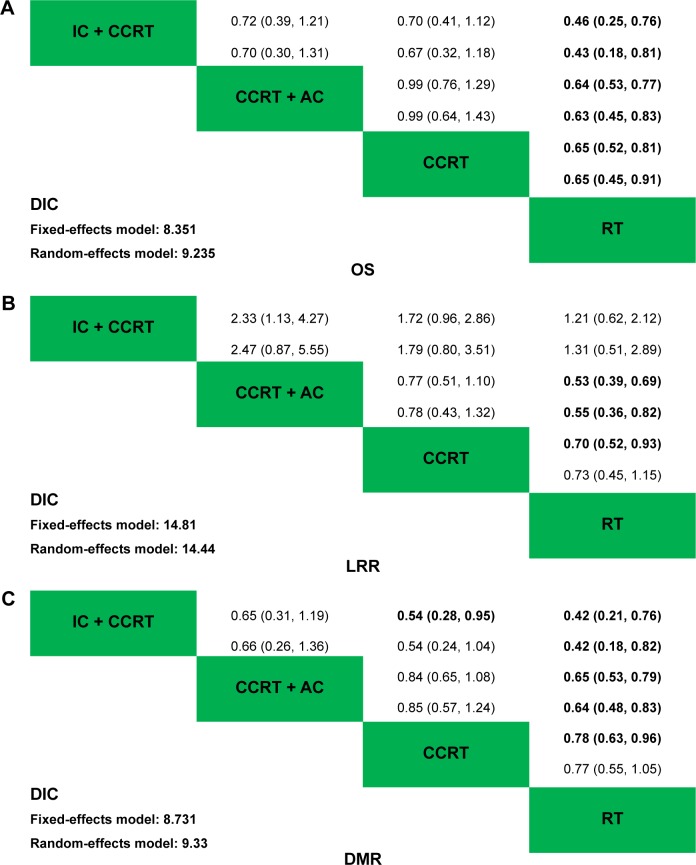
Whether the addition of induction chemotherapy (IC) or adjuvant chemotherapy (AC) to concurrent chemoradiotherapy (CCRT) is superior to CCRT alone for locally advanced nasopharyngeal cancer is unknown. A Bayesian network meta-analysis was performed to investigate the efficacy of CCRT, IC + CCRT, and CCRT + AC on locally advanced nasopharyngeal cancer. The overall survival (OS) with hazard ratios (HRs) and locoregional recurrence rates (LRRs) and distant metastasis rates (DMRs) with risk ratios (RRs) were investigated. After a comprehensive database search, eleven studies involving 2,626 assigned patients were included in this network meta-analysis. Compared with CCRT alone, IC + CCRT resulted in no significant improvement in OS or LRR and a marginal improvement in DMR (OS: HR =0.67, 95% credible interval (CrI) 0.32-1.18; LRR: RR =1.79, 95% CrI 0.80-3.51; DMR: RR =1.79, 95% CrI 0.24-1.04) and CCRT + AC exhibited no beneficial effects on any of the endpoints of OS, LRR, or DMR (OS: HR =0.99, 95% CrI 0.64-1.43; LRR: RR =0.78, 95% CrI 0.43-1.32; DMR: RR =0.85, 95% CrI 0.57-1.24). As a conclusion, for locally advanced nasopharyngeal cancer, no significant differences in the treatment efficacies of CCRT, IC + CCRT, and CCRT + AC were found, with the exception of a marginally significant improvement in distant control observed following IC + CCRT compared with CCRT alone.

Keywords: adjuvant chemotherapy; concurrent chemotherapy; induction chemotherapy; nasopharyngeal cancer; network meta-analysis; radiotherapy.


Figures
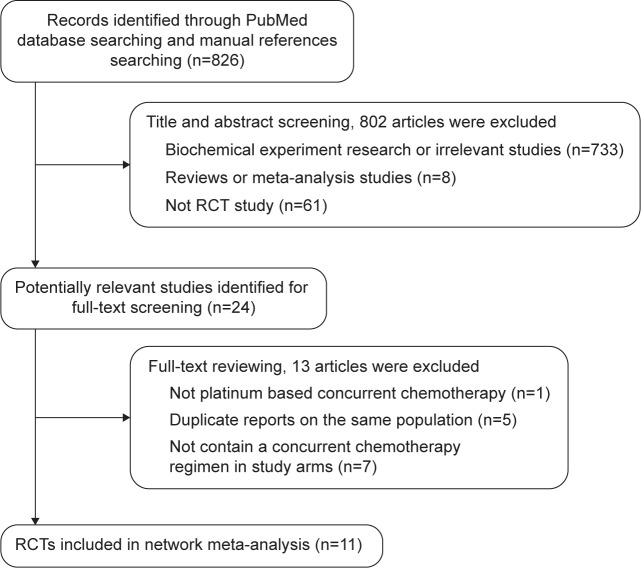
Figure 1
Figure 1
Flowchart illustrating the study selection. Abbreviation: RCT, randomized controlled trial.
Figure 2
Figure 2
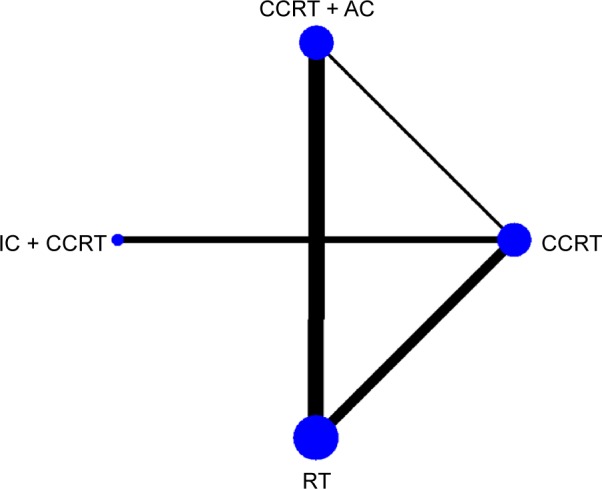
Network plot for multiple-treatment comparison. Notes: The widths of the lines are proportional to the numbers of trials comparing each pair of treatments. The size of each node is proportional to the number of assigned patients (sample size). Abbreviations: AC, adjuvant chemotherapy; CCRT, concurrent chemoradiotherapy; IC, induction chemotherapy; RT, radiotherapy.
Figure 3
Figure 3
Results of the network meta-analyses of (A) OS, (B) LRR, and (C) DMR. Notes: The upper triangles denote the pooled result estimates. The treatments in the rows were compared with those in the columns. In each result cell, the first and second lines contain the estimates from the fixed- and random-effects models, respectively. The numbers in parentheses indicate the corresponding 95% credible intervals. The lower triangles denote the DIC statistics from the fixed- and random-effects models. Data in bold indicates statistical significance at P<0.05. Abbreviations: AC, adjuvant chemotherapy; CCRT, concurrent chemoradiotherapy; DIC, deviance information criterion; DMR, distant metastasis rate; IC, induction chemotherapy; OS, overall survival; LRR, locoregional recurrence rate; RT, radiotherapy.
Figure 4
Figure 4
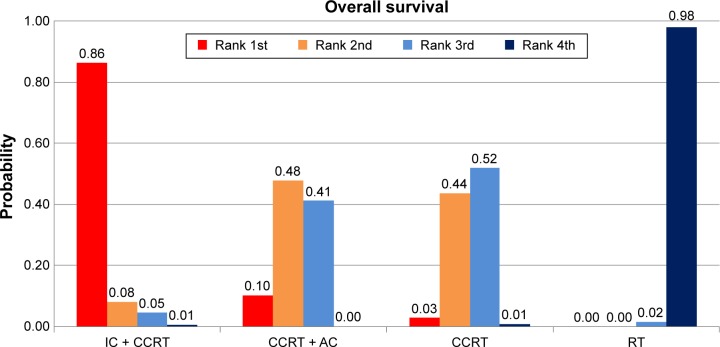
Rank probabilities of each treatment regimen in term of overall survival (OS) based on random-effects model. Note: The rankings indicate the probabilities of being the best treatment choice, the second best treatment choice, and so on for the four treatment regimens in term of OS.
Figure 5
Figure 5
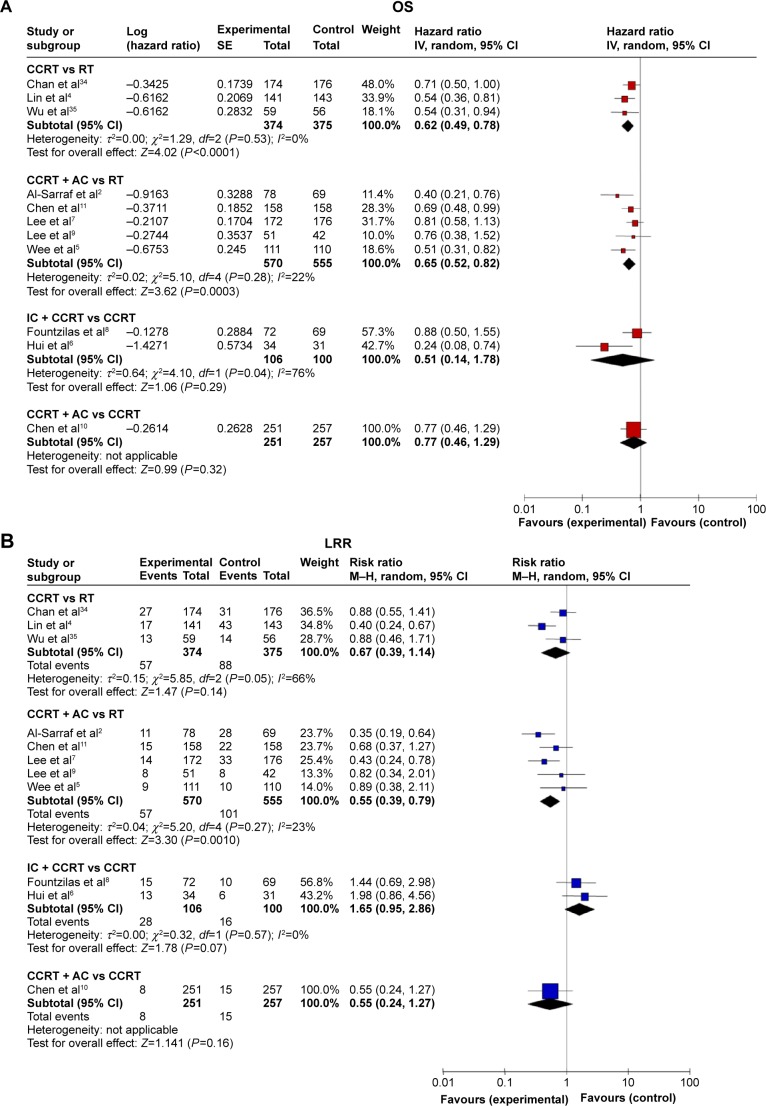
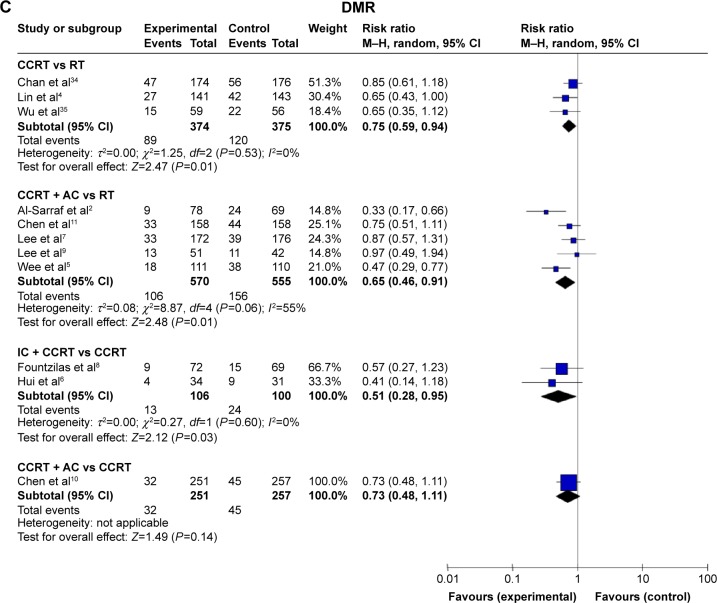
Forest plot of the direct comparison results. Notes: Random-effects meta-analyses of the results of the direct comparisons of the (A) OSs, (B) LRRs, and (C) DMRs among the treatment regimens. The squares indicate the study-specific statistical weights, the horizontal lines indicate the 95% confidence intervals (CIs), and the diamonds indicate the HR or RR summary statistics with the corresponding 95% confidence intervals. Abbreviations: AC, adjuvant chemotherapy; CCRT, concurrent chemoradiotherapy; DMR, distant metastasis rate; HR, hazard ratio; IC, induction chemotherapy; LRR, locoregional recurrence rate; OS, overall survival; RR, risk ratio; RT, radiotherapy.
Figure 5
Figure 5
Forest plot of the direct comparison results. Notes: Random-effects meta-analyses of the results of the direct comparisons of the (A) OSs, (B) LRRs, and (C) DMRs among the treatment regimens. The squares indicate the study-specific statistical weights, the horizontal lines indicate the 95% confidence intervals (CIs), and the diamonds indicate the HR or RR summary statistics with the corresponding 95% confidence intervals. Abbreviations: AC, adjuvant chemotherapy; CCRT, concurrent chemoradiotherapy; DMR, distant metastasis rate; HR, hazard ratio; IC, induction chemotherapy; LRR, locoregional recurrence rate; OS, overall survival; RR, risk ratio; RT, radiotherapy.
Figure 6
Figure 6
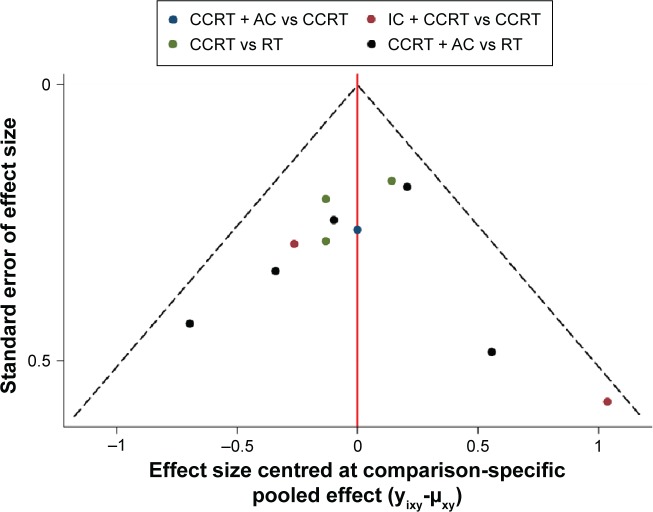
Comparison-adjusted funnel plot for the network meta-analysis. Notes: The different colors correspond to different comparisons. The lack of substantial asymmetry indicates that the small-study effect was not significant. Abbreviations: AC, adjuvant chemotherapy; CCRT, concurrent chemoradiotherapy; IC, induction chemotherapy; RT, radiotherapy.

References

    1. Wei WI, Sham JS. Nasopharyngeal carcinoma. Lancet. 2005;365(9476):2041–2054. - PubMed
    1. Al-Sarraf M, LeBlanc M, Giri PG, et al. Chemoradiotherapy versus radiotherapy in patients with advanced nasopharyngeal cancer: phase III randomized Intergroup study 0099. J Clin Oncol. 1998;16(4):1310–1317. - PubMed
    1. Chan AT, Teo PM, Ngan RK, et al. Concurrent chemotherapy-radiotherapy compared with radiotherapy alone in locoregionally advanced nasopharyngeal carcinoma: progression-free survival analysis of a phase III randomized trial. J Clin Oncol. 2002;20(8):2038–2044. - PubMed
    1. Lin JC, Jan JS, Hsu CY, Liang WM, Jiang RS, Wang WY. Phase III study of concurrent chemoradiotherapy versus radiotherapy alone for advanced nasopharyngeal carcinoma: positive effect on overall and progression-free survival. J Clin Oncol. 2003;21(4):631–637. - PubMed
    1. Wee J, Tan EH, Tai BC, et al. Randomized trial of radiotherapy versus concurrent chemoradiotherapy followed by adjuvant chemotherapy in patients with American Joint Committee on Cancer/International Union against cancer stage III and IV nasopharyngeal cancer of the endemic variety. J Clin Oncol. 2005;23(27):6730–6738. - PubMed

LinkOut - more resources