Review
. 2016 Jan 19:5:1.
doi: 10.1186/s13630-016-0022-8. eCollection 2015.

Tetrahymena basal bodies

Affiliations
Review

Tetrahymena basal bodies

Brian A Bayless et al. Cilia. .

Abstract

Tetrahymena thermophila is a ciliate with hundreds of cilia primarily used for cellular motility. These cells propel themselves by generating hydrodynamic forces through coordinated ciliary beating. The coordination of cilia is ensured by the polarized organization of basal bodies (BBs), which exhibit remarkable structural and molecular conservation with BBs in other eukaryotes. During each cell cycle, massive BB assembly occurs and guarantees that future Tetrahymena cells gain a full complement of BBs and their associated cilia. BB duplication occurs next to existing BBs, and the predictable patterning of new BBs is facilitated by asymmetric BB accessory structures that are integrated with a membrane-associated cytoskeletal network. The large number of BBs combined with robust molecular genetics merits Tetrahymena as a unique model system to elucidate the fundamental events of BB assembly and organization.

Keywords: Basal body; Centriole; Ciliate; Microtubule; Tetrahymena.


Figures
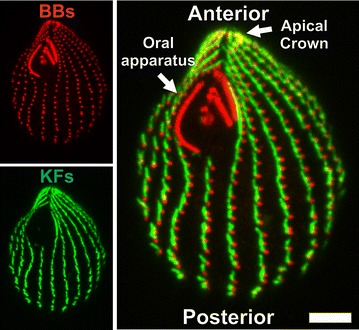
Fig. 1
Fig. 1
Polarized organization of Tetrahymena BBs. BBs are labeled in red (α-centrin, [27]) and kinetodesmal fibers are labeled in green (α-KF, [44]). The merged image highlights the organized ciliary array, the oral apparatus, and the apical crown which demarcates anterior–posterior polarity. Scale bar 5 μm
Fig. 2
Fig. 2
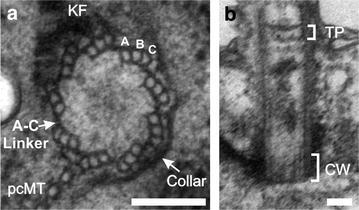
Tetrahymena BB structure. a Cross-sectional view of a proximal section of a Tetrahymena BB. Collar electron-dense collar; pcMT post-ciliary microtubules; KF kinetodesmal fiber; b longitudinal view of a BB; TP terminal plate; CW Cartwheel. Scale bars 100 nm
Fig. 3
Fig. 3
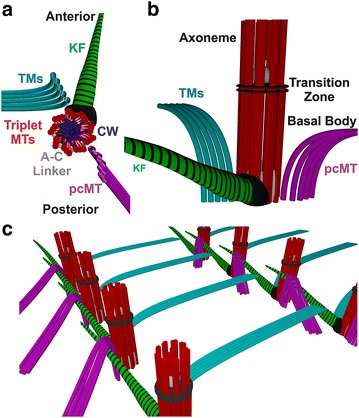
Schematic representation of Tetrahymena BBs and associated accessory structures. a 3D schematic of an individual cortical BB viewed from the interior of the cell. b An individual cortical BB viewed slightly offset from the anterior direction. c Image shows a portion of two ciliary rows highlighting the positioning of the three major accessory structures relative to neighboring BBs. pcMTs post-ciliary microtubules; KF kinetodesmal fiber; TMs transverse microtubules; CW cartwheel

References

    1. Cavalier-Smith T. Kingdom protozoa and its 18 phyla. Microbiol Rev. 1993;57(4):953–994. - PMC - PubMed
    1. Eisen JA, Coyne RS, Wu M, Wu D, Thiagarajan M, Wortman JR, et al. Macronuclear genome sequence of the ciliate Tetrahymena thermophila, model eukaryote. PLoS Biol. 2006;4(9):e286. doi: 10.1371/journal.pbio.0040286. - DOI - PMC - PubMed
    1. Allen RD. The morphogenesis of basal bodies and accessory structures of the cortex of the ciliated protozoan Tetrahymena pyriformis. J. Cell Biol. 1969;40(3):716–733. doi: 10.1083/jcb.40.3.716. - DOI - PMC - PubMed
    1. Jerka-Dziadosz M. Cytoskeleton-related structures in tetrahymena thermophila: microfilaments at the apical and division-furrow rings. J. Cell Sci. 1981;51:241–253. - PubMed
    1. Williams NE, Frankel J. Regulation of microtubules in Tetrahymena. I. Electron microscopy of oral replacement. J. Cell Biol. 1973;56(2):441–457. doi: 10.1083/jcb.56.2.441. - DOI - PMC - PubMed

LinkOut - more resources