


Smooth Tubercle Bacilli: Neglected Opportunistic Tropical Pathogens
- PMID: 26793699
- PMCID: PMC4707939
- DOI: 10.3389/fpubh.2015.00283
Smooth Tubercle Bacilli: Neglected Opportunistic Tropical Pathogens
Abstract
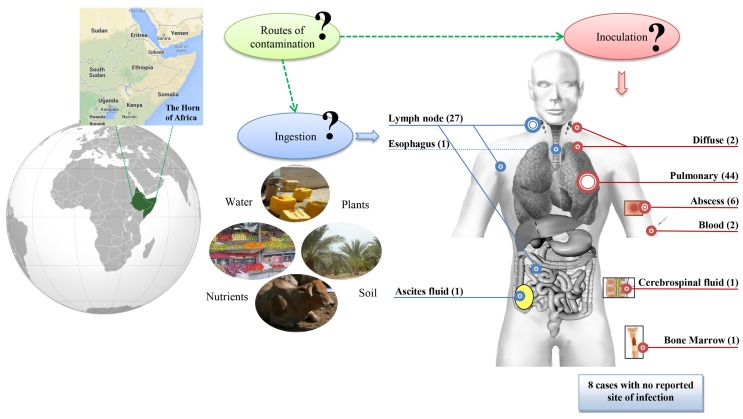
Smooth tubercle bacilli (STB) including "Mycobacterium canettii" are members of the Mycobacterium tuberculosis complex (MTBC), which cause non-contagious tuberculosis in human. This group comprises <100 isolates characterized by smooth colonies and cordless organisms. Most STB isolates have been obtained from patients exposed to the Republic of Djibouti but seven isolates, including the three seminal ones obtained by Georges Canetti between 1968 and 1970, were recovered from patients in France, Madagascar, Sub-Sahara East Africa, and French Polynesia. STB form a genetically heterogeneous group of MTBC organisms with large 4.48 ± 0.05 Mb genomes, which may link Mycobacterium kansasii to MTBC organisms. Lack of inter-human transmission suggested a yet unknown environmental reservoir. Clinical data indicate a respiratory tract route of contamination and the digestive tract as an alternative route of contamination. Further epidemiological and clinical studies are warranted to elucidate areas of uncertainty regarding these unusual mycobacteria and the tuberculosis they cause.
Keywords: Djibouti; Horn of Africa; Mycobacterium tuberculosis complex; amoebas; cellulases; smooth tubercle bacilli; “Mycobacterium canettii”.
Figures

References
-
- WHO (World Health Organization). Global Tuberculosis Report. (2014). Available from: http://apps.who.int/iris/bitstream/10665/137094/1/9789241564809_eng.pdf
-
- Runyon EH. Identification of mycobacterial pathogens utilizing colony characteristics. Am J Clin Pathol (1970) 54:578–86. - PubMed
Publication types
LinkOut - more resources
Full Text Sources
Other Literature Sources
Miscellaneous
