Ecological Drivers of Mansonella perstans Infection in Uganda and Patterns of Co-endemicity with Lymphatic Filariasis and Malaria
- PMID: 26793972
- PMCID: PMC4721671
- DOI: 10.1371/journal.pntd.0004319
Ecological Drivers of Mansonella perstans Infection in Uganda and Patterns of Co-endemicity with Lymphatic Filariasis and Malaria
Abstract
Background: Mansonella perstans is a widespread, but relatively unknown human filarial parasite transmitted by Culicoides biting midges. Although it is found in many parts of sub-Saharan Africa, only few studies have been carried out to deepen the understanding of its ecology, epidemiology, and health consequences. Hence, knowledge about ecological drivers of the vector and parasite distribution, integral to develop spatially explicit models for disease prevention, control, and elimination strategies, is limited.
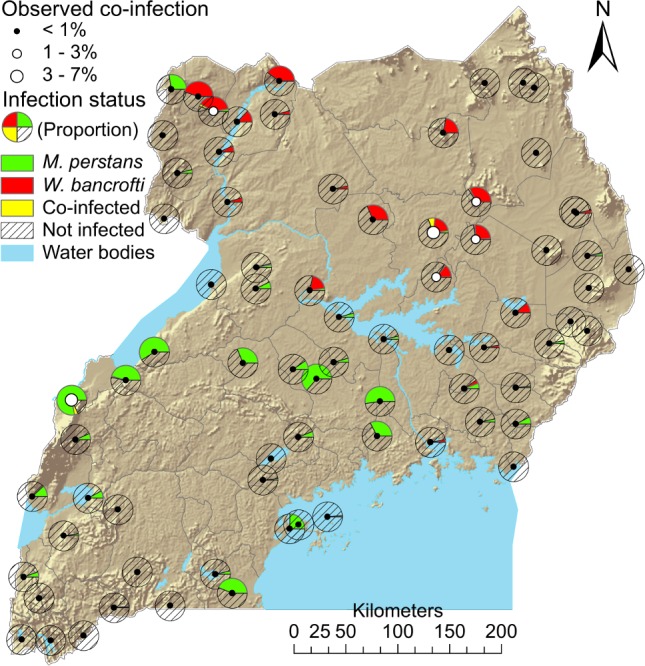
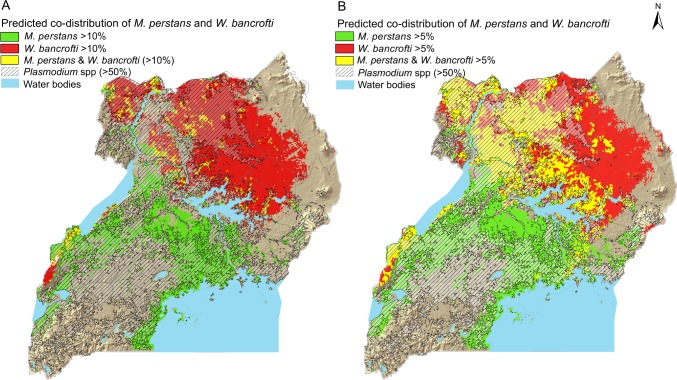
Methodology: We analyzed data from a comprehensive nationwide survey of M. perstans infection conducted in 76 schools across Uganda in 2000-2003, to identify environmental drivers. A suite of Bayesian geostatistical regression models was fitted, and the best fitting model based on the deviance information criterion was utilized to predict M. perstans infection risk for all of Uganda. Additionally, we investigated co-infection rates and co-distribution with Wuchereria bancrofti and Plasmodium spp. infections observed at the same survey by mapping geographically overlapping areas.
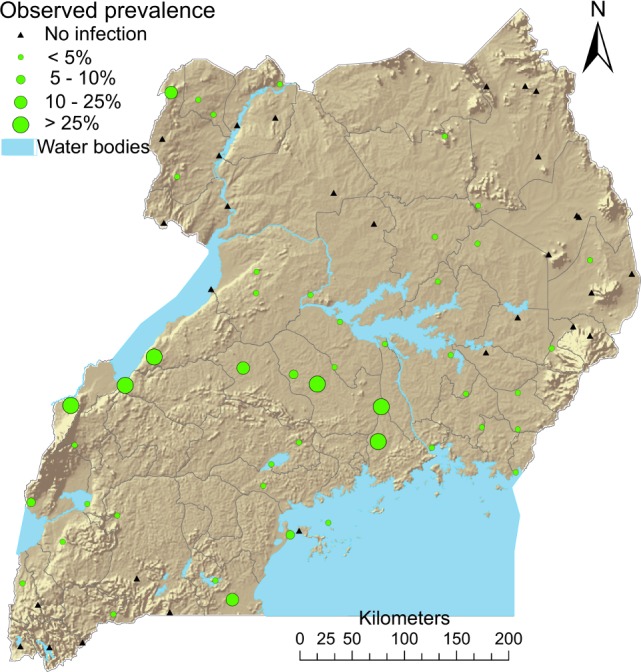
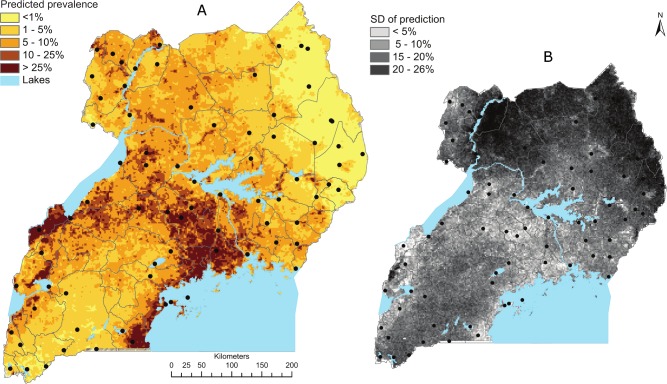
Principal findings: Several bioclimatic factors were significantly associated with M. perstans infection levels. A spatial Bayesian regression model showed the best fit, with diurnal temperature range, normalized difference vegetation index, and cattle densities identified as significant covariates. This model was employed to predict M. perstans infection risk at non-sampled locations. The level of co-infection with W. bancrofti was low (0.3%), due to limited geographic overlap. However, where the two infections did overlap geographically, a positive association was found.
Conclusions/significance: This study presents the first geostatistical risk map for M. perstans in Uganda. We confirmed a widespread distribution of M. perstans, and identified important potential drivers of risk. The results provide new insight about the ecologic preferences of this otherwise poorly known filarial parasite and its Culicoides vector species in Uganda, which might be relevant for other settings in sub-Saharan Africa.
Conflict of interest statement
The authors have declared that no competing interests exist.
Figures
References
-
- Nelson GS (1965) Filarial infections as zoonoses. J Helminthol 39: 229–250. - PubMed
-
- Linley JR, Hoch AL, Pinheiro FP (1983) Biting midges (Diptera: Ceratopogonidae) and human health. J Med Entomol 20: 347–364. - PubMed
-
- Linley JR (1985) Biting midges (Diptera: Ceratopogonidae) as vectors of nonviral animal pathogens. J Med Entomol 22: 589–599. - PubMed
Publication types
MeSH terms
LinkOut - more resources
Full Text Sources
Other Literature Sources
Medical
Miscellaneous