Comparison of Upper Extremity Physical Characteristics Between Adolescent Competitive Swimmers and Nonoverhead Athletes
- PMID: 26794629
- PMCID: PMC4851131
- DOI: 10.4085/1062-6050-51.2.04
Comparison of Upper Extremity Physical Characteristics Between Adolescent Competitive Swimmers and Nonoverhead Athletes
Abstract
Context: Alterations to upper extremity physical characteristics of competitive swimmers (posture, range of motion [ROM], and subacromial-space distance) are commonly attributed to cumulative training load during a swimmer's competitive career. However, this accepted clinical belief has not been established in the literature. It is important to understand whether alterations in posture and associated physical characteristics occur as a result of sport training or factors other than swimming participation to better understand injury risk and possible interventions.
Objective: To compare posture, subacromial-space distance, and glenohumeral external-rotation, internal-rotation, and horizontal-adduction ROM between adolescent competitive swimmers and nonoverhead athletes.
Design: Cross-sectional study.
Setting: Local swimming pools and high school athletic training rooms.
Patients or other participants: Forty-four competitive adolescent swimmers and 31 nonoverhead athletes who were not currently experiencing any elbow, shoulder, neck, or back pain that limited their sport activity.
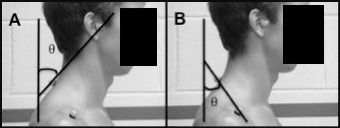
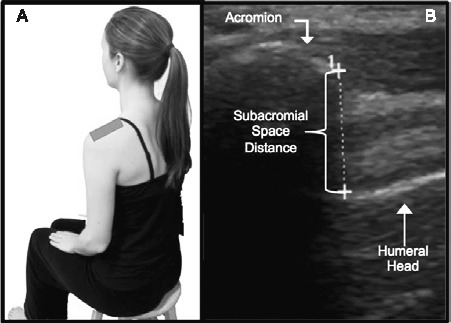
Intervention(s): Posture, subacromial-space distance, and glenohumeral ROM were measured using photography, diagnostic ultrasound, and a digital inclinometer, respectively.
Main outcome measure(s): Forward shoulder posture, forward head posture, normalized subacromial-space distance, internal-rotation ROM, and external-rotation ROM.
Results: No clinically significant differences existed between swimmers and nonoverhead athletes for posture, normalized subacromial-space distance, or external- or internal-rotation ROM. Swimmers presented with less horizontal-adduction ROM than nonoverhead athletes.
Conclusions: Factors other than swimming participation, such as school and technology use, play important roles in the adaptation of physical characteristics in adolescents. Adolescents, regardless of swimming participation, presented with postural deviations. It is important to consider factors other than swimming participation that contribute to alterations in physical characteristics to understand injury risk and injury-prevention strategies in competitive adolescent swimmers.
Keywords: posture; range of motion; subacromial space.
Figures

References
-
- 2012 USA Swimming membership demographics. USA Swimming Web site. http://www.usaswimming.org/_Rainbow/Documents/ceb07df5-c623-49a9-ad4c-dc.... Published 2012. Accessed January 14, 2014.
-
- Hibberd EE, Myers JB. Practice habits and attitudes and behaviors concerning shoulder pain in high school competitive club swimmers. Clin J Sport Med. 2013;23(6):450–455. - PubMed
-
- Weldon EJ, III, Richardson AB. Upper extremity overuse injuries in swimming: a discussion of swimmer's shoulder. Clin Sports Med. 2001;20(3):423–438. - PubMed
-
- Pink MM, Tibone JE. The painful shoulder in the swimming athlete. Orthop Clin North Am. 2000;31(2):247–261. - PubMed
-
- Sein ML, Walton J, Linklater J, et al. Shoulder pain in elite swimmers: primarily due to swim-volume-induced supraspinatus tendinopathy. Br J Sport Med. 2010;44(2):105–113. - PubMed
Publication types
MeSH terms
LinkOut - more resources
Full Text Sources
Other Literature Sources