


Effectiveness of a universal parental support programme to promote health behaviours and prevent overweight and obesity in 6-year-old children in disadvantaged areas, the Healthy School Start Study II, a cluster-randomised controlled trial
- PMID: 26795378
- PMCID: PMC4721005
- DOI: 10.1186/s12966-016-0327-4
Effectiveness of a universal parental support programme to promote health behaviours and prevent overweight and obesity in 6-year-old children in disadvantaged areas, the Healthy School Start Study II, a cluster-randomised controlled trial
Abstract
Background: There is increasing evidence for the effectiveness of parental support programmes to promote healthy behaviours and prevent obesity in children, but only few studies have been conducted among groups with low socio-economic status. The aim of this study was to develop and evaluate the effectiveness of a parental support programme to promote healthy dietary and physical activity habits and to prevent overweight and obesity in six-year-old children in disadvantaged areas.
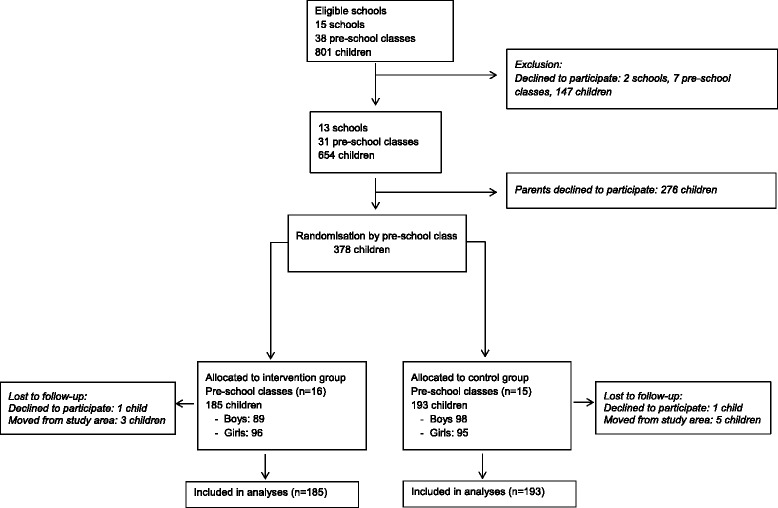
Methods: A cluster-randomised controlled trial was carried out in disadvantaged areas in Stockholm. Participants were six-year-old children (n = 378) and their parents. Thirty-one school classes from 13 schools were randomly assigned to intervention (n = 16) and control groups (n = 15). The intervention lasted for 6 months and included: 1) Health information for parents, 2) Motivational Interviewing with parents and 3) Teacher-led classroom activities with children. Physical activity was measured by accelerometry, dietary intake and screen time with a questionnaire, body weight and height were measured and BMI standard deviation score was calculated. Measurements were conducted at baseline, post-intervention and at 5months follow-up. Group effects were examined using Mixed-effect Regression analyses adjusted for sex, parental education and baseline values.
Results: Fidelity to all three intervention components was satisfactory. Significant intervention effects were found regarding consumption of unhealthy foods (p = 0.01) and unhealthy drinks (p = 0.01). At follow-up, the effect on intake of unhealthy foods was sustained for boys (p = 0.03). There was no intervention effect on physical activity. Further, the intervention had no apparent effect on BMI sds for the whole sample, but a significant difference between groups was detected among children who were obese at baseline (p = 0.03) which was not sustained at follow-up.
Conclusions: The Healthy School Start study shows that it is possible to influence intake of unhealthy foods and drinks and weight development in obese children by providing individual parental support in a school context. However, the effects were short-lived. Therefore, the programme needs to be prolonged and/or intensified in order to obtain stronger and sustainable effects. This study is an important contribution to the further development of evidence-based parental support programmes to prevent overweight and obesity in children in disadvantaged areas.
References
-
- Lim SS, Vos T, Flaxman AD, Danaei G, Shibuya K, Adair-Rohani H, et al. A comparative risk assessment of burden of disease and injury attributable to 67 risk factors and risk factor clusters in 21 regions, 1990–2010: a systematic analysis for the Global Burden of Disease Study 2010. Lancet. 2013;380(9859):2224–60. doi: 10.1016/S0140-6736(12)61766-8. - DOI - PMC - PubMed
Publication types
MeSH terms
LinkOut - more resources
Full Text Sources
Other Literature Sources
Medical
