


Prognostic Implications of Long-Chain Acylcarnitines in Heart Failure and Reversibility With Mechanical Circulatory Support
- PMID: 26796394
- PMCID: PMC5429585
- DOI: 10.1016/j.jacc.2015.10.079
Prognostic Implications of Long-Chain Acylcarnitines in Heart Failure and Reversibility With Mechanical Circulatory Support
Abstract
Background: Heart failure (HF) is characterized by perturbations in energy homeostasis and metabolism. The reversibility and prognostic value of circulating markers associated with these changes remain unclear.
Objectives: This study sought to describe the metabolomic profiles of patients along the spectrum of systolic HF, determine their association with adverse outcomes in a clinical trial of HF, and evaluate whether identified metabolites change with treatment for end-stage systolic HF.
Methods: To assess association of metabolites with clinical outcomes, we evaluated a population of 453 chronic systolic HF patients who had been randomized to exercise training versus usual care. To assess change in metabolites with mechanical circulatory support, 41 patients with end-stage HF who underwent left ventricular assist device (LVAD) placement were studied. Targeted, quantitative profiling of 60 metabolites using tandem flow injection mass spectrometry was performed on frozen plasma samples obtained prior to randomization, as well as prior to and ≥90 days post-placement in the LVAD group. Principal components analysis was used for data reduction.
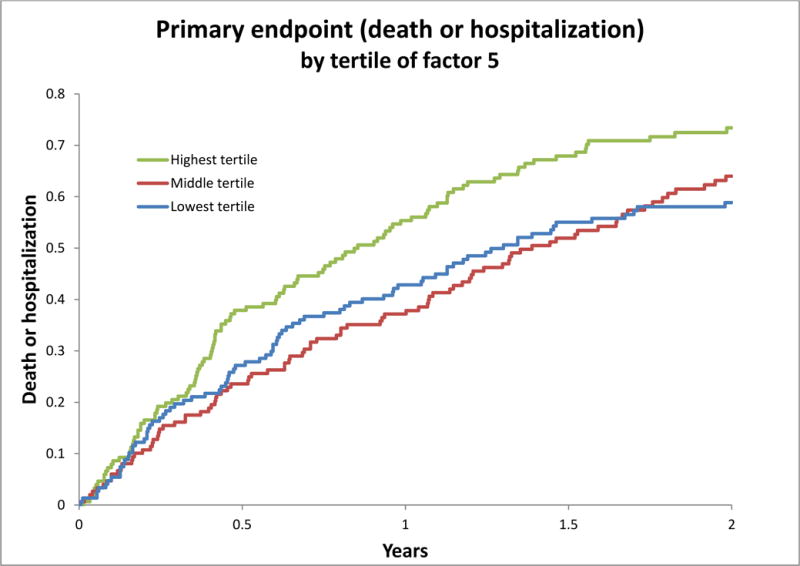
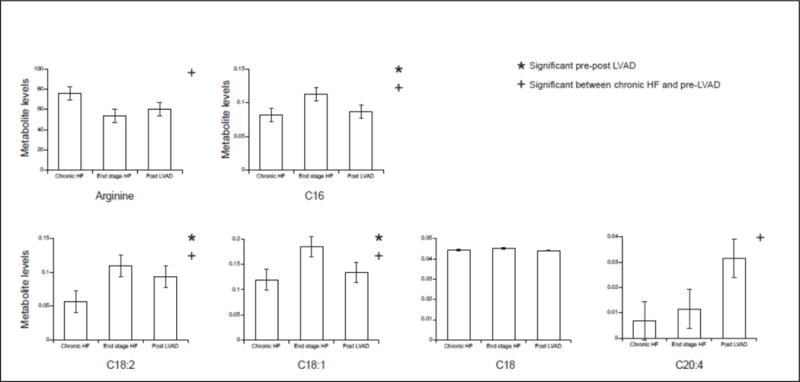
Results: Five principal components analysis-derived factors were significantly associated with peak Vo2 levels at baseline in fully adjusted models. Of these, factor 5 (composed of long-chain acylcarnitines) was associated with increased risk of all 3 pre-specified clinical trial outcomes: all-cause mortality/all-cause hospitalization, all cause-hospitalization, and cardiovascular death or cardiovascular hospitalization. Individual components of factor 5 were significantly higher in patients with end-stage HF prior to LVAD placement and decreased significantly post-implantation.
Conclusions: In chronic HF patients, circulating long-chain acylcarnitine metabolite levels were independently associated with adverse clinical outcomes and decreased after long-term mechanical circulatory support. These metabolites may serve as potential targets for new diagnostics or therapeutic interventions. (Exercise Training Program to Improve Clinical Outcomes in Individuals With Congestive Heart Failure; NCT00047437).
Keywords: metabolomics; phenotypes; prognosis.
Copyright © 2016 American College of Cardiology Foundation. Published by Elsevier Inc. All rights reserved.
Figures
Comment in
-
Metabolic Staging in Human Heart Failure: Circulating Acylcarnitines and the Failing Heart's Energetic Signature.J Am Coll Cardiol. 2016 Jan 26;67(3):300-2. doi: 10.1016/j.jacc.2015.11.017. J Am Coll Cardiol. 2016. PMID: 26796395 No abstract available.
References
-
- Braunwald E. The war against heart failure: the Lancet lecture. Lancet. 2015;385:812–24. - PubMed
-
- Neubauer S. The failing heart–an engine out of fuel. The New England journal of medicine. 2007;356:1140–51. - PubMed
-
- Shah SH, Bain JR, Muehlbauer MJ, et al. Association of a peripheral blood metabolic profile with coronary artery disease and risk of subsequent cardiovascular events. Circulation Cardiovascular genetics. 2010;3:207–14. - PubMed
Publication types
MeSH terms
Substances
Associated data
Grants and funding
LinkOut - more resources
Full Text Sources
Other Literature Sources
Medical
Research Materials
Miscellaneous
