


Evidence for association of SNPs in ABCB1 and CBR3, but not RAC2, NCF4, SLC28A3 or TOP2B, with chronic cardiotoxicity in a cohort of breast cancer patients treated with anthracyclines
- PMID: 26799497
- PMCID: PMC5558515
- DOI: 10.2217/pgs.15.162
Evidence for association of SNPs in ABCB1 and CBR3, but not RAC2, NCF4, SLC28A3 or TOP2B, with chronic cardiotoxicity in a cohort of breast cancer patients treated with anthracyclines
Abstract
Aims: Validation of associations for SNPs in RAC2, NCF4 and SLC28A3, identification of a novel association with a TOP2B SNP and screening 23 SNPs putatively relevant to anthracycline-induced cardiotoxicity.
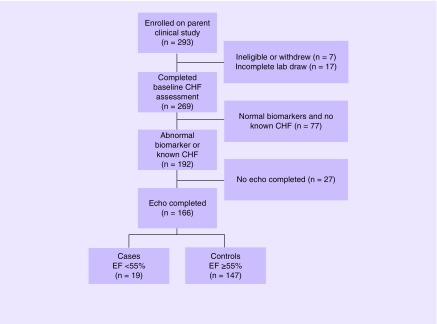
Patients & methods: A total of 166 breast cancer patients treated with doxorubicin underwent echocardiogram, including 19 cases with systolic dysfunction (ejection fraction <55%) and 147 controls. Four high priority SNPs were tested in the primary analysis, with appropriate statistical correction, and 23 additional SNPs were screened in an uncorrected secondary analysis.
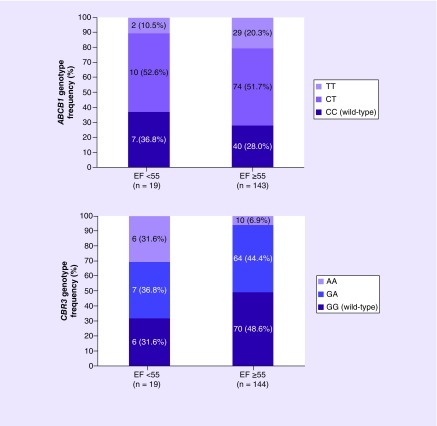
Results: Previously reported associations for RAC2, NCF4 and SLC28A3 could not be validated and a novel association with TOP2B was not discovered in this cohort (all p > 0.05), likely due to inadequate power. Two SNPs were identified in the uncorrected secondary analysis including a protective SNP in ABCB1 (3435C>T, p = 0.049) and a risk allele in CBR3 (V244M, p = 0.012).
Conclusion: The associations reported in prior publications and those discovered in this secondary analysis require further replication in independent cohorts.
Keywords: ABCB1; CBR3; NCF4; RAC2; SLC28A3; TOP2B; anthracycline; cardiotoxicity; doxorubicin; pharmacogenetic; systolic dysfunction.
Conflict of interest statement
This work was supported in part by The Breast Cancer Research Foundation (BCRF) (N003173 to JM Rae), the NIH (1RO1GM099143 to JM Rae), by a Pfizer Foundation Fellowship Award awarded to K Cooney to support M Caram, by the University of Michigan Cancer Research Committee Research Grant awarded to J Smerage and by the National Cancer Institute of the NIH under Award Number P30CA046592 by the use of the following Cancer Center Core: UM DNA Sequencing Core. The authors have no other relevant affiliations or financial involvement with any organization or entity with a financial interest in or financial conflict with the subject matter or materials discussed in the manuscript apart from those disclosed.
No writing assistance was utilized in the production of this manuscript.
Figures
References
-
- Fumoleau P, Roche H, Kerbrat P, et al. Long-term cardiac toxicity after adjuvant epirubicin-based chemotherapy in early breast cancer: French Adjuvant Study Group results. Ann. Oncol. 2006;17(1):85–92. - PubMed
-
- Perez EA, Suman VJ, Davidson NE, et al. Effect of doxorubicin plus cyclophosphamide on left ventricular ejection fraction in patients with breast cancer in the North Central Cancer Treatment Group N9831 Intergroup Adjuvant Trial. J. Clin. Oncol. 2004;22(18):3700–3704. - PubMed
-
- Ganz PA, Hussey MA, Moinpour CM, et al. Late cardiac effects of adjuvant chemotherapy in breast cancer survivors treated on southwest oncology group protocol S8897. J. Clin. Oncol. 2008;26(8):1223–1230. - PubMed
-
- Zambetti M, Moliterni A, Materazzo C, et al. Long-term cardiac sequelae in operable breast cancer patients given adjuvant chemotherapy with or without doxorubicin and breast irradiation. J. Clin. Oncol. 2001;19(1):37–43. - PubMed
Publication types
MeSH terms
Substances
Grants and funding
LinkOut - more resources
Full Text Sources
Other Literature Sources
Medical
Molecular Biology Databases
