


Systematic review of dyadic and family-oriented interventions for late-life depression
- PMID: 26799782
- PMCID: PMC5166608
- DOI: 10.1002/gps.4434
Systematic review of dyadic and family-oriented interventions for late-life depression
Abstract
Objective: Supportive behaviors (both instrumental and emotional) from spouses and close family members can impact the trajectory of older adults' depressive symptoms. Interventions that target both the patient and support person may be more effective than interventions that target the patient only, in terms of alleviating mood symptoms in the identified patient. The purpose of this paper was to review the characteristics and findings of dyadic and family-oriented interventions for late-life mood disorders to determine if they are effective and beneficial.
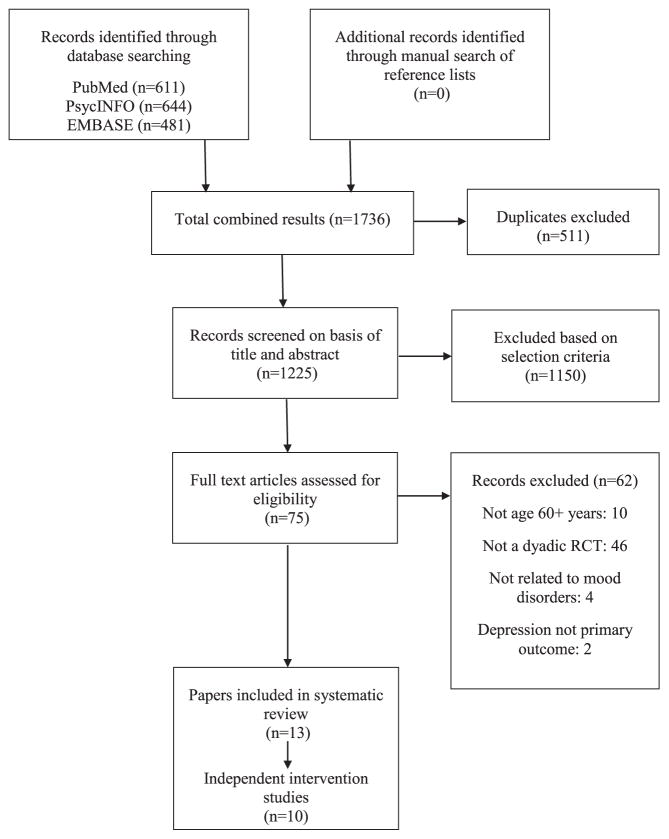
Methods: Following PRISMA guidelines, we conducted a systematic review of reports in the literature on dyadic or family-oriented interventions for late-life mood disorders. We searched PubMed, OVID PsycINFO, and EMBASE for peer-reviewed journal articles in English through October 2014.
Results: We identified 13 articles, representing a total of 10 independent investigations. Identified studies focused on spouses and close family members as support persons. Effect sizes for dyadic interventions that treated major depressive disorder were, on average, moderately strong, while effect sizes for dyadic interventions that reduced depressive symptoms were generally small. We did not identify any dyadic studies that treated bipolar disorder.
Conclusions: This review showed that dyadic interventions are feasible and that these interventions can decrease symptomatology in individuals who have major depressive disorder. Research is needed to understand the relative efficacy of a dyadic approach over a single-target approach in treating depression. Copyright © 2016 John Wiley & Sons, Ltd.
Keywords: couples; interventions; mood disorders; older adults; systematic review.
Copyright © 2016 John Wiley & Sons, Ltd.
Conflict of interest statement
Drs. Stahl, Rodakowski, Park, and Dew report no competing interests. Ms Saghafi also reports no competing interests. Dr. Reynolds reports receiving pharmaceutical support for NIH-sponsored research studies from Bristol-Myers Squibb, Forest, Pfizer, and Lilly; and serving on the American Association for Geriatric Psychiatry editorial review board. He has received an honorarium as a speaker from MedScape/WEB MD. He is the co-inventor (Licensed Intellectual Property) of Psychometric analysis of the Pittsburgh Sleep Quality Index (PSQI) PRO10050447 (PI: Buysse).
Figures
References
-
- Berg CA, Upchurch R. A developmental-contextual model of couples coping with chronic illness across the adult life span. Psych Bulletin. 2007;133:920–954. - PubMed
-
- Bolka CR, Bonner LM, Campbell DG, et al. Family involvement, medication adherence, and depression outcomes among patients in veterans affairs primary care. Psychiatric Serv. 2013;64:472–478. - PubMed
-
- Carstensen LL, Isaacowitz D, Charles ST. Taking time seriously: a theory of socioemotional selectivity. Am Psychologist. 1999;54:165–181. - PubMed
Publication types
MeSH terms
Grants and funding
LinkOut - more resources
Full Text Sources
Other Literature Sources
Medical
