


Characterization of a cold-active esterase from Serratia sp. and improvement of thermostability by directed evolution
- PMID: 26800680
- PMCID: PMC4722774
- DOI: 10.1186/s12896-016-0235-3
Characterization of a cold-active esterase from Serratia sp. and improvement of thermostability by directed evolution
Abstract
Background: In recent years, cold-active esterases have received increased attention due to their attractive properties for some industrial applications such as high catalytic activity at low temperatures.
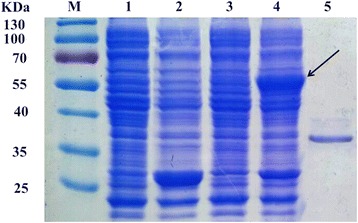
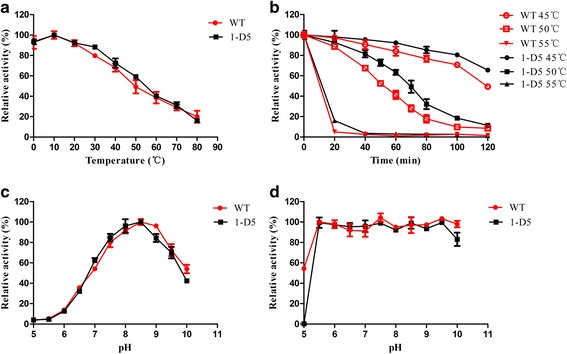
Results: An esterase-encoding gene (estS, 909 bp) from Serratia sp. was identified, cloned and expressed in Escherichia coli DE3 (BL21). The estS encoded a protein (EstS) of 302 amino acids with a predicted molecular weight of 32.5 kDa. It showed the highest activity at 10 °C and pH 8.5. EstS was cold active and retained ~92 % of its original activity at 0 °C. Thermal inactivation analysis showed that the T1/2 value of EstS was 50 min at 50 °C (residual activity 41.23 %) after 1 h incubation. EstS is also quite stable in high salt conditions and displayed better catalytic activity in the presence of 4 M NaCl. To improve the thermo-stability of EstS, variants of estS gene were created by error-prone PCR. A mutant 1-D5 (A43V, R116W, D147N) that showed higher thermo-stability than its wild type predecessor was selected. 1-D5 showed enhanced T1/2 of 70 min at 50 °C and retained 63.29 % of activity after incubation at 50 °C for 60 min, which were about 22 % higher than the wild type (WT). CD spectrum showed that the secondary structure of WT and 1-D5 are more or less similar, but an increase in β-sheets was recorded, which enhanced the thermostability of mutant protein.
Conclusion: EstS was a novel cold-active and salt-tolerant esterase and half-life of mutant 1-D5 was enhanced by 1.4 times compared with WT. The features of EstS are interesting and can be exploited for commercial applications. The results have also provided useful information about the structure and function of Est protein.
Figures




References
-
- Li XL, Zhang WH, Wang YD, Dai YJ, Zhang HT, Wang Y, et al. A high-detergent-performance, cold-adapted lipase from Pseudomonas stutzeri PS59 suitable for detergent formulation. J Mol Catalysis B Enzymatic. 2014;102:16–24. doi: 10.1016/j.molcatb.2014.01.006. - DOI
-
- Tutino ML, Parrilli E, De Santi C, Giuliani M, Marino G, de Pascale D. Cold-adapted esterases and lipases: a biodiversity still under-exploited. Curr Chem Biol. 2010;4(1):74–83.
-
- Suzuki T, Nakayama T, Choo DW, Hirano Y, Kurihara T, Nishino T, et al. Cloning, heterologous expression, renaturation, and characterization of a cold-adapted esterase with unique primary structure from a psychrotroph Pseudomonas sp. strain B11-1. Protein Expr Purif. 2003;30(2):171–8. doi: 10.1016/S1046-5928(03)00128-1. - DOI - PubMed
-
- Kulakova L, Galkin A, Nakayama T, Nishino T, Esaki N. Cold-active esterase from Psychrobacter sp. Ant300: gene cloning, characterization, and the effects of Gly → Pro substitution near the active site on its catalytic activity and stability. Biochim Biophys Acta Protein Proteomics. 2004;1696(1):59–65. doi: 10.1016/j.bbapap.2003.09.008. - DOI - PubMed
Publication types
MeSH terms
Substances
LinkOut - more resources
Full Text Sources
Other Literature Sources
Molecular Biology Databases
Research Materials
