


Functional and pathological relevance of HERC family proteins: a decade later
- PMID: 26801221
- PMCID: PMC11108380
- DOI: 10.1007/s00018-016-2139-8
Functional and pathological relevance of HERC family proteins: a decade later
Abstract
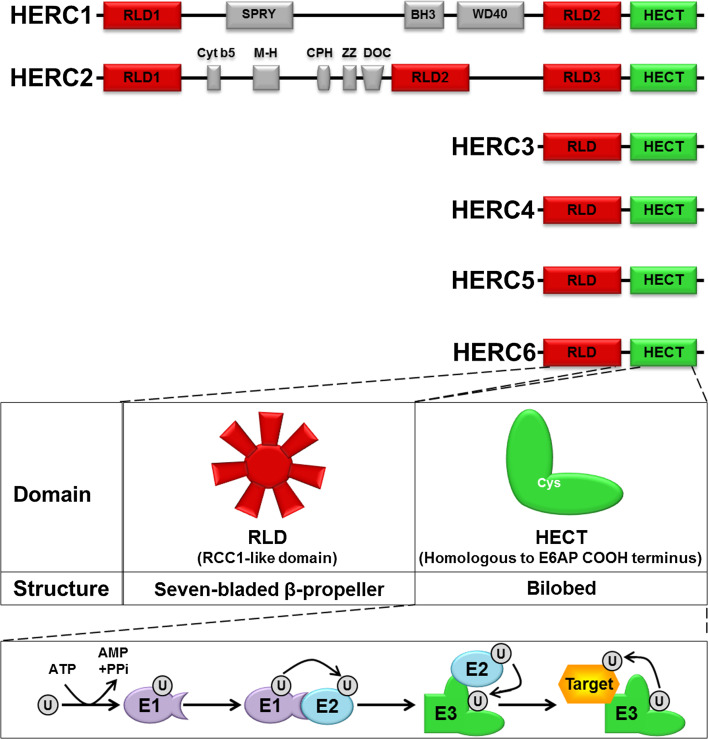
The HERC gene family encodes proteins with two characteristic domains in their sequence: the HECT domain and the RCC1-like domain (RLD). In humans, the HERC family comprises six members that can be divided into two groups based on their molecular mass and domain structure. Whereas large HERCs (HERC1 and HERC2) contain one HECT and more than one RLD, small HERCs (HERC3-6) possess single HECT and RLD domains. Accumulating evidence shows the HERC family proteins to be key components of a wide range of cellular functions, including neurodevelopment, DNA damage repair, cell growth and immune response. Considering the significant recent advances made regarding HERC functionality, an updated review summarizing the progress is greatly needed at 10 years since the last HERC review. We provide an integrated view of HERC function and go into detail about its implications for several human diseases such as cancer and neurological disorders.
Keywords: HECT; HERC proteins; RCC1; RLD; Ubiquitin ligase.
Figures

References
Publication types
MeSH terms
Substances
LinkOut - more resources
Full Text Sources
Other Literature Sources
