


Ascorbic acid improves brachial artery vasodilation during progressive handgrip exercise in the elderly through a nitric oxide-mediated mechanism
- PMID: 26801312
- PMCID: PMC4867342
- DOI: 10.1152/ajpheart.00817.2015
Ascorbic acid improves brachial artery vasodilation during progressive handgrip exercise in the elderly through a nitric oxide-mediated mechanism
Erratum in
-
Errata for vol. 313, p.Am J Physiol Heart Circ Physiol. 2017 Aug 1;313(2):H457. doi: 10.1152/ajpheart.00817.2015-corr.2017. Am J Physiol Heart Circ Physiol. 2017. PMID: 28801481 Free PMC article. No abstract available.
Abstract
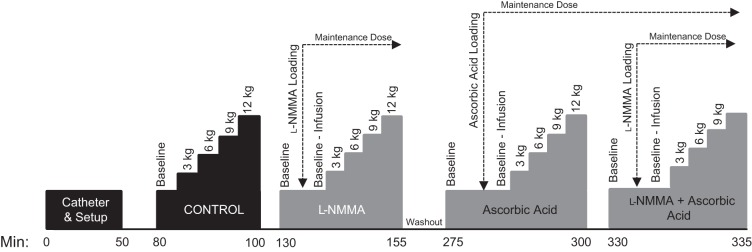
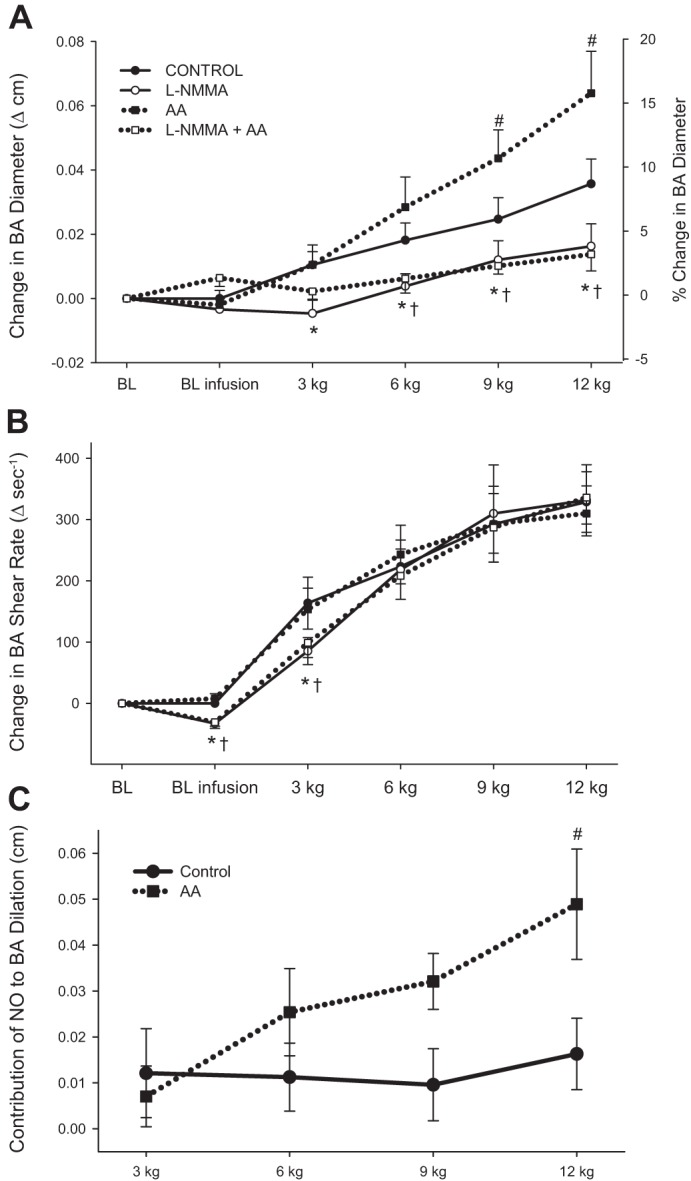
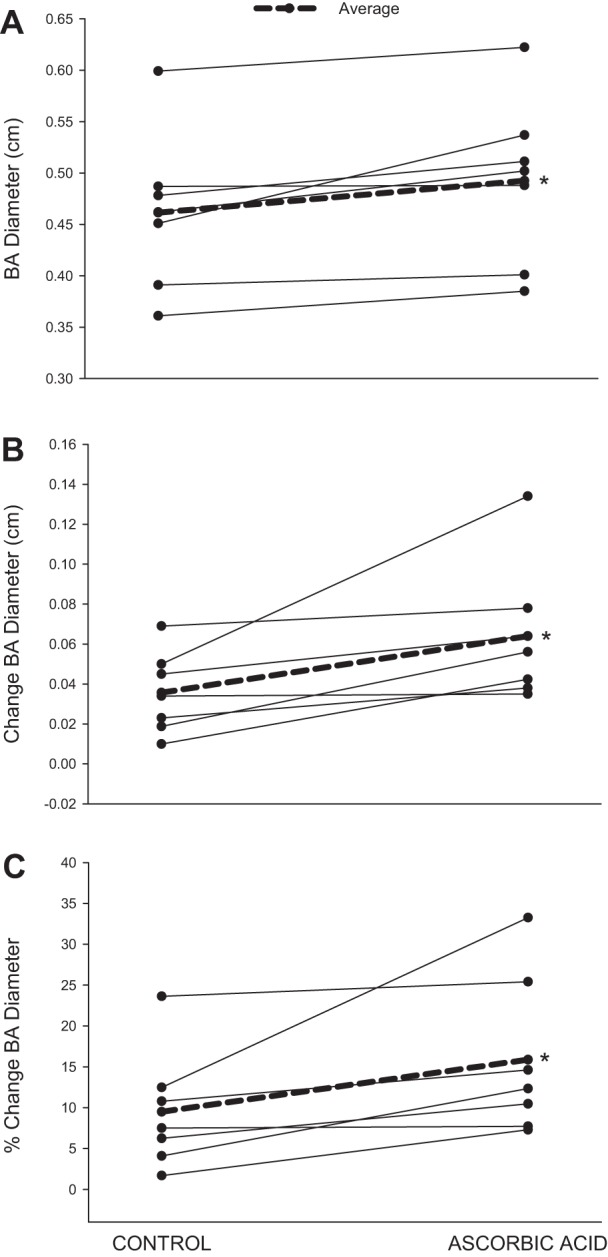
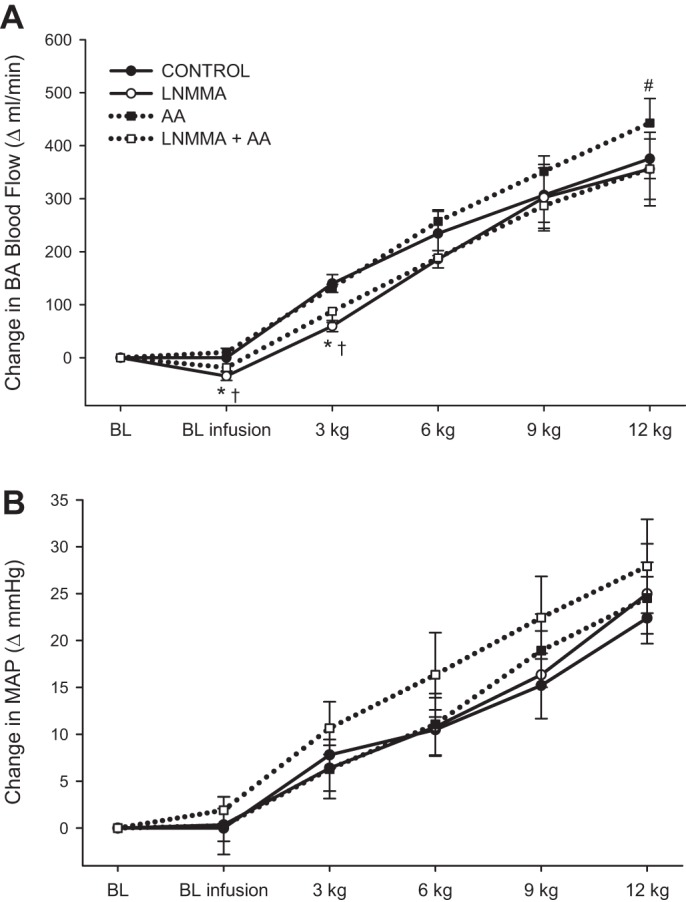
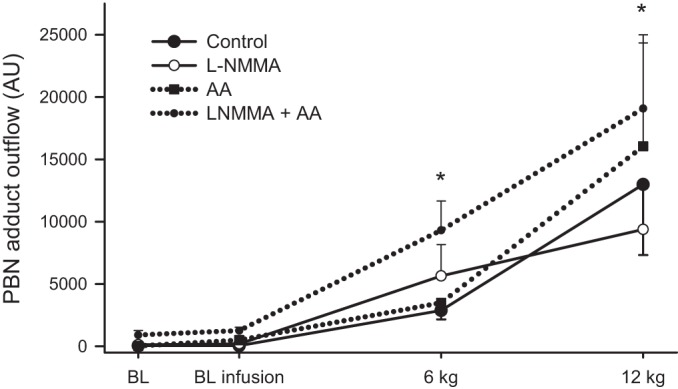
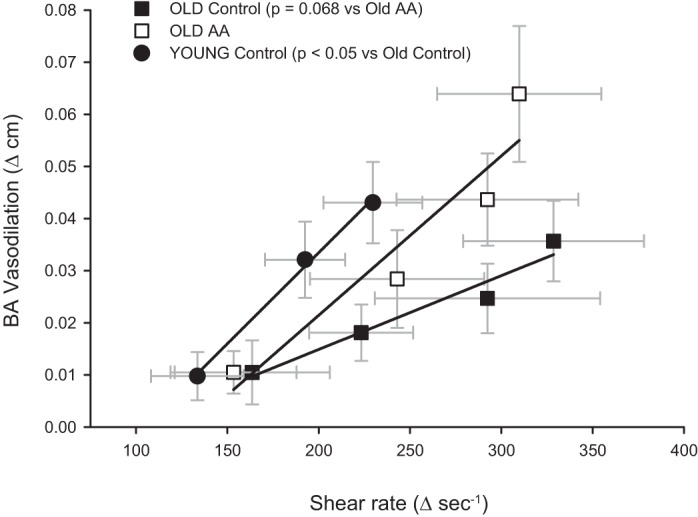
The proposed mechanistic link between the age-related attenuation in vascular function and free radicals is an attractive hypothesis; however, direct evidence of free radical attenuation and a concomitant improvement in vascular function in the elderly is lacking. Therefore, this study sought to test the hypothesis that ascorbic acid (AA), administered intra-arterially during progressive handgrip exercise, improves brachial artery (BA) vasodilation in a nitric oxide (NO)-dependent manner, by mitigating free radical production. BA vasodilation (Doppler ultrasound) and free radical outflow [electron paramagnetic resonance (EPR) spectroscopy] were measured in seven healthy older adults (69 ± 2 yr) during handgrip exercise at 3, 6, 9, and 12 kg (∼13-52% of maximal voluntary contraction) during the control condition and nitric oxide synthase (NOS) inhibition via N(G)-monomethyl-L-arginine (L-NMMA), AA, and coinfusion of l-NMMA + AA. Baseline BA diameter was not altered by any of the treatments, while L-NMMA and L-NMMA + AA diminished baseline BA blood flow and shear rate. AA improved BA dilation compared with control at 9 kg (control: 6.5 ± 2.2%, AA: 10.9 ± 2.5%, P = 0.01) and 12 kg (control: 9.5 ± 2.7%, AA: 15.9 ± 3.7%, P < 0.01). NOS inhibition blunted BA vasodilation compared with control and when combined with AA eliminated the AA-induced improvement in BA vasodilation. Free radical outflow increased with exercise intensity but, interestingly, was not attenuated by AA. Collectively, these results indicate that AA improves BA vasodilation in the elderly during handgrip exercise through an NO-dependent mechanism; however, this improvement appears not to be the direct consequence of attenuated free radical outflow from the forearm.
Keywords: aging; endothelium; l-NMMA; vascular function.
Figures

References
-
- Anderson TJ, Uehata A, Gerhard MD, Meredith IT, Knab S, Delagrange D, Lieberman EH, Ganz P, Creager MA, Yeung AC. Close relation of endothelial function in the human coronary and peripheral circulations. J Am Coll Cardiol 26: 1235–1241, 1995. - PubMed
-
- Ashton T, Young IS, Peters JR, Jones E, Jackson SK, Davies B, Rowlands CC. Electron spin resonance spectroscopy, exercise, and oxidative stress: an ascorbic acid intervention study. J Appl Physiol 87: 2032–2036, 1999. - PubMed
-
- Bailey DM. Radical dioxygen: from gas to (unpaired!) electrons. Adv Exp Med Biol 543: 201–221, 2003. - PubMed
-
- Bailey DM, Davies B, Young IS, Jackson MJ, Davison GW, Isaacson R, Richardson RS. EPR spectroscopic detection of free radical outflow from an isolated muscle bed in exercising humans. J Appl Physiol 94: 1714–1718, 2003. - PubMed
Publication types
MeSH terms
Substances
Grants and funding
LinkOut - more resources
Full Text Sources
Other Literature Sources
Medical
