


Comparative trends in incident fracture rates for all long-term care and community-dwelling seniors in Ontario, Canada, 2002-2012
- PMID: 26801930
- PMCID: PMC5096943
- DOI: 10.1007/s00198-015-3477-3
Comparative trends in incident fracture rates for all long-term care and community-dwelling seniors in Ontario, Canada, 2002-2012
Abstract
Summary: In this population-based study, we compared incident fracture rates in long-term care (LTC) versus community seniors between 2002 and 2012. Hip fracture rates declined more rapidly in LTC than in the community. An excess burden of fractures occurred in LTC for hip, pelvis, and humerus fractures in men and hip fractures only in women.
Introduction: This study compares trends in incident fracture rates between long-term care (LTC) and community-dwelling seniors ≥65 years, 2002-2012.
Methods: This is a population-based cohort study using administrative data. Measurements were age/sex-adjusted incident fracture rates and rate ratios (RR) and annual percent change (APC).
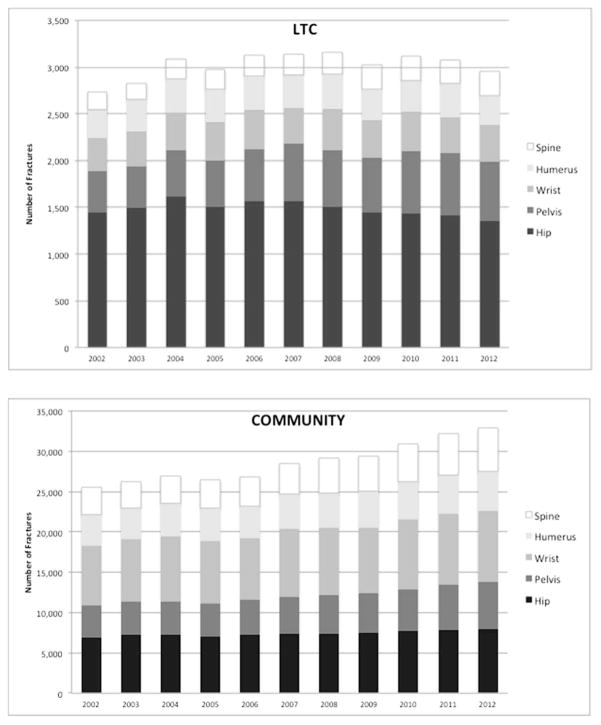
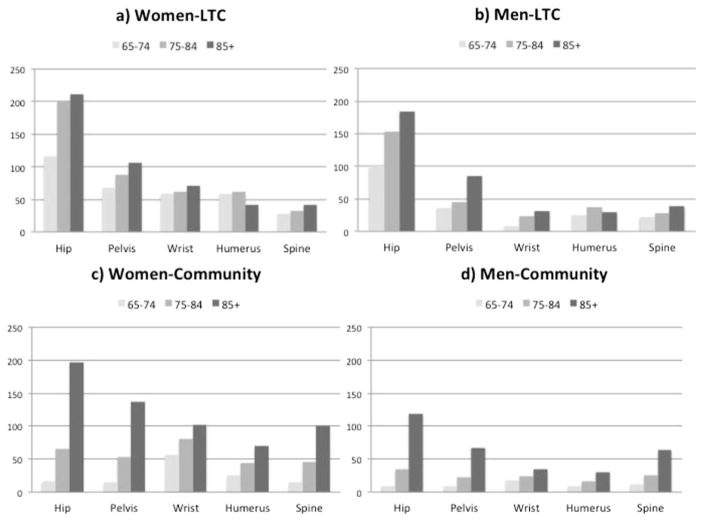
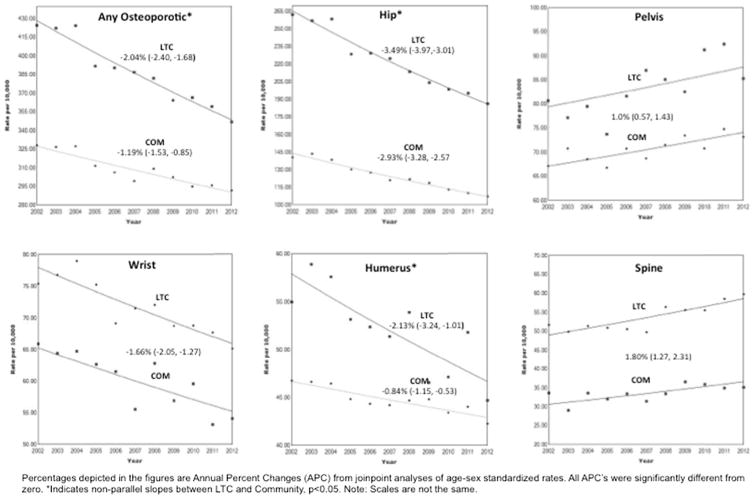
Results: Over 11 years, hip fracture rates had a marked decline occurring more rapidly in LTC (APC, -3.49 (95% confidence interval (CI), -3.97, -3.01)) compared with the community (APC, -2.93 (95% CI, -3.28, -2.57); p < 0.05 for difference in slopes). Humerus and wrist fracture rates decreased; however, an opposite trend occurred for pelvis and spine fractures with rates increasing over time in both cohorts (all APCs, p < 0.05). In 2012, incident hip fracture rates were higher in LTC than the community (RRs: women, 1.55 (95% CI, 1.45, 1.67); men, 2.18 (95% CI, 1.93, 2.47)). Higher rates of pelvis (RR, 1.48 (95% CI, 1.22, 1.80)) and humerus (RR, 1.40 (95% CI, 1.07, 1.84)) fractures were observed in LTC men, not women. In women, wrist (RR, 0.76 (95% CI, 0.71, 0.81)) and spine (RR, 0.52 (95% CI, 0.45, 0.61)) fracture rates were lower in LTC than the community; in men, spine (RR, 0.75 (95% CI, 0.57, 0.98) but not wrist fracture (RR, 0.91 (95% CI, 0.67, 1.23)) rates were significantly lower in LTC than the community.
Conclusion: Previous studies in the community have shown declining hip fracture rates over time, also demonstrated in our study but at a more rapid rate in LTC. Rates of humerus and wrist fractures also declined. An excess burden of fractures in LTC occurred for hip fractures in women and for hip, pelvis, and humerus fractures in men.
Keywords: Community-dwelling seniors; Incident fracture rates; Long-term care; Ontario.
Conflict of interest statement
Conflicts of interests Alexandra Papaioannou received grants/funds from Amgen, Eli Lilly, and Merck, a honoraria from Amgen and Eli Lilly, participated in a speaker forum for Amgen and Eli Lilly, and was a consultant for Amgen and Eli Lilly. Jonathan D. Adachi received grants/funds from Actavis, Amgen, Eli Lilly, Merck, and Novartis, a honoraria from Amgen, Eli Lilly, Merck, and Novartis, participated in a speaker forum for Amgen, Eli Lilly, Merck, and Novartis, acted as a consultant for Amgen, Eli Lilly, Merck, and Novartis, and is a board member for the International Osteoporosis Foundation. Courtney Kennedy, George Ioannidis, Cathy Cameron, Ruth Croxford, Sara Mursleen, and Susan Jaglal have no conflicts of interest to declare.
Figures
References
-
- Nguyen ND, Ahlborg HG, Center JR, Eisman JA, Nguyen TV. Residual lifetime risk of fractures in women and men. J Bone Miner Res. 2007;22:781–788. - PubMed
-
- Boonen S, Dejaeger E, Vanderschueren D, Venken K, Bogaerts A, Verschueren S, Milisen K. Osteoporosis and osteoporotic fracture occurrence and prevention in the elderly: a geriatric perspective. Best Pract Res Clin Endocrinol Metab. 2008;22:765–785. - PubMed
-
- van Staa TP, Leufkens HG, Cooper C. Does a fracture at one site predict later fractures at other sites? A British cohort study. Osteoporos Int. 2002;13:624–629. - PubMed
Publication types
MeSH terms
Grants and funding
LinkOut - more resources
Full Text Sources
Other Literature Sources
Medical
Miscellaneous
