


Serum Biomarkers Indicate Long-term Reduction in Liver Fibrosis in Patients With Sustained Virological Response to Treatment for HCV Infection
- PMID: 26804385
- PMCID: PMC5726250
- DOI: 10.1016/j.cgh.2016.01.009
Serum Biomarkers Indicate Long-term Reduction in Liver Fibrosis in Patients With Sustained Virological Response to Treatment for HCV Infection
Abstract
Background & aims: Sustained virological response (SVR) to antiviral therapy for hepatitis C virus (HCV) correlates with changes in biochemical measures of liver function. However, little is known about the long-term effects of SVR on liver fibrosis. We investigated the effects of HCV therapy on fibrosis, based on the Fibrosis-4 (FIB4) score, over a 10-year period.
Methods: We collected data from participants in the Chronic Hepatitis Cohort Study-a large observational multicenter study of patients with hepatitis at 4 US health systems-from January 1, 2006, through December 31, 2013. We calculated patients' FIB4 score and the aminotransferase-to-platelet ratio index (APRI) score over a 10-year period. Of 4731 patients with HCV infection, 1657 (35%) were treated and 755 (46%) of these patients achieved SVR.
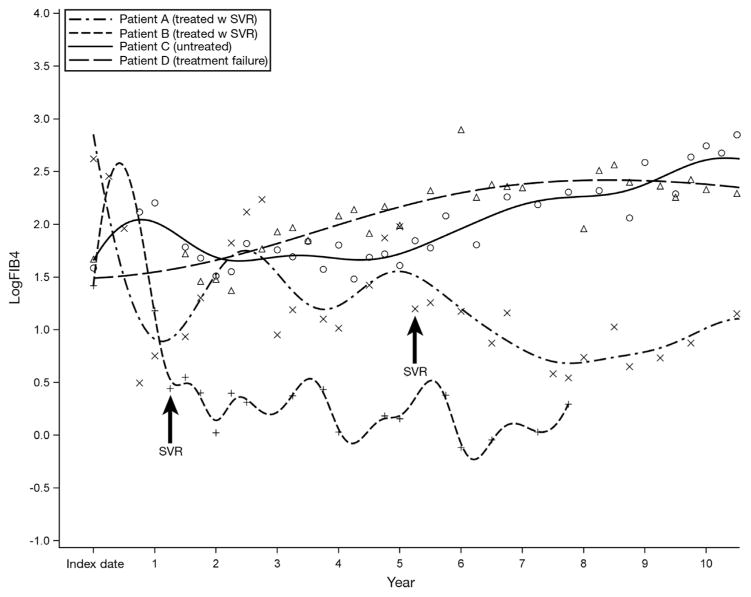
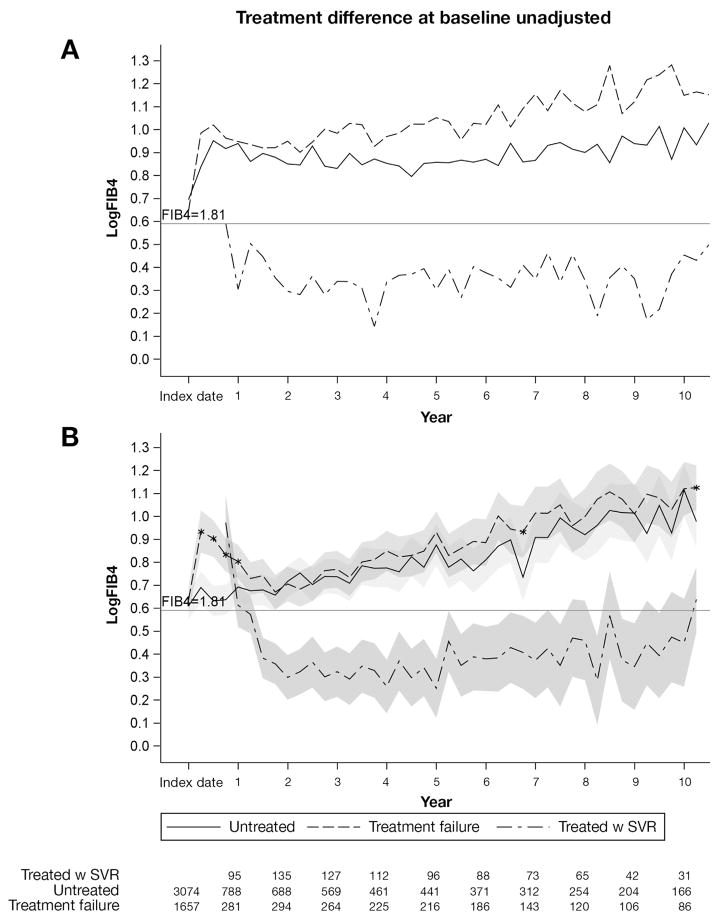
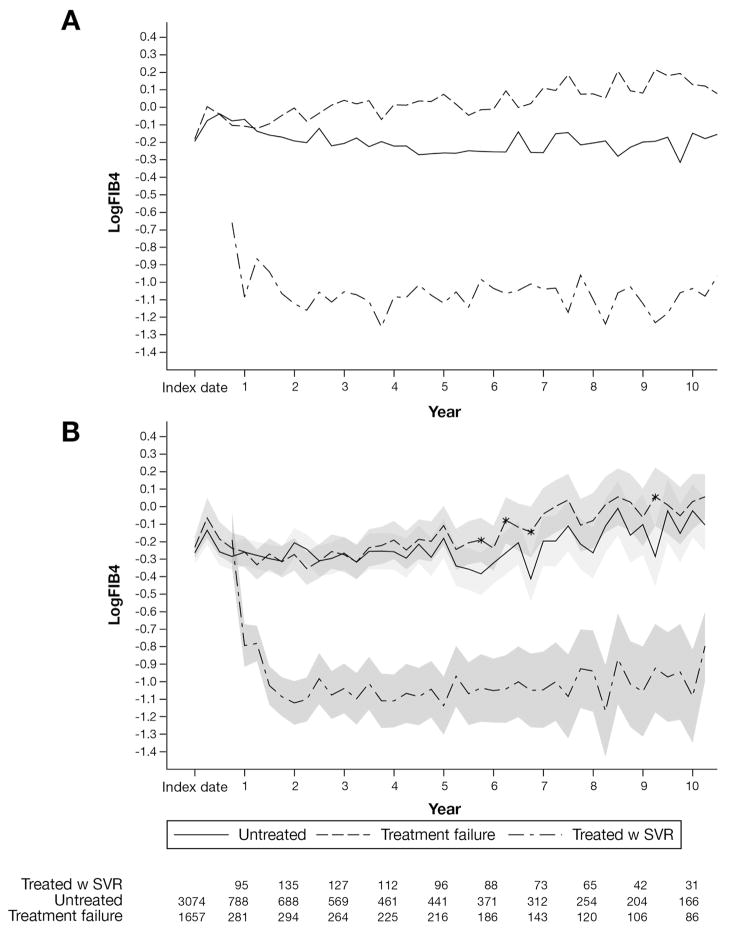
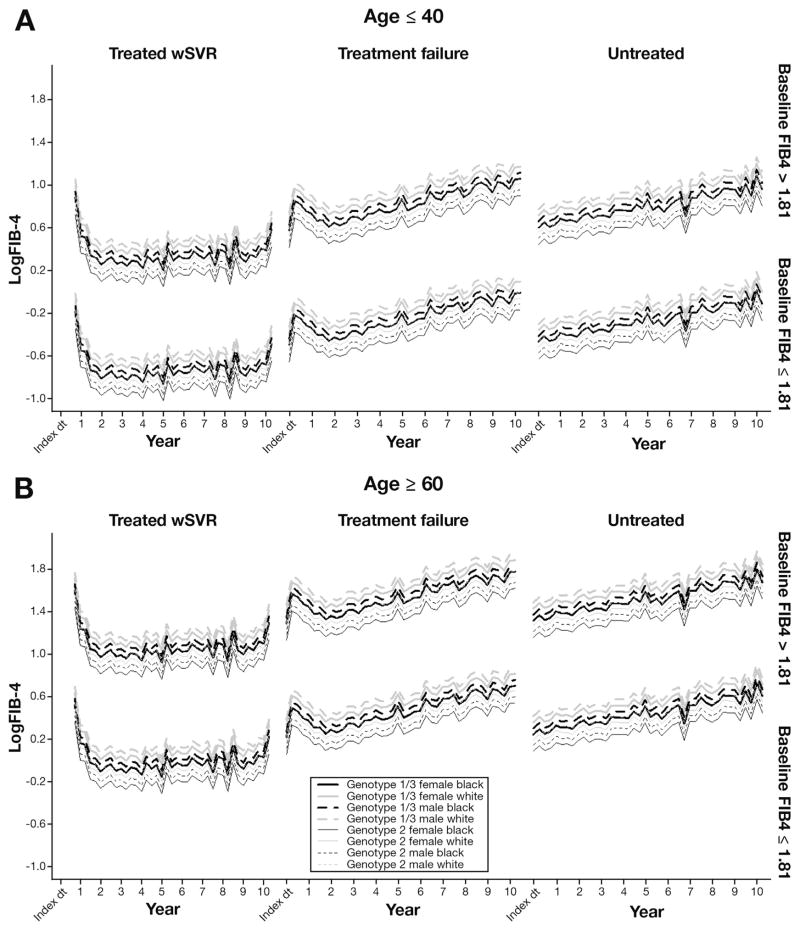
Results: In propensity score-adjusted analyses, we observed significant longitudinal changes in FIB4 score that varied with treatment and response to treatment. In patients achieving SVR, FIB4 scores decreased sharply, remaining significantly lower over the 10-year period than in untreated patients or patients with treatment failure (P < .001). In independent analyses, men and patients with HCV genotype 1 or 3 infections had higher FIB4 scores than women or patients with HCV genotype 2 infections (P < .01 for both). Findings were similar in a sensitivity analysis that substituted the APRI as the marker of fibrosis instead of the FIB4 score.
Conclusions: SVR to HCV treatment appears to induce long-term regression of fibrosis based on FIB4 scores collected over 10 years from a large observational study of US hepatitis patients. Patients receiving no treatment or with treatment failure had progressive increases in FIB4 scores.
Keywords: CHeCS; Fibrosis Progression; Growth Curve Analysis of Trajectory; Outcome.
Copyright © 2016 AGA Institute. Published by Elsevier Inc. All rights reserved.
Conflict of interest statement
This author discloses the following: Stuart C. Gordon receives grant/research support from AbbVie Pharmaceuticals, Bristol-Myers Squibb, Gilead Pharmaceuticals, Intercept Pharmaceuticals, and Merck, and is a consultant/advisor for AbbVie Pharmaceuticals, Amgen, Bristol-Myers Squibb, CVS Caremark, Gilead Pharmaceuticals, and Merck, and is on the Data Monitoring Board for Tibotec/ Janssen Pharmaceuticals. The remaining authors disclose no conflicts.
Figures
References
-
- D'Ambrosio R, Aghemo A, Rumi MG, et al. A morphometric and immunohistochemical study to assess the benefit of a sustained virological response in hepatitis C virus patients with cirrhosis. Hepatology. 2012;56:532–543. - PubMed
-
- Mallet V, Gilgenkrantz H, Serpaggi J, et al. Brief communication: the relationship of regression of cirrhosis to outcome in chronic hepatitis C. Ann Intern Med. 2008;149:399–403. - PubMed
-
- Pockros PJ, Hamzeh FM, Martin P, et al. Histologic outcomes in hepatitis C-infected patients with varying degrees of virologic response to interferon-based treatments. Hepatology. 2010;52:1193–1200. - PubMed
-
- Poynard T, McHutchison J, Manns M, et al. Impact of pegylated interferon alfa-2b and ribavirin on liver fibrosis in patients with chronic hepatitis C. Gastroenterology. 2002;122:1303–1313. - PubMed
Publication types
MeSH terms
Substances
Grants and funding
LinkOut - more resources
Full Text Sources
Other Literature Sources
Medical
