


Hypovitaminosis D in bariatric surgery: A systematic review of observational studies
- PMID: 26805016
- PMCID: PMC4792683
- DOI: 10.1016/j.metabol.2015.12.004
Hypovitaminosis D in bariatric surgery: A systematic review of observational studies
Abstract
Background: Obesity is a public health problem that carries global and substantial social and economic burden. Relative to non-surgical interventions, bariatric surgery has the most substantial and lasting impact on weight loss. However, it leads to a number of nutritional deficiencies requiring long term supplementation.
Objectives: The aims of this paper are to review 25-hydroxyvitamin D [25(OH)D] status pre and post bariatric surgery, describe the dose response of vitamin D supplementation, and assess the effect of the surgical procedure on 25(OH)D level following supplementation.
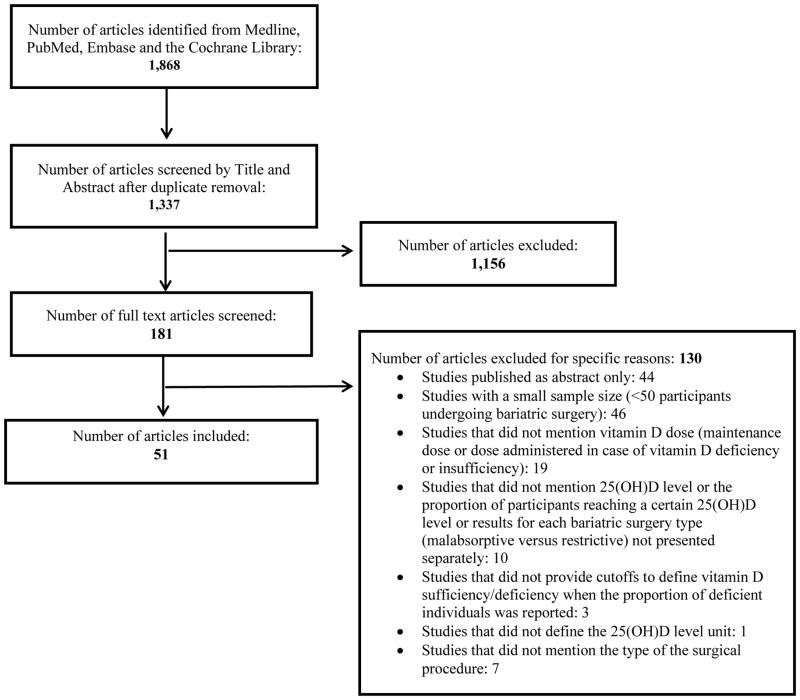
Methods: We searched Medline, PubMed, the Cochrane Library and EMBASE, for relevant observational studies published in English, from 2000 to April 2015. The identified references were reviewed, in duplicate and independently, by two reviewers.
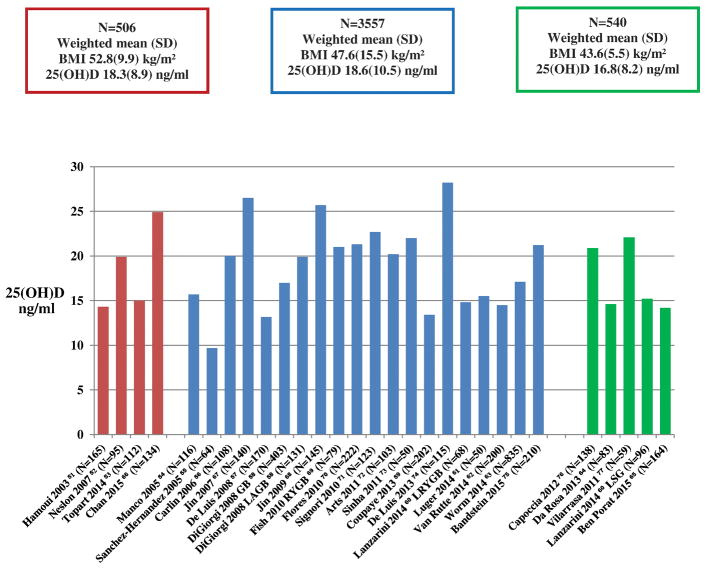
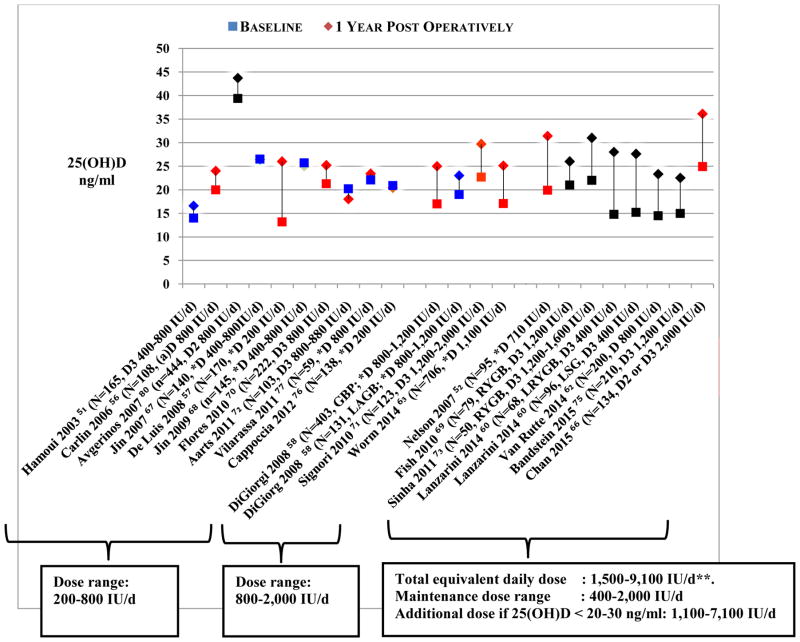
Results: We identified 51 eligible observational studies assessing 25(OH)D status pre and/or post bariatric surgery. Mean pre-surgery 25(OH)D level was below 30ng/ml in 29 studies, and 17 of these studies showed mean 25(OH)D levels ≤20ng/ml. Mean 25(OH)D levels remained below 30ng/ml following bariatric surgery, despite various vitamin D replacement regimens, with only few exceptions. The increase in post-operative 25(OH)D levels tended to parallel increments in vitamin D supplementation dose but varied widely across studies. An increase in 25(OH)D level by 9-13ng/ml was achieved when vitamin D deficiency was corrected using vitamin D replacement doses of 1100-7100IU/day, in addition to the usual maintenance equivalent daily dose of 400-2000IU (total equivalent daily dose 1500-9100IU). There was no difference in mean 25(OH)D level following supplementation between malabsorptive/combination procedures and restrictive procedures.
Conclusion: Hypovitaminosisis D persists in obese patients undergoing bariatric surgery, despite various vitamin D supplementation regimens. Further research is needed to determine the optimal vitamin D dose to reach desirable 25(OH)D levels in this population, and to demonstrate whether this dose varies according to the surgical procedure.
Keywords: Bariatric surgery; Obesity; Predictor; Vitamin D deficiency; Vitamin D dose.
Copyright © 2016 Elsevier Inc. All rights reserved.
Conflict of interest statement
The authors declare no conflict of interest.
Figures
References
-
- [Accessed in October 2015];WHO website. Available from: http://www.who.int/gho/ncd/risk_factors/obesity_text/en/
-
- Flegal KM, Carroll MD, Kit BK, Ogden CL. Prevalence of obesity and trends in the distribution of body mass index among US adults, 1999–2010. JAMA. 2012;307(5):491–7. - PubMed
-
- Flegal KM, Carroll MD, Ogden CL, Johnson CL. Prevalence and trends in obesity among US adults, 1999–2000. JAMA. 2002;288(14):1723–7. - PubMed
Publication types
MeSH terms
Substances
Grants and funding
LinkOut - more resources
Full Text Sources
Other Literature Sources
Medical
Miscellaneous
