


Whole-genome sequencing of the endangered bovine species Gayal (Bos frontalis) provides new insights into its genetic features
- PMID: 26806430
- PMCID: PMC4726396
- DOI: 10.1038/srep19787
Whole-genome sequencing of the endangered bovine species Gayal (Bos frontalis) provides new insights into its genetic features
Abstract
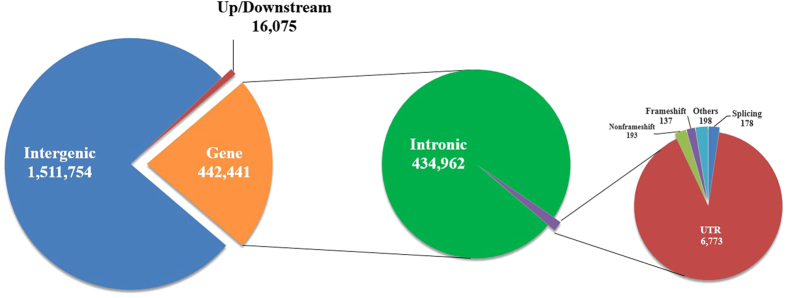
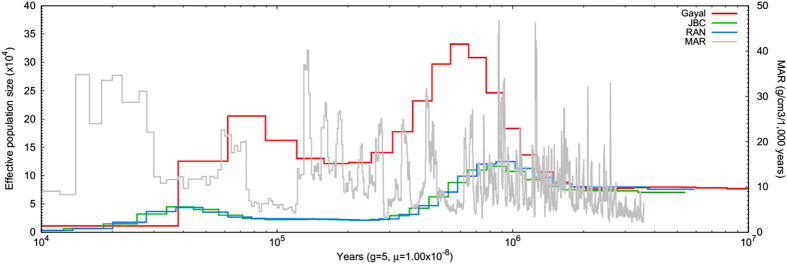
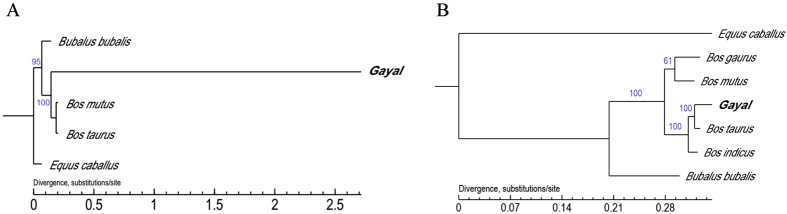
Gayal (Bos frontalis) is a semi-wild and endangered bovine species that differs from domestic cattle (Bos taurus and Bos indicus), and its genetic background remains unclear. Here, we performed whole-genome sequencing of one Gayal for the first time, with one Red Angus cattle and one Japanese Black cattle as controls. In total, 97.8 Gb of sequencing reads were generated with an average 11.78-fold depth and >98.44% coverage of the reference sequence (UMD3.1). Numerous different variations were identified, 62.24% of the total single nucleotide polymorphisms (SNPs) detected in Gayal were novel, and 16,901 breed-specific nonsynonymous SNPs (BS-nsSNPs) that might be associated with traits of interest in Gayal were further investigated. Moreover, the demographic history of bovine species was first analyzed, and two population expansions and two population bottlenecks were identified. The obvious differences among their population sizes supported that Gayal was not B. taurus. The phylogenic analysis suggested that Gayal was a hybrid descendant from crossing of male wild gaur and female domestic cattle. These discoveries will provide valuable genomic information regarding potential genomic markers that could predict traits of interest for breeding programs of these cattle breeds and may assist relevant departments with future conservation and utilization of Gayal.
Figures
References
-
- Mondal M., Dhali A., Rajkhowa C. & Prakash B. S. Secretion patterns of growth hormone in growing captive mithuns (Bos frontalis). Zool. Sci. 21, 1125–1129 (2004). - PubMed
-
- Qu K. X. et al.. Karyotype analysis of mithun (Bos frontalis) and mithun bull x Brahman cow hybrids. Genet. Mol. Res. 11, 131–140 (2012). - PubMed
-
- Chi J. et al.. New insights into the karyotypic relationships of Chinese muntjac (Muntiacus reevesi), forest musk deer (Moschus berezovskii) and gayal (Bos frontalis). Cytogenet. Genome Res. 108, 310–316 (2005). - PubMed
-
- Dongmei X. et al.. Polymorphisms of the insulin-like growth factor-binding protein 3 gene (IGFBP3) in gayal (Bos frontalis). Gene 497, 98–102 (2012). - PubMed
-
- Shan X. N. et al.. The karyotype analysis of gayal. Hereditas 2, 25–27 (1980).
Publication types
MeSH terms
LinkOut - more resources
Full Text Sources
Other Literature Sources
