


Phylogeographic analysis of severe fever with thrombocytopenia syndrome virus from Zhoushan Islands, China: implication for transmission across the ocean
- PMID: 26806841
- PMCID: PMC4726339
- DOI: 10.1038/srep19563
Phylogeographic analysis of severe fever with thrombocytopenia syndrome virus from Zhoushan Islands, China: implication for transmission across the ocean
Abstract
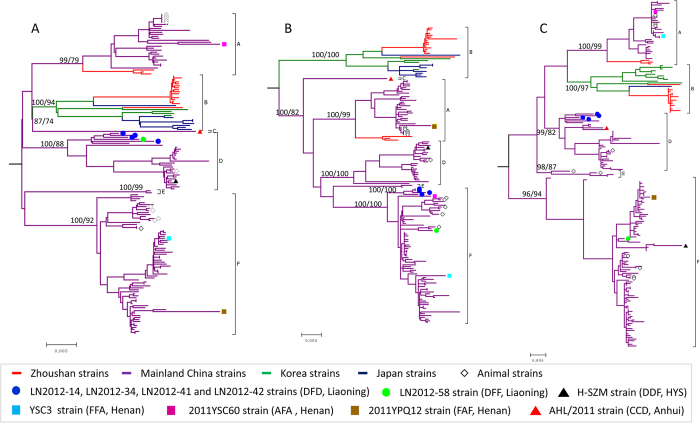
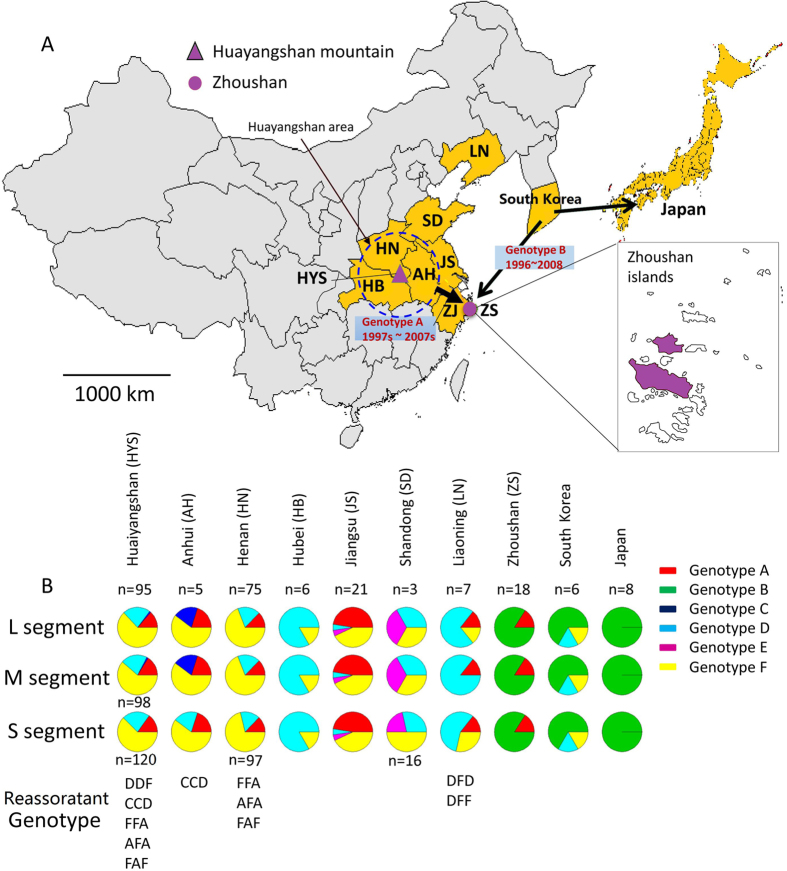
From June 2011 to August 2014, 21 cases of infection by severe fever with thrombocytopenia syndrome bunyavirus (SFTSV) were confirmed in Zhoushan Islands in the Eastern coast of China. To identify the source of SFTSV in Zhoushan Islands, the whole SFTSV genomes were amplified and sequenced from 17 of 21 patients. The L, M, and S genomic segments of these SFTSV strains were phylogenetically analyzed together with those of 188 SFTSV strains available from GenBank. Phylogenetic analysis demonstrated SFTSV could be classified into six genotypes. The genotypes F, A, and D were dominant in mainland China. Additionally, seven types of SFTSV genetic reassortants (abbreviated as AFA, CCD, DDF, DFD, DFF, FAF, and FFA for the L, M and S segments) were identified from 10 strains in mainland China. Genotype B was dominant in Zhoushan Islands, Japan and South Korea, but not found in mainland China. Phylogeographic analysis also revealed South Korea possible be the origin area for genotype B and transmitted into Japan and Zhoushan islands in the later part of 20(th) century. Therefore, we propose that genotype B isolates were probable transmitted from South Korea to Japan and Zhoushan Islands.
Figures
References
-
- Zhang Y. Z. et al. Hemorrhagic fever caused by a novel tick-borne Bunyavirus in Huaiyangshan, China. Zhonghua Liu Xing Bing Xue Za Zhi. 32, 209–220 (2011). - PubMed
-
- Zhang Y. Z. et al. Hemorrhagic fever caused by a novel Bunyavirus in China: pathogenesis and correlates of fatal outcome. Clin Infect Dis. 54, 527–533 (2012). - PubMed
-
- Liu Y. et al. Person-to-person transmission of severe fever with thrombocytopenia syndrome virus. Vector Borne Zoonotic Dis. 12, 156–160 (2012). - PubMed
Publication types
MeSH terms
LinkOut - more resources
Full Text Sources
Other Literature Sources
