


Is Long-Term Low-Dose Aspirin Therapy Associated with Renal Dysfunction in Patients with Type 2 Diabetes? JPAD2 Cohort Study
- PMID: 26808136
- PMCID: PMC4726501
- DOI: 10.1371/journal.pone.0147635
Is Long-Term Low-Dose Aspirin Therapy Associated with Renal Dysfunction in Patients with Type 2 Diabetes? JPAD2 Cohort Study
Abstract
Background: Low-dose aspirin is widely recommended for patients at high risk for cardiovascular disease (CVD); however, it remains uncertain whether long-term treatment adversely affects renal function in patients with diabetes. We investigated whether long-term low-dose aspirin affects renal dysfunction in patients with diabetes.
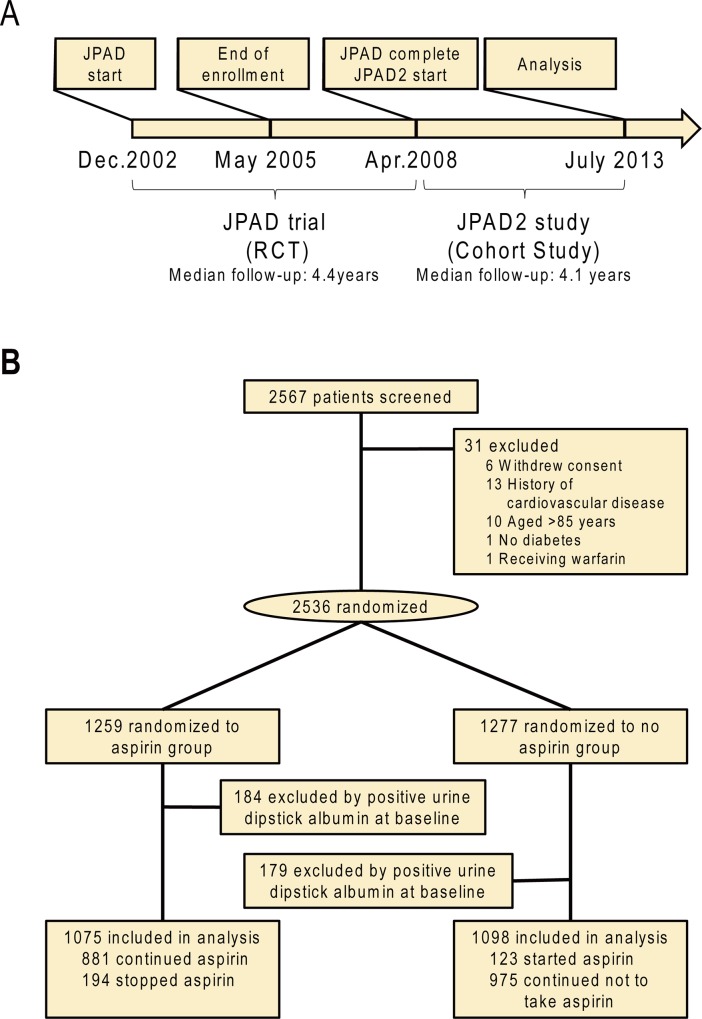
Methods: We conducted a randomized controlled trial (RCT), the Japanese Primary Prevention of Atherosclerosis with Aspirin for Diabetes (JPAD) trial, to evaluate low-dose aspirin as primary prevention for CVD in patients with type 2 diabetes. We followed the patients with negative urine dipstick albumin of the JPAD trial in a cohort study after the RCT period was completed. Patients were randomly allocated to receive aspirin (81 mg or 100 mg daily, aspirin group) or no aspirin (no aspirin group). After the RCT, the treating physician decided whether to administer aspirin. We evaluated the incidence of positive urine dipstick albumin and annual changes in estimated glomerular filtration rate (eGFR).
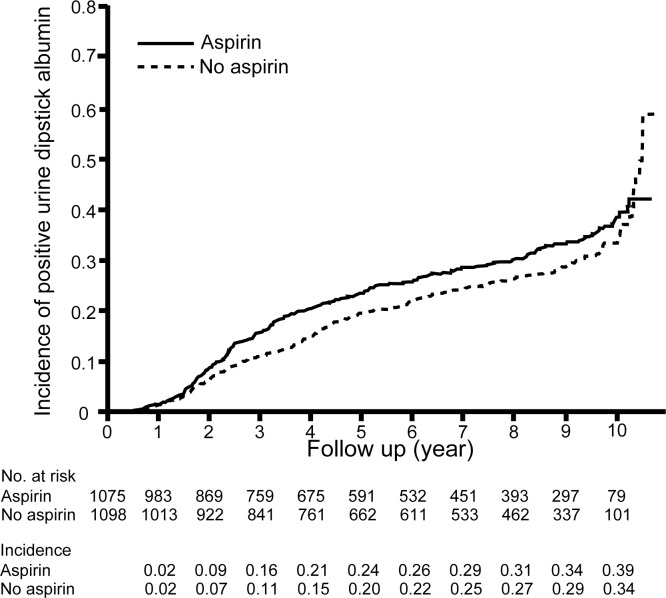
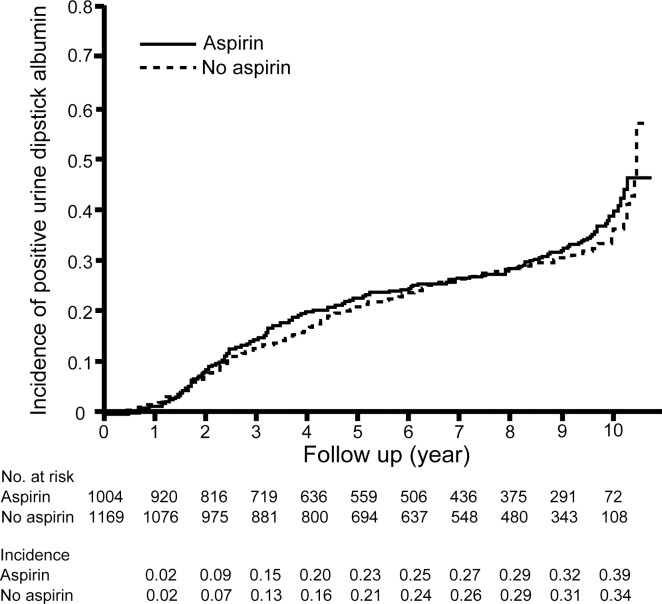
Results: Positive urine dipstick albumin developed in 297 patients in the aspirin group (n = 1,075) and 270 patients in the no aspirin group (n = 1,098) during follow-up (median, 8.5 years). Intention-to-treat analysis showed low-dose aspirin did not increase the incidence of positive urine dipstick albumin (hazard ratio [HR], 1.17; 95% confidence interval [CI], 0.995-1.38). On-treatment analysis yielded similar results (HR, 1.08; 95% CI, 0.92-1.28). Multivariable analysis showed the incidence of positive urine dipstick albumin was higher among the elderly and those with elevated serum creatinine, high hemoglobin A1c, or high blood pressure; however, low-dose aspirin did not increase the risk of positive urine dipstick albumin. There were no significant differences in annual changes in eGFR between the groups (aspirin, -0.8 ± 2.9; no aspirin, -0.9 ± 2.5 ml/min/1.73 m(2)/year).
Conclusion: Long-term low-dose aspirin does not affect eGFR and positive urine dipstick albumin in patients with type 2 diabetes.
Conflict of interest statement
Figures
References
-
- Antithrombotic Trialists C, Baigent C, Blackwell L, Collins R, Emberson J, Godwin J, et al. Aspirin in the primary and secondary prevention of vascular disease: collaborative meta-analysis of individual participant data from randomised trials. Lancet. 2009;373(9678):1849–60. 10.1016/S0140-6736(09)60503-1 - DOI - PMC - PubMed
-
- Suleyman H, Demircan B, Karagoz Y. Anti-inflammatory and side effects of cyclooxygenase inhibitors. Pharmacol Rep. 2007;59(3):247–58. - PubMed
-
- Fored CM, Ejerblad E, Lindblad P, Fryzek JP, Dickman PW, Signorello LB, et al. Acetaminophen, aspirin, and chronic renal failure. The New England journal of medicine. 2001;345(25):1801–8. - PubMed
-
- Ibanez L, Morlans M, Vidal X, Martinez MJ, Laporte JR. Case-control study of regular analgesic and nonsteroidal anti-inflammatory use and end-stage renal disease. Kidney international. 2005;67(6):2393–8. - PubMed
Publication types
MeSH terms
Substances
LinkOut - more resources
Full Text Sources
Other Literature Sources
Medical
Research Materials
Miscellaneous
