. 2016 Apr:278:22-6.
doi: 10.1016/j.expneurol.2016.01.017. Epub 2016 Jan 22.

Respiratory outcomes after mid-cervical transplantation of embryonic medullary cells in rats with cervical spinal cord injury

Affiliations

Respiratory outcomes after mid-cervical transplantation of embryonic medullary cells in rats with cervical spinal cord injury

B J Dougherty et al. Exp Neurol. 2016 Apr.

Abstract

Respiratory motor output after cervical spinal cord injury (cSCI) is profoundly influenced by spinal serotonin. We hypothesized that intraspinal transplantation of embryonic midline brainstem (MB) cells rich in serotonergic raphé neurons would improve respiratory outcomes after cSCI. One week after hemisection of the 2nd cervical segment (C2Hx) a suspension of either embryonic (E14) MB cells, fetal spinal cord cells (FSC), or media only (sham) was delivered to the dorsal C3 spinal cord of adult male rats. Six weeks later, ventilation was evaluated using plethysmography; phrenic nerve activity was evaluated in a subset of rats. Seven of 12 rats receiving MB-derived grafts had clear histological evidence of serotonin-positive neurons in the C3-4 dorsal white matter. The transplantations had no impact on baseline breathing patterns, but during a brief respiratory challenge (7% inspired CO2) rats with successful MB grafts had increased ventilation compared to rats with failed MB grafts, FSC or sham grafts. Recordings from the phrenic nerve ipsilateral to C2Hx also indicated increased output during respiratory challenge in rats with successful MB grafts. We conclude that intraspinal allografting of E14 MB cells can have a positive impact on respiratory motor recovery following high cSCI.

Keywords: Phrenic; Plasticity; Respiratory; Serotonin; Spinal cord injury.


Figures

Figure 1
Figure 1
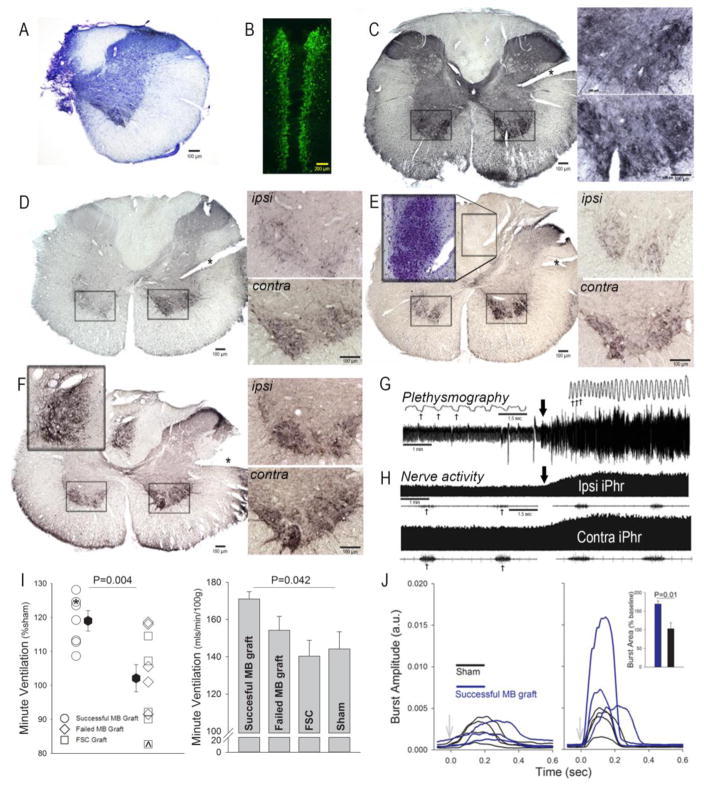
A: Transverse histological section through C2 spinal cord following chronic C2Hx (cresyl violet stain). B: Coronal section of the E14 midline brainstem (MB) following incubation with 5-HT antibodies (fluorescent secondary antibody). The image shows the area extending from the pontine flexure (rostral) to the rostral cervical spinal cord (caudal). Panels C–F show transverse C3 spinal cord sections incubated with antibodies against 5-HT with a nickel-enhanced DAB reaction. In these panels, an * is placed over the “score” in the tissue denoting the side contralateral (contra) to C2Hx. The ipsilateral (ipsi) and contra ventral horns (boxed areas) are depicted at higher magnification to the right of whole spinal cord sections. C: Section from a spinal-intact rat; note the bilaterally uniform 5-HT immunostaining. D: Section from a sham treated C2Hx rat; note the marked reduction of 5-HT immunostaining in the ipsilateral cord. E: C3 section from a rat which received an E14 FSC cell suspension; the lesion from this animal is depicted in panel A. The inset panel from the midline dorsal spinal cord depicts cresyl violet stained neurons in the adjacent spinal cord serial section (40 μm cuts). The inset clearly shows the location of the FSC transplant. F: Section from C2Hx rat which received an E14 MB cell suspension. The inset panel from the midline dorsal spinal cord depicts the MB graft at a higher magnification. G: Representative airflow traces obtained using whole body plethysmography. Baseline data were recorded during quiet breathing, and this was followed by a brief hypercapnic challenge (7% inspired CO2; onset indicated by the thick arrow). The top traces show an expanded time scale so that single respiratory efforts can be clearly observed (example breaths indicated by the thin arrows). H: Representative recordings of phrenic nerve activity ipsilateral (Ipsi) and contralateral (Contra) to a C2Hx lesion. A compressed record of the integrated phrenic activity (iPhr) during baseline and hypercapnic challenge is shown in the top traces (onset indicated by the thick arrow). The bottom traces show an expanded time scale of the raw burst depicting a few individual inspiratory efforts (thin arrows). I: Minute ventilation during the respiratory challenge. In the first graph, data are expressed relative to breathing in the sham group (%sham). The individual data point marked by ^ is from the animal with histology depicted in Panel E; the individual data point marked by * was obtained from the animal with histology depicted in Panel F. The second graph is a histogram depicting minute ventilation expressed relative to body mass (mls/min100g) in animals with successful or failed MB grafts, and also FSC or sham transplant. One-way ANOVA indicated a difference in breathing across these groups, with successful MB grafts having the highest value. J: Waveform averages of integrated phrenic activity recorded ipsilateral to injury during baseline (left panel) and respiratory challenge (right panel). On average the increase in burst area was greater in rats with successful MB graft compared to sham treatment (inset panel). With the exception of Panel B, all data presented in Figure 1 were obtained at 6 weeks following the transplantation procedures (i.e., 7 weeks post-C2Hx injury).

References

    1. Dale EA, Ben Mabrouk F, Mitchell GS. Unexpected benefits of intermittent hypoxia: enhanced respiratory and nonrespiratory motor function. Physiology. 2014;29:39–48. - PMC - PubMed
    1. Eaton MJ, Pearse DD, McBroom JS, Berrocal YA. The combination of human neuronal serotonergic cell implants and environmental enrichment after contusive SCI improves motor recovery over each individual strategy. Behavioural brain research. 2008;194:236–241. - PubMed
    1. Feraboli-Lohnherr D, Orsal D, Yakovleff A, Gimenez y Ribotta M, Privat A. Recovery of locomotor activity in the adult chronic spinal rat after sublesional transplantation of embryonic nervous cells: specific role of serotonergic neurons. Exp Brain Res. 1997;113:443–454. - PubMed
    1. Fuller DD, Doperalski NJ, Dougherty BJ, Sandhu MS, Bolser DC, Reier PJ. Modest spontaneous recovery of ventilation following chronic high cervical hemisection in rats. Experimental neurology. 2008;211:97–106. - PMC - PubMed
    1. Golder FJ, Mitchell GS. Spinal synaptic enhancement with acute intermittent hypoxia improves respiratory function after chronic cervical spinal cord injury. Journal of Neuroscience. 2005;25:2925–2932. - PMC - PubMed

Publication types