


Project Energize: intervention development and 10 years of progress in preventing childhood obesity
- PMID: 26809555
- PMCID: PMC4727351
- DOI: 10.1186/s13104-016-1849-1
Project Energize: intervention development and 10 years of progress in preventing childhood obesity
Abstract
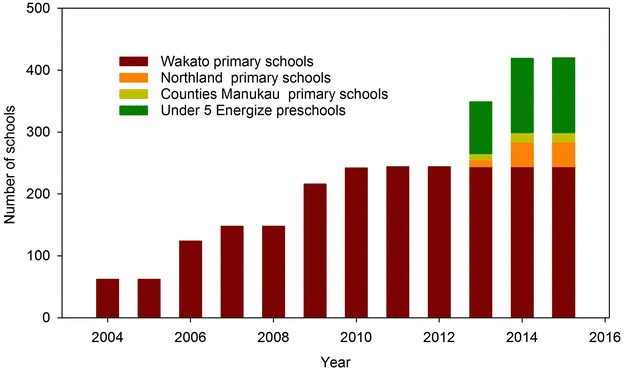
Prevention of childhood obesity is a global priority. The school setting offers access to large numbers of children and the ability to provide supportive environments for quality physical activity and nutrition. This article describes Project Energize, a through-school physical activity and nutrition programme that celebrated its 10-year anniversary in 2015 so that it might serve as a model for similar practices, initiatives and policies elsewhere. The programme was envisaged and financed by the Waikato District Health Board of New Zealand in 2004 and delivered by Sport Waikato to 124 primary schools as a randomised controlled trial from 2005 to 2006. The programme has since expanded to include all 242 primary schools in the Waikato region and 70 schools in other regions, including 53,000 children. Ongoing evaluation and development of Project Energize has shown it to be sustainable (ongoing for >10 years), both effective (lower obesity, higher physical fitness) and cost effective (one health related cost quality adjusted life year between $18,000 and $30,000) and efficient ($45/child/year) as a childhood 'health' programme. The programme's unique community-based approach is inclusive of all children, serving a population that is 42% Māori, the indigenous people of New Zealand. While the original nine healthy eating and seven quality physical activity goals have not changed, the delivery and assessment processes has been refined and the health service adapted over the 10 years of the programme existence, as well as adapted over time to other settings including early childhood education and schools in Cork in Ireland. Evaluation and research associated with the programme delivery and outcomes are ongoing. The dissemination of findings to politicians and collaboration with other service providers are both regarded as priorities.
Figures
References
-
- United Nations General Assembly. Political declaration of the high-level meeting of the general assembly on the prevention and control of non-communicable diseases, vol. A/66/L.1. New York: 2011.
-
- World Health Organisation . Global action plan for the prevention and control of non-communicable diseases 2013–2020. Geneva: World Health Organisation; 2013.
-
- Roberto CA, Swinburn B, Hawkes C, Huang TT, Costa SA, Ashe M, Zwicker L, Cawley JH, Brownell KD: Patchy progress on obesity prevention: emerging examples, entrenched barriers, and new thinking. Lancet. 2015. - PubMed
-
- Waters E, de Silva-Sanigorski A, Hall BJ, Brown T, Campbell KJ, Gao Y, Armstrong R, Prosser L, Summerbell CD. Interventions for preventing obesity in children. Cochrane Database Syst Rev. 2011;(12):CD001871. doi:10.1002/14651858.CD001871.pub3. - PubMed
Publication types
MeSH terms
LinkOut - more resources
Full Text Sources
Other Literature Sources
Medical
