


Diagnosis of late-onset Pompe disease and other muscle disorders by next-generation sequencing
- PMID: 26809617
- PMCID: PMC4727295
- DOI: 10.1186/s13023-016-0390-6
Diagnosis of late-onset Pompe disease and other muscle disorders by next-generation sequencing
Abstract
Background: Late-onset Pompe disease (LOPD) is a rare treatable lysosomal storage disorder characterized by progressive lysosomal glycogen accumulation and muscle weakness, with often a limb-girdle pattern. Despite published guidelines, testing for LOPD is often overlooked or delayed in adults, owing to its low frequency compared to other muscle disorders with similar muscle patterns. Next-generation sequencing has the capability to test concurrently for several muscle disorders. This could potentially lead to increased diagnosis of LOPD, disorders with non-specific muscle weakness or atypical patients.
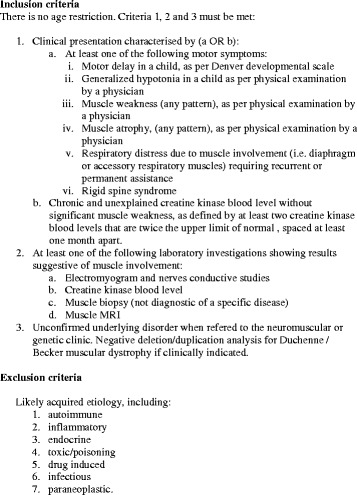
Methods: We developed a gene panel to further study its clinical utility in a cohort of patients with suspected muscle disorders. We designed a gene panel to analyze the coding sequences and splice site junctions of GAA causing LOPD, along with 77 other genes causing muscle disorders with overlapping phenotypes.
Results: At a median coverage of ~200X (sequences per base), all GAA exons were successfully covered with >20X and only 0.3 % of exons across all genes were <20X. The panel showed an excellent sensitivity (100 %) and specificity (98 %) across all selected genes, using known variations in Pompe patients and controls. We determined its clinical utility by analyzing 34 patients with suspected muscle disorders of undetermined etiology and various muscle patterns, who were referred or followed in neuromuscular and genetics clinics. A putative diagnosis was found in up to 32 % of patients. The gene panel was instrumental in reaching a diagnosis in atypical patients, including one LOPD case. Acid alpha-glucosidase activity was used to confirm the molecular results in all patients.
Conclusion: This work highlights the high clinical utility of gene panels in patients with suspected muscle disorders and its potential to facilitate the diagnosis of patients showing non-specific muscle weakness or atypical phenotypes. We propose that gene panels should be used as a first-tier test in patients with suspected muscle disorders of undetermined etiology, which could further increase overall diagnosis of muscle conditions, and potentially reduce diagnostic delay. Further studies are necessary to determine the impact of first-tier gene panels on diagnostic delay and on treatment outcome for LOPD.
References
Publication types
MeSH terms
LinkOut - more resources
Full Text Sources
Other Literature Sources
Medical
Miscellaneous
