


Ultrasound-guided nerve blocks for intracapsular and extracapsular hip fractures
- PMID: 26809928
- PMCID: PMC4799725
- DOI: 10.1016/j.ajem.2015.12.016
Ultrasound-guided nerve blocks for intracapsular and extracapsular hip fractures
Abstract
Objectives: To compare pain relief between patients with intracapsular and extracapsular hip fractures who received an ultrasound-guided femoral nerve block (USFNB).
Design: A multicenter, prospective, randomized, clinical trial.
Setting: The study was conducted in the emergency departments of 3 academic hospitals located in New York City.
Subjects: Patients aged ≥60 years presenting to the emergency department with hip fracture.
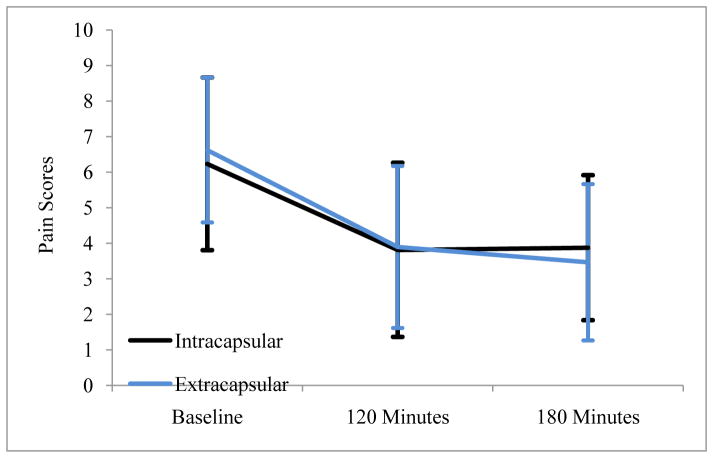
Methods: A subgroup analysis from a larger data set was conducted of patients with intracapsular and extracapsular hip fractures who received an USFNB. We compared pain scores at baseline and then at 2 and 3 hours after the nerve block was performed, and also assessed pain relief at 2 and 3 hours.
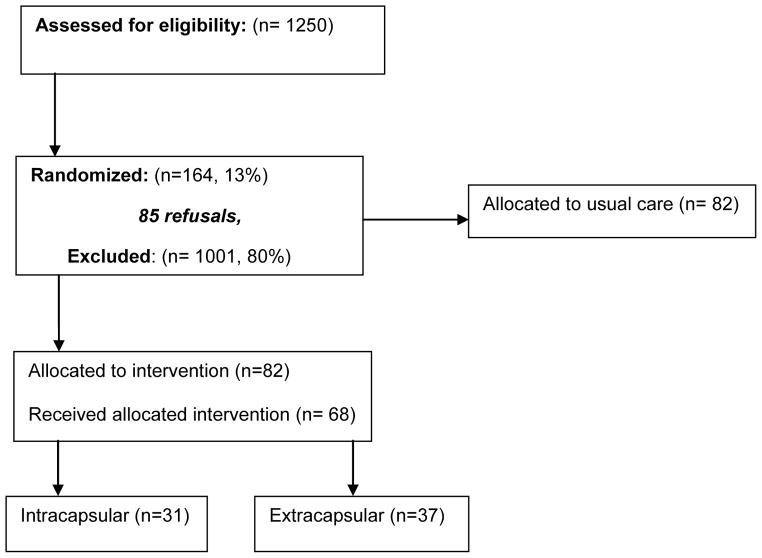
Results: Seventy-seven patients were randomized to receive USFNB, of which 68 had follow-up data at 2 and 3 hours and were included in the data analysis. Thirty-one were diagnosed with intracapsular and 37 with extracapsular hip fractures. In both groups, reductions in pain scores were clinically and statistically significant. In the intracapsular group, mean pain scores decreased from 6.23 to 3.81 (P < .0001) at 2 hours and from 6.23 to 3.87 (P < .0001) at 3 hours. In the extracapsular group, mean pain scores decreased from 6.62 to 3.89 (P < .0001) at 2 hours and from 6.62 to 3.46 (P < .0001) at 3 hours. These differences were similar between the extracapsular and intracapsular groups at 2 hours (P = .92) and at 3 hours (P = .58), thus demonstrating similar reductions in pain in the 2 groups. The differences in pain relief between the intracapsular and extracapsular groups were also similar: 1.61 (confidence interval [CI], 1.14-2.08) vs 1.35 (CI, 0.96-1.75) at 2 hours (P = .39) and 1.68 (CI, 1.21-2.15) vs 1.38 (CI, 0.89-1.87) at 3 hours (P = .38).
Conclusion: Ultrasound-guided femoral nerve block was equally effective in reducing pain for patients with both intracapsular and extracapsular hip fractures.
Published by Elsevier Inc.
Figures

References
-
- Roberts HC, Eastwood H. Pain and its control in patients with fractures of the femoral neck while awaiting surgery. Injury. 1994;25:237–9. - PubMed
-
- Layzell MJ. Use of femoral nerve blocks in adults with hip fractures. Nursing Standard. 2013;27:49–56. - PubMed
-
- Morrison RS, Magaziner J, Gilbert M, Koval KJ, McLaughlin MA, Orosz G, Strauss E, Siu AL. Relationship between pain and opioid analgesics on the development of delirium following hip fracture. J Gerontol A: Biol Med Sci. 2003;58:M76–M81. - PubMed
-
- Marcantonio ER, Flacker JM, Michaels M, et al. Delirium is independently associated with poor functional recovery after hip fracture. J Am Geriatr Soc. 2000;48:618–624. - PubMed
Publication types
MeSH terms
Substances
Grants and funding
LinkOut - more resources
Full Text Sources
Other Literature Sources
Medical
