


Impact of a Mobile Phone Intervention to Reduce Sedentary Behavior in a Community Sample of Adults: A Quasi-Experimental Evaluation
- PMID: 26810027
- PMCID: PMC4746437
- DOI: 10.2196/jmir.5137
Impact of a Mobile Phone Intervention to Reduce Sedentary Behavior in a Community Sample of Adults: A Quasi-Experimental Evaluation
Abstract
Background: Greater time spent sedentary is linked with increased risk of breast, colorectal, ovarian, endometrial, and prostate cancers. Given steadily increasing rates of mobile phone ownership, mobile phone interventions may have the potential to broadly influence sedentary behavior across settings.
Objective: The purpose of this study was to examine the short-term impact of a mobile phone intervention that targeted sedentary time in a diverse community sample.
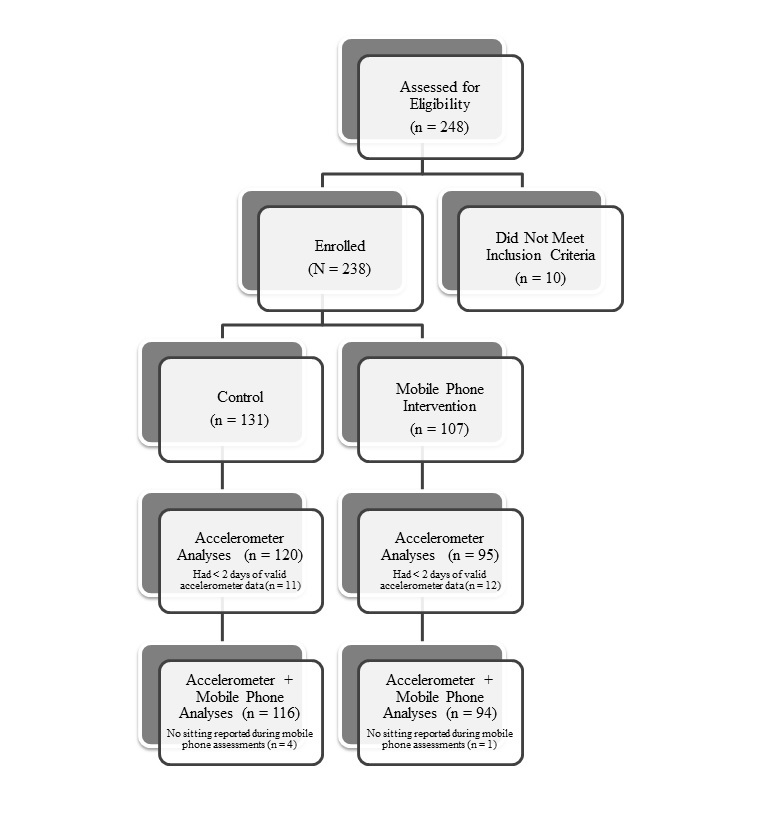
Methods: Adults participated in a quasi-experimental evaluation of a mobile phone intervention designed to reduce sedentary time through prompts to interrupt periods of sitting. Participants carried mobile phones and wore accelerometers for 7 consecutive days. Intervention participants additionally received mobile phone prompts during self-reported sitting and information about the negative health impact of prolonged sedentariness. The study was conducted from December 2012 to November 2013 in Dallas, Texas. Linear mixed model regression analyses were conducted to evaluate the influence of the intervention on daily accelerometer-determined estimates of sedentary and active time.
Results: Participants (N=215) were predominantly female (67.9%, 146/215) and nonwhite (black: 50.7%, 109/215; Latino: 12.1%, 26/215; other: 5.6%, 12/215). Analyses revealed that participants who received the mobile phone intervention had significantly fewer daily minutes of sedentary time (B=-22.09, P=.045) and more daily active minutes (B=23.01, P=.04) than control participants.
Conclusions: A simple mobile phone intervention was associated with engaging in less sedentary time and more physical activity. Findings underscore the potential impact of mobile phone interventions to positively influence sedentary behavior and physical activity.
Keywords: African Americans; mobile phone; physical activity; sedentary lifestyle.
Conflict of interest statement
Conflicts of Interest: None declared.
Figures
References
-
- Biswas A, Oh PI, Faulkner GE, Bajaj RR, Silver MA, Mitchell MS, Alter DA. Sedentary time and its association with risk for disease incidence, mortality, and hospitalization in adults: a systematic review and meta-analysis. Ann Intern Med. 2015 Jan 20;162(2):123–132. doi: 10.7326/M14-1651.2091327 - DOI - PubMed
-
- Ford ES, Caspersen CJ. Sedentary behaviour and cardiovascular disease: a review of prospective studies. Int J Epidemiol. 2012 Oct;41(5):1338–1353. doi: 10.1093/ije/dys078. http://ije.oxfordjournals.org/cgi/pmidlookup?view=long&pmid=22634869 dys078 - DOI - PMC - PubMed
-
- Matthews CE, George SM, Moore SC, Bowles HR, Blair A, Park Y, Troiano RP, Hollenbeck A, Schatzkin A. Amount of time spent in sedentary behaviors and cause-specific mortality in US adults. Am J Clin Nutr. 2012 Feb;95(2):437–445. doi: 10.3945/ajcn.111.019620. http://www.ajcn.org/cgi/pmidlookup?view=long&pmid=22218159 ajcn.111.019620 - DOI - PMC - PubMed
-
- Hamilton MT, Healy GN, Dunstan DW, Zderic TW, Owen N. Too little exercise and too much sitting: inactivity physiology and the need for new recommendations on sedentary behavior. Curr Cardiovasc Risk Rep. 2008 Jul;2(4):292–298. doi: 10.1007/s12170-008-0054-8. http://europepmc.org/abstract/MED/22905272 - DOI - PMC - PubMed
Publication types
MeSH terms
Grants and funding
LinkOut - more resources
Full Text Sources
Other Literature Sources
Medical
