


Comparing Intelligence Quotient Change After Treatment With Proton Versus Photon Radiation Therapy for Pediatric Brain Tumors
- PMID: 26811522
- PMCID: PMC4872015
- DOI: 10.1200/JCO.2015.62.1383
Comparing Intelligence Quotient Change After Treatment With Proton Versus Photon Radiation Therapy for Pediatric Brain Tumors
Abstract
Purpose: Compared with photon radiation (XRT), proton beam radiation therapy (PBRT) reduces dose to normal tissues, which may lead to better neurocognitive outcomes. We compared change in intelligence quotient (IQ) over time in pediatric patients with brain tumors treated with PBRT versus XRT.
Patients and methods: IQ scores were available for 150 patients (60 had received XRT, 90 had received PBRT). Linear mixed models examined change in IQ over time since radiation therapy (RT) by RT group, controlling for demographic/clinical characteristics. Craniospinal and focal RT subgroups were also examined.
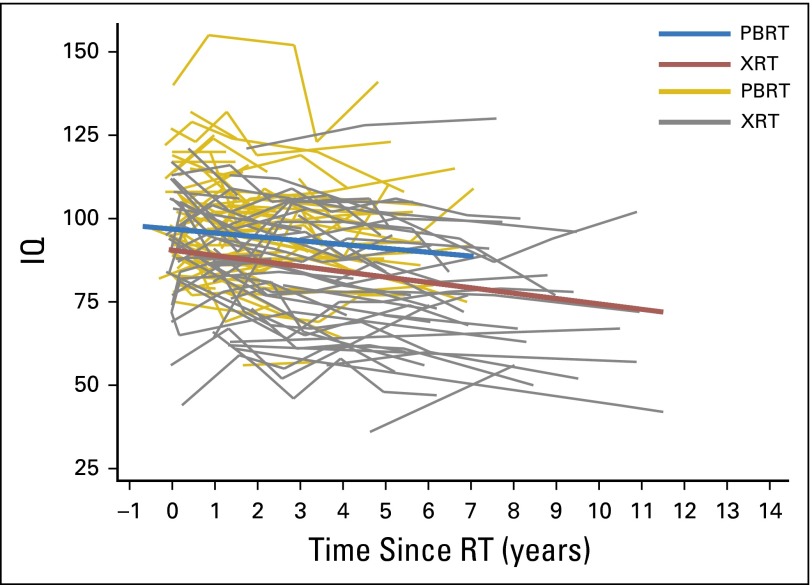
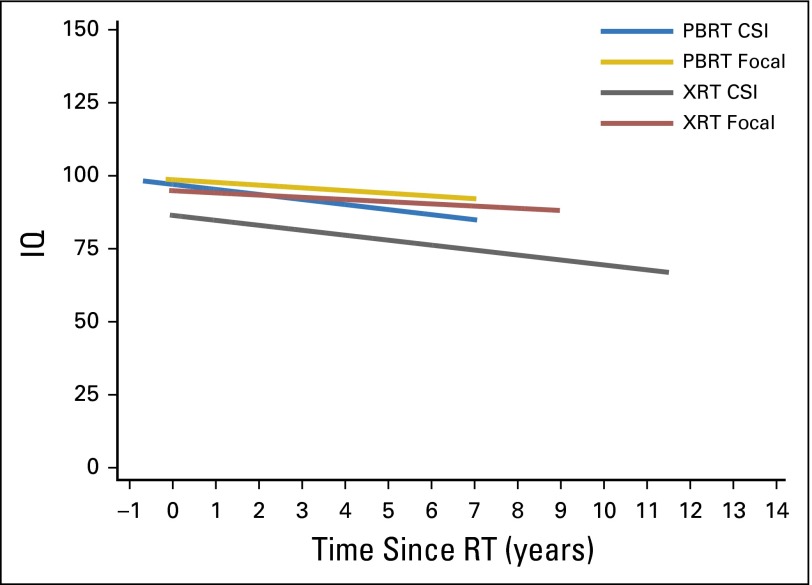
Results: In the PBRT group, no change in IQ over time was identified (P = .130), whereas in the XRT group, IQ declined by 1.1 points per year (P = .004). IQ slopes did not differ between groups (P = .509). IQ was lower in the XRT group (by 8.7 points) versus the PBRT group (P = .011). In the craniospinal subgroup, IQ remained stable in both the PBRT (P = .203) and XRT groups (P = .060), and IQ slopes did not differ (P = .890). IQ was lower in the XRT group (by 12.5 points) versus the PBRT group (P = .004). In the focal subgroup, IQ scores remained stable in the PBRT group (P = .401) but declined significantly in the XRT group by 1.57 points per year (P = .026). IQ slopes did not differ between groups (P = .342).
Conclusion: PBRT was not associated with IQ decline or impairment, yet IQ slopes did not differ between the PBRT and XRT groups. It remains unclear if PBRT results in clinically meaningful cognitive sparing that significantly exceeds that of modern XRT protocols. Additional long-term data are needed to fully understand the neurocognitive impact of PBRT in survivors of pediatric brain tumors.
© 2016 by American Society of Clinical Oncology.
Conflict of interest statement
Authors’ disclosures of potential conflicts of interest are found in the article online at
Figures
Comment in
-
Proton Beam Radiation Therapy: The Future May Prove Brighter for Pediatric Patients With Brain Tumors.J Clin Oncol. 2016 Apr 1;34(10):1024-6. doi: 10.1200/JCO.2015.65.4350. Epub 2016 Jan 25. J Clin Oncol. 2016. PMID: 26811526 Free PMC article. No abstract available.
References
-
- Palmer SL, Goloubeva O, Reddick WE, et al. Patterns of intellectual development among survivors of pediatric medulloblastoma: A longitudinal analysis. J Clin Oncol. 2001;19:2302–2308. - PubMed
-
- Ris MD, Packer R, Goldwein J, et al. Intellectual outcome after reduced-dose radiation therapy plus adjuvant chemotherapy for medulloblastoma: A Children’s Cancer Group study. J Clin Oncol. 2001;19:3470–3476. - PubMed
-
- Palmer SL, Gajjar A, Reddick WE, et al. Predicting intellectual outcome among children treated with 35-40 Gy craniospinal irradiation for medulloblastoma. Neuropsychology. 2003;17:548–555. - PubMed
-
- Mulhern RK, Merchant TE, Gajjar A, et al. Late neurocognitive sequelae in survivors of brain tumours in childhood. Lancet Oncol. 2004;5:399–408. - PubMed
Publication types
MeSH terms
Substances
Grants and funding
LinkOut - more resources
Full Text Sources
Other Literature Sources
Medical
