. 2016 Feb;22(2):224-32.
doi: 10.3201/eid2202.151358.

Invasive Group A Streptococcus Infection among Children, Rural Kenya

Invasive Group A Streptococcus Infection among Children, Rural Kenya

Anna C Seale et al. Emerg Infect Dis. 2016 Feb.

Abstract

To determine the extent of group A Streptococcus (GAS) infections in sub-Saharan Africa and the serotypes that cause disease, we analyzed surveillance data for 64,741 hospital admissions in Kilifi, Kenya, during 1998-2011. We evaluated incidence, clinical presentations, and emm types that cause invasive GAS infection. We detected 370 cases; of the 369 for which we had data, most were skin and soft tissue infections (70%), severe pneumonia (23%), and primary bacteremia (14%). Overall case-fatality risk was 12%. Incidence of invasive GAS infection was 0.6 cases/1,000 live births among neonates, 101/100,000 person-years among children <1 year of age, and 35/100,000 among children <5 years of age. Genome sequencing identified 88 emm types. GAS causes serious disease in children in rural Kenya, especially neonates, and the causative organisms have considerable genotypic diversity. Benefit from the most advanced GAS type-specific vaccines may be limited, and efforts must be directed to protect against disease in regions of high incidence.

Keywords: GAS; Kenya; Streptococcus pyogenes; bacteria; child; children; group A Streptococcus; infection; neonatal.


Figures
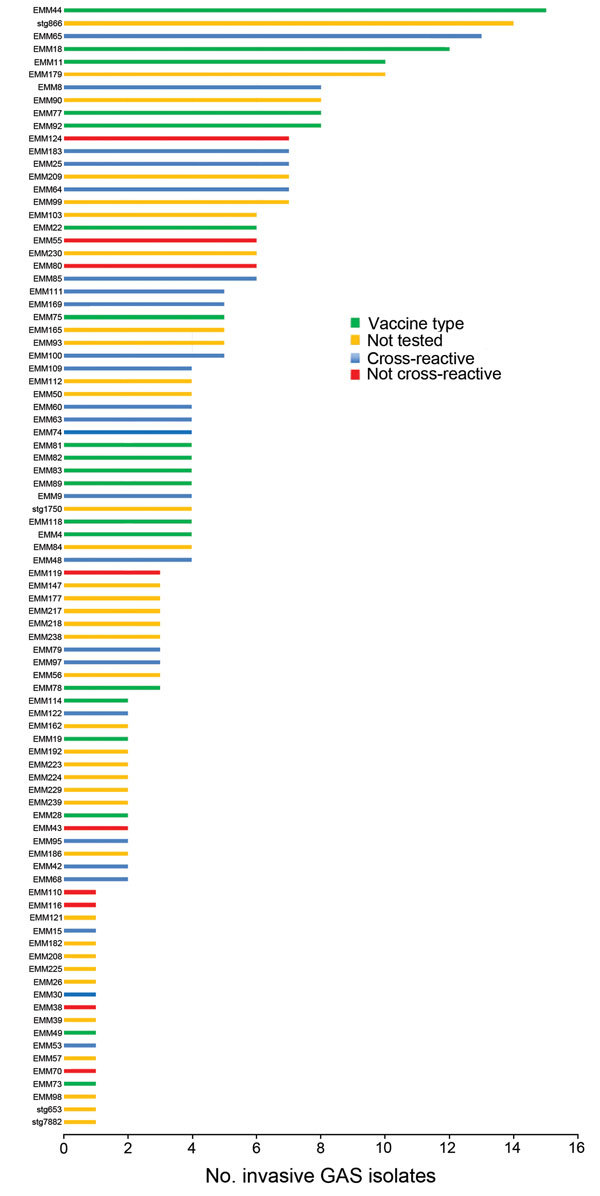
Figure 1
Figure 1
emm types of group A Streptococcus (GAS) isolates from children with GAS disease admitted to Kilifi County Hospital, Kenya, 1998–2011. emm types shown in green are included in the 30-valent vaccine; emm types in blue are not included in the 30-valent vaccine, but this vaccine may provide immunity to this emm type through cross-reactivity; emm types in red are not included in the 30-valent vaccine, and there is no evidence of cross-reactivity; emm types in yellow are not included in the 30-valent vaccine, and their cross-reactivity has not yet been tested.
Figure 2
Figure 2
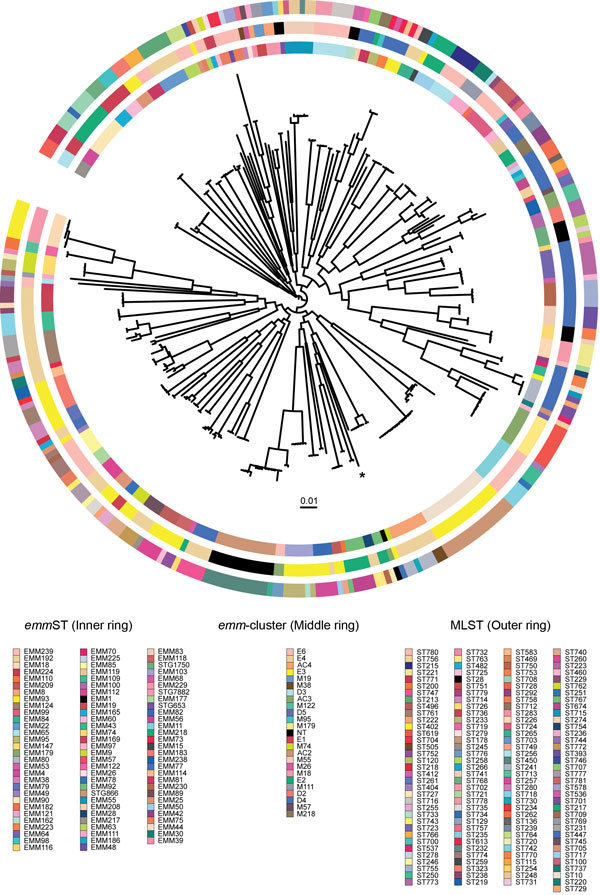
Population structure of 328 Streptococcus pyogenes strains from children with group A Streptococcus (GAS) disease admitted to Kilifi County Hospital, Kenya, 1998–2011. Unrooted maximum-likelihood phylogeny based on the whole-genome associations of mapped S. pyogenes genomes to the MGAS5005 reference genome indicates extensive genomic diversity within the population. The rings surrounding the central phylogeny correspond to standard GAS molecular typing methods; colors indicate different STs. Inner ring, emm ST (16); middle ring, emm cluster (17); outer ring, multilocus sequence type (18). NT, nontypeable emm clusters; ST, sequence type. *Position of the MGAS5005 reference genome. Scale bar indicates genetic change of 0.01.

References

    1. Liu L, Oza S, Hogan D, Perin J, Rudan I, Lawn JE, et al. Global, regional, and national causes of child mortality in 2000–13, with projections to inform post-2015 priorities: an updated systematic analysis. Lancet. 2015;385:430–40 . 10.1016/S0140-6736(14)61698-6 - DOI - PubMed
    1. Rudan I, Nair H, Marusic A, Campbell H. Reducing mortality from childhood pneumonia and diarrhoea: the leading priority is also the greatest opportunity. J Glob Health. 2013;3:010101 . 10.7189/jogh.03.010101 - DOI - PMC - PubMed
    1. Carapetis JR, Steer AC, Mulholland EK, Weber M. The global burden of group A streptococcal diseases. Lancet Infect Dis. 2005;5:685–94. 10.1016/S1473-3099(05)70267-X - DOI - PubMed
    1. The WHO Young Infants Study Group. Bacterial etiology of serious infections in young infants in developing countries: results of a multicentre study. Pediatr Infect Dis. 1999;18(Suppl):S17–22. 10.1097/00006454-199910001-00004 - DOI - PubMed
    1. Berkley JA, Lowe BS, Mwangi I, Williams T, Bauni E, Mwarumba S, et al. Bacteremia among children admitted to a rural hospital in Kenya. N Engl J Med. 2005;352:39–47. 10.1056/NEJMoa040275 - DOI - PubMed

Publication types

MeSH terms

Substances