Pharmaceutical Industry Off-label Promotion and Self-regulation: A Document Analysis of Off-label Promotion Rulings by the United Kingdom Prescription Medicines Code of Practice Authority 2003-2012
- PMID: 26812151
- PMCID: PMC4727894
- DOI: 10.1371/journal.pmed.1001945
Pharmaceutical Industry Off-label Promotion and Self-regulation: A Document Analysis of Off-label Promotion Rulings by the United Kingdom Prescription Medicines Code of Practice Authority 2003-2012
Abstract
Background: European Union law prohibits companies from marketing drugs off-label. In the United Kingdom--as in some other European countries, but unlike the United States--industry self-regulatory bodies are tasked with supervising compliance with marketing rules. The objectives of this study were to (1) characterize off-label promotion rulings in the UK compared to the whistleblower-initiated cases in the US and (2) shed light on the UK self-regulatory mechanism for detecting, deterring, and sanctioning off-label promotion.
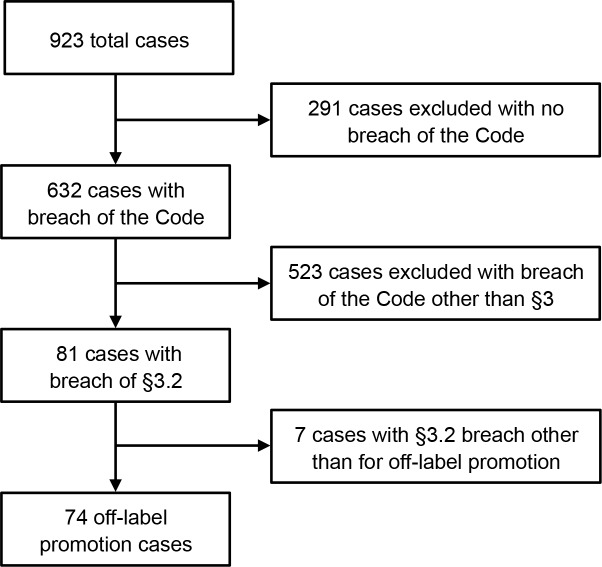
Methods and findings: We conducted structured reviews of rulings by the UK self-regulatory authority, the Prescription Medicines Code of Practice Authority (PMCPA), between 2003 and 2012. There were 74 off-label promotion rulings involving 43 companies and 65 drugs. Nineteen companies were ruled in breach more than once, and ten companies were ruled in breach three or more times over the 10-y period. Drawing on a typology previously developed to analyse US whistleblower complaints, we coded and analysed the apparent strategic goals of each off-label marketing scheme and the practices consistent with those alleged goals. 50% of rulings cited efforts to expand drug use to unapproved indications, and 39% and 38% cited efforts to expand beyond approved disease entities and dosing strategies, respectively. The most frequently described promotional tactic was attempts to influence prescribers (n = 72, 97%), using print material (70/72, 97%), for example, advertisements (21/70, 30%). Although rulings cited prescribers as the prime target of off-label promotion, competing companies lodged the majority of complaints (prescriber: n = 16, 22%, versus companies: n = 42, 57%). Unlike US whistleblower complaints, few UK rulings described practices targeting consumers (n = 3, 4%), payers (n = 2, 3%), or company staff (n = 2, 3%). Eight UK rulings (11%) pertaining to six drugs described promotion of the same drug for the same off-label use as was alleged by whistleblowers in the US. However, while the UK cases typically related to only one or a few claims made in printed material, several complaints in the US alleged multifaceted and covert marketing activities. Because this study is limited to PMCPA rulings and whistleblower-initiated federal cases, it may offer a partial view of exposed off-label marketing.
Conclusion: The UK self-regulatory system for exposing marketing violations relies largely on complaints from company outsiders, which may explain why most off-label promotion rulings relate to plainly visible promotional activities such as advertising. This contrasts with the US, where Department of Justice investigations and whistleblower testimony have alleged complex off-label marketing campaigns that remain concealed to company outsiders. UK authorities should consider introducing increased incentives and protections for whistleblowers combined with US-style governmental investigations and meaningful sanctions. UK prescribers should be attentive to, and increasingly report, off-label promotion.
Conflict of interest statement
AV and CD are members of Health Action International (HAI), a non-profit organisation working to increase access to essential medicines and the rational use of medicines. HAI has undertaken work, with the WHO, on a teaching manual for medical and pharmacy students, 'Understanding and Responding to Pharmaceutical Promotion'.
Figures

References
-
- European Union. Directive 2001/83/EC of the European Parliament and of the Council of 6 November 2001 on the Community code relating to medicinal products for human use; Article 87. http://ec.europa.eu/health/files/eudralex/vol-1/dir_2001_83_consol_2012/.... Accessed 28 July 2015.
-
- Ratner M, Gura T. Off-label or off-limits? Nat Biotech. 2008;26(8):867–75. - PubMed
-
- European Federation of Pharmaceutical Industries and Associations (EFPIA). Promotion of off label use of medicines by European healthcare bodies in indications where authorised medicines are available. 2014. http://www.efpia.eu/uploads/Modules/Documents/efpia-position-paper-off-l.... Accessed 28 July 2015.
Publication types
MeSH terms
Substances
LinkOut - more resources
Full Text Sources
Other Literature Sources