. 2016 Jan 26;11(1):e0147905.
doi: 10.1371/journal.pone.0147905. eCollection 2016.

On the Viability of Conspiratorial Beliefs

Affiliations

On the Viability of Conspiratorial Beliefs

David Robert Grimes. PLoS One. .

Erratum in

Abstract

Conspiratorial ideation is the tendency of individuals to believe that events and power relations are secretly manipulated by certain clandestine groups and organisations. Many of these ostensibly explanatory conjectures are non-falsifiable, lacking in evidence or demonstrably false, yet public acceptance remains high. Efforts to convince the general public of the validity of medical and scientific findings can be hampered by such narratives, which can create the impression of doubt or disagreement in areas where the science is well established. Conversely, historical examples of exposed conspiracies do exist and it may be difficult for people to differentiate between reasonable and dubious assertions. In this work, we establish a simple mathematical model for conspiracies involving multiple actors with time, which yields failure probability for any given conspiracy. Parameters for the model are estimated from literature examples of known scandals, and the factors influencing conspiracy success and failure are explored. The model is also used to estimate the likelihood of claims from some commonly-held conspiratorial beliefs; these are namely that the moon-landings were faked, climate-change is a hoax, vaccination is dangerous and that a cure for cancer is being suppressed by vested interests. Simulations of these claims predict that intrinsic failure would be imminent even with the most generous estimates for the secret-keeping ability of active participants-the results of this model suggest that large conspiracies (≥1000 agents) quickly become untenable and prone to failure. The theory presented here might be useful in counteracting the potentially deleterious consequences of bogus and anti-science narratives, and examining the hypothetical conditions under which sustainable conspiracy might be possible.


Conflict of interest statement

Competing Interests: The author has declared that no competing interests exist.

Figures

Fig 1
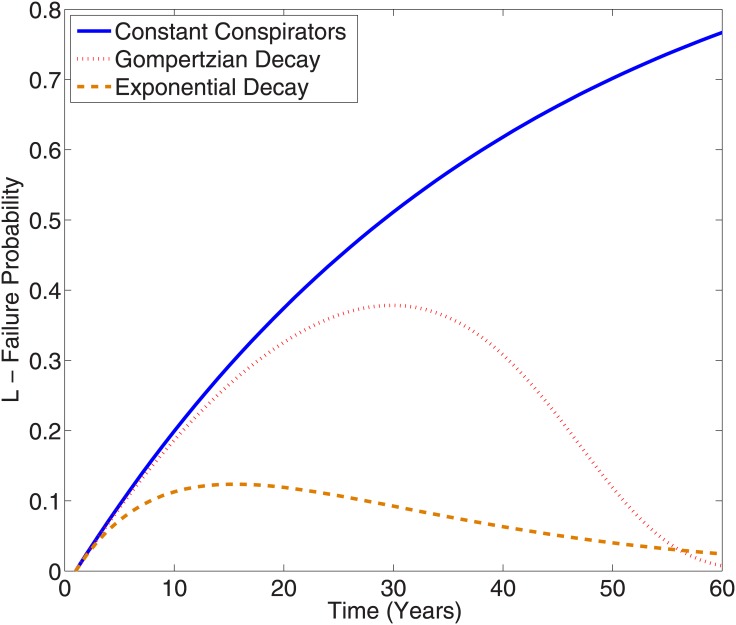
Fig 1. Projected failure probability L for a conspiracy of 5000 initial conspirators and p = 5 × 10⁻⁶ with different population assumptions.
The blue sold line depicts L over time with a constant level of conspirators being maintained. The red dotted line shows a single event with Gompertzian decay of the conspiring population, assuming an average initial age of 40 years old and the dashed orange line shows an exponential decay with number of conspirators being halved every 10 years. In the first case, the likelihood of conspiracy failure always increases with time. In the Gompertzian case, the chances of failure initially increase towards a maximum (L = 0.38 after 29 years in this example), but the death of conspirators with time acts to decrease probability of failure after this. Finally, if conspirators are removed extrinsically, then the curve hits a maximum (L = 0.12 after 14 years) before decaying to lower likelihoods as less conspirators exist to betray confidence.
Fig 2
Fig 2
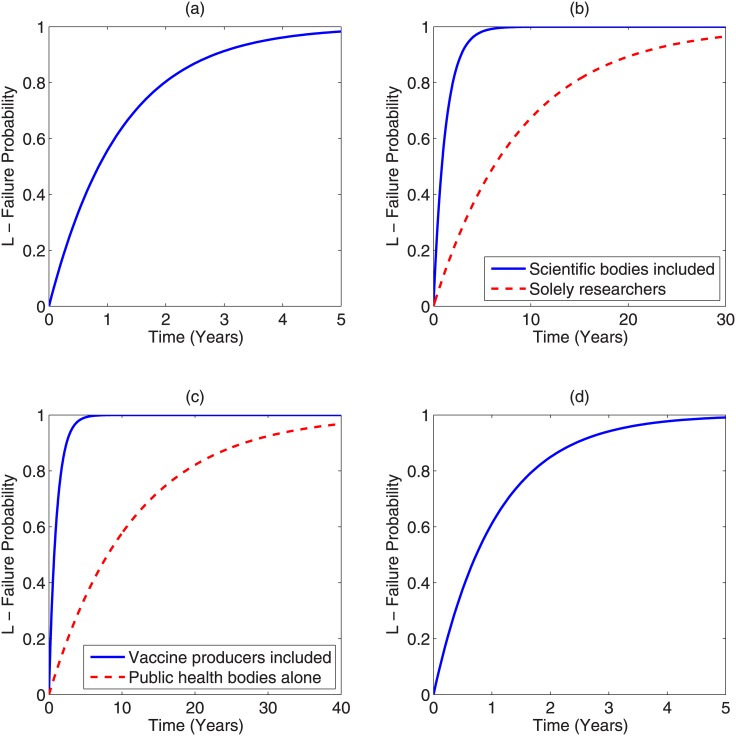
Failure curves for (a) NASA moon-landing hoax—results for both constant population and Gompertzian function are so close as to be non-resolvable visually (b) Climate change hoax—The blue solid line depicts failure probability with time if all scientific bodies endorsing the scientific consensus are involved, the red-dotted line presents the curve if solely active climate researchers were involved (c) Vaccination conspiracy—blue solid line showing failure probability with time for a combination of public health bodies and major drug manufacturers and the red-dotted line depicting case if only public health bodies were conspiring (d) Failure with time for a suppressed cancer cure conspiracy.
Fig 3
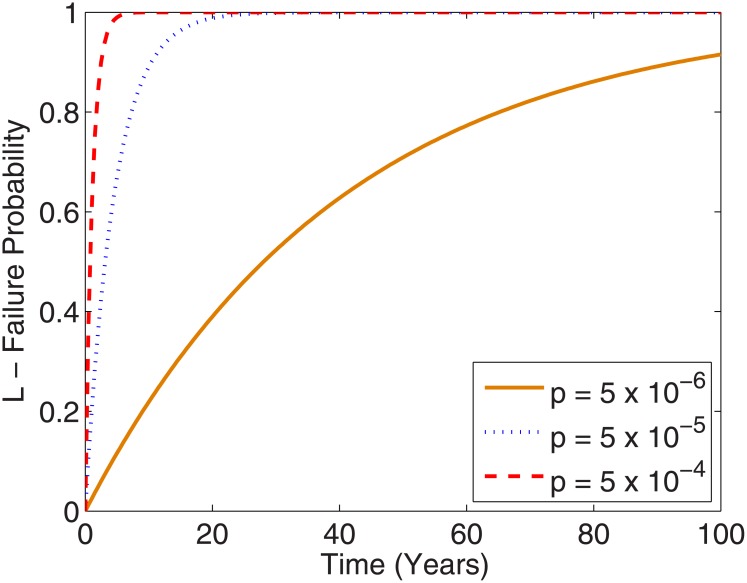
Fig 3. Failure curves for a conspiracy of No = 5000 as p changes by two orders of magnitude.
Fig 4
Fig 4
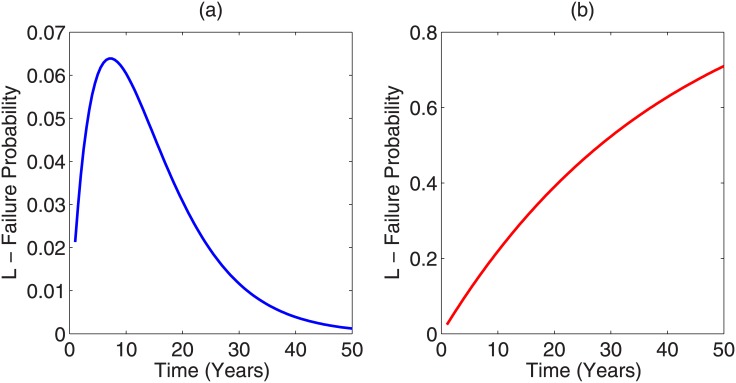
Failure curves for a conspiracy of No = 5000 over a 50 year period with exponential removal of conspirators with half-life t2 of 5 years (λ=ln 2t2=0.139yr1) with (a) assumption of constant p (b) proportional change in probability p(t) = po eλt.

References

    1. Sunstein CR, Vermeule A. Conspiracy Theories: Causes and Cures*. Journal of Political Philosophy. 2009;17(2):202–227. 10.1111/j.1467-9760.2008.00325.x - DOI
    1. Goertzel T. Belief in conspiracy theories. Political Psychology. 1994;15(4):731–742. 10.2307/3791630 - DOI
    1. Lewandowsky S, Gignac GE, Oberauer K. The Role of Conspiracist Ideation and Worldviews in Predicting Rejection of Science. PLoS ONE. 2013. October;8(10):e75637 10.1371/journal.pone.0075637 - DOI - PMC - PubMed
    1. Poland GA, Jacobson RM. The Age-Old Struggle against the Antivaccinationists. New England Journal of Medicine. 2011;364(2):97–99. 10.1056/NEJMp1010594 - DOI - PubMed
    1. Jacobson RM, Targonski PV, Poland GA. A taxonomy of reasoning flaws in the anti-vaccine movement. Vaccine. 2007;25(16):3146–3152. 10.1016/j.vaccine.2007.01.046 - DOI - PubMed

LinkOut - more resources