. 2016 Jan 26:17:10.
doi: 10.1186/s13059-015-0864-1.

Functional analysis of androgen receptor mutations that confer anti-androgen resistance identified in circulating cell-free DNA from prostate cancer patients

Affiliations

Functional analysis of androgen receptor mutations that confer anti-androgen resistance identified in circulating cell-free DNA from prostate cancer patients

Nada Lallous et al. Genome Biol. .

Abstract

Background: The androgen receptor (AR) is a pivotal drug target for the treatment of prostate cancer, including its lethal castration-resistant (CRPC) form. All current non-steroidal AR antagonists, such as hydroxyflutamide, bicalutamide, and enzalutamide, target the androgen binding site of the receptor, competing with endogenous androgenic steroids. Several AR mutations in this binding site have been associated with poor prognosis and resistance to conventional prostate cancer drugs. In order to develop an effective CRPC therapy, it is crucial to understand the effects of these mutations on the functionality of the AR and its ability to interact with endogenous steroids and conventional AR inhibitors.

Results: We previously utilized circulating cell-free DNA (cfDNA) sequencing technology to examine the AR gene for the presence of mutations in CRPC patients. By modifying our sequencing and data analysis approaches, we identify four additional single AR mutations and five mutation combinations associated with CRPC. Importantly, we conduct experimental functionalization of all the AR mutations identified by the current and previous cfDNA sequencing to reveal novel gain-of-function scenarios. Finally, we evaluate the effect of a novel class of AR inhibitors targeting the binding function 3 (BF3) site on the activity of CRPC-associated AR mutants.

Conclusions: This work demonstrates the feasibility of a prognostic and/or diagnostic platform combining the direct identification of AR mutants from patients' serum, and the functional characterization of these mutants in order to provide personalized recommendations regarding the best future therapy.


Figures

Fig. 1
Fig. 1
AR mutations identified in CRPC patients. a AR gene organization showing the AR-LBD mutants. b AR mutants mapped on the X-ray structure (PDB: 2 AM9) of the LBD (cartoon representation, in gray) in complex with testosterone (TES, ball-and-stick representation, in cyan). AR mutants encoded by exon 8 are shown in magenta ball-and-stick representation. The rest of the mutants are shown in blue
Fig. 2
Fig. 2
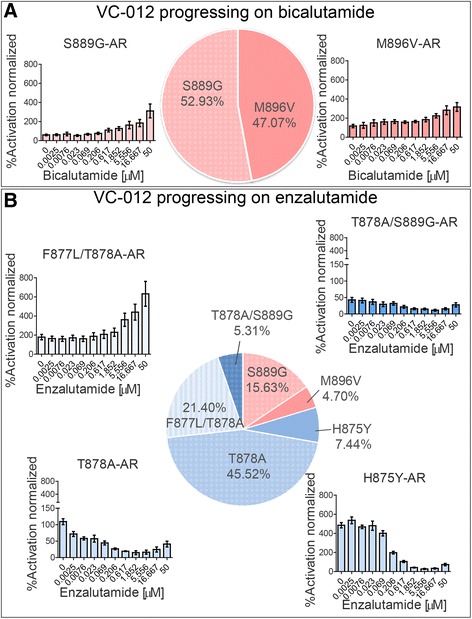
Characterization of AR mutants identified in patient VC-012 after progression on bicalutamide and enzalutamide. a Two AR mutants were identified in the cfDNA isolated after patient progression on bicalutamide. Both mutants show agonist response to bicalutamide in an in vitro transcription assay. b Four additional mutants were identified in the same patient VC-012 after progression on enzalutamide, all with various agonist effects toward enzalutamide in vitro. The percentage in the charts only reflects the mutated form of the androgen receptor. Each concentration was assayed in quadruplicate n = 4, with a biological replicate of n = 3. Results were averaged and normalized by expressing them as a percentage of the wild-type AR activity ± SEM
Fig. 3
Fig. 3
Steroid activation of AR mutants in comparison with the wild-type receptor in luciferase reporter assay. While most of the AR mutants showed similar or lower affinity to the activation by DHT (a), when compared to wild-type, several variants presented better activation by estradiol (b), progesterone (c), or hydrocortisone (d) than the wild-type. PC3 cells were transfected with both wild-type or mutated AR and a reporter plasmid pARR3-tk-luciferase. After 48 h post transfection, cells were treated with increasing concentrations of steroids. The graphs represent the average ± SEM of three independent experiments with four replicates each. The activity of each mutant in the presence of a steroid was normalized to the wild-type stimulated by 500 nM of the same steroid
Fig. 4
Fig. 4
AR mutants associated with enzalutamide resistance in CRPC patients. a Molecular dynamics (MD) model of AR LBD (cartoon representation, in gray) in complex with enzalutamide (ball-and-stick representation, in blue). The residues presented as gray sticks are found to be mutated in patients progressing on enzalutamide treatment. b The F877L mutant showed an agonist response to enzalutamide in an in vitro cell-based assay but was inhibited by the first generation anti-androgens hydroxyflutamide and bicalutamide. Each concentration was assayed in quadruplicate n = 4, with a biological replicate of n = 3. Results were averaged and normalized by expressing them as a percentage of WT AR activity ± SEM
Fig. 5
Fig. 5
Characterization of the in-house developed AR inhibitor VPC-13566. a Dose-response curve illustrating the inhibiting effect of the VPC-13566 and enzalutamide on the AR transcriptional activity in PC3 cells transfected with wild-type AR plasmid. Data points represent the mean of three independent experiments performed in four replicates each. Error bars represent the standard error of the mean ± SEM for n = 12 values. b The specific binding to the BF3 site was confirmed by BAG1L peptide (1-20) displacement using a TR-FRET assay. c The effect of VPC-13566 on PC3 cell viability. % cell viability is plotted in dose dependent manner. Data points represent the mean ± SEM of two independent experiments performed in quadruplicate

References

    1. de Bono JS, Logothetis CJ, Molina A, Fizazi K, North S, Chu L, et al. Abiraterone and increased survival in metastatic prostate cancer. N Engl J Med. 2011;364:1995–2005. doi: 10.1056/NEJMoa1014618. - DOI - PMC - PubMed
    1. Li Z, Bishop AC, Alyamani M, Garcia JA, Dreicer R, Bunch D, et al. Conversion of abiraterone to D4A drives anti-tumour activity in prostate cancer. Nature. 2015;523:347–51. doi: 10.1038/nature14406. - DOI - PMC - PubMed
    1. Beer TM, Armstrong AJ, Rathkopf DE, Loriot Y, Sternberg CN, Higano CS, et al. Enzalutamide in metastatic prostate cancer before chemotherapy. N Engl J Med. 2014;371:424–33. doi: 10.1056/NEJMoa1405095. - DOI - PMC - PubMed
    1. Scher HI, Beer TM, Higano CS, Anand A, Taplin ME, Efstathiou E, et al. Antitumour activity of MDV3100 in castration-resistant prostate cancer: a phase 1-2 study. Lancet. 2010;375:1437–46. doi: 10.1016/S0140-6736(10)60172-9. - DOI - PMC - PubMed
    1. Montgomery RB, Mostaghel EA, Vessella R, Hess DL, Kalhorn TF, Higano CS, et al. Maintenance of intratumoral androgens in metastatic prostate cancer: a mechanism for castration-resistant tumor growth. Cancer Res. 2008;68:4447–54. doi: 10.1158/0008-5472.CAN-08-0249. - DOI - PMC - PubMed

Publication types

MeSH terms