Comparative Study
. 2016 Jan 27:9:38.
doi: 10.1186/s13071-016-1314-y.

Multi-parallel qPCR provides increased sensitivity and diagnostic breadth for gastrointestinal parasites of humans: field-based inferences on the impact of mass deworming

Affiliations
Comparative Study

Multi-parallel qPCR provides increased sensitivity and diagnostic breadth for gastrointestinal parasites of humans: field-based inferences on the impact of mass deworming

Alice V Easton et al. Parasit Vectors. .

Abstract

Background: Although chronic morbidity in humans from soil transmitted helminth (STH) infections can be reduced by anthelmintic treatment, inconsistent diagnostic tools make it difficult to reliably measure the impact of deworming programs and often miss light helminth infections.

Methods: Cryopreserved stool samples from 796 people (aged 2-81 years) in four villages in Bungoma County, western Kenya, were assessed using multi-parallel qPCR for 8 parasites and compared to point-of-contact assessments of the same stools by the 2-stool 2-slide Kato-Katz (KK) method. All subjects were treated with albendazole and all Ascaris lumbricoides expelled post-treatment were collected. Three months later, samples from 633 of these people were re-assessed by both qPCR and KK, re-treated with albendazole and the expelled worms collected.

Results: Baseline prevalence by qPCR (n = 796) was 17 % for A. lumbricoides, 18 % for Necator americanus, 41 % for Giardia lamblia and 15% for Entamoeba histolytica. The prevalence was <1% for Trichuris trichiura, Ancylostoma duodenale, Strongyloides stercoralis and Cryptosporidium parvum. The sensitivity of qPCR was 98% for A. lumbricoides and N. americanus, whereas KK sensitivity was 70% and 32%, respectively. Furthermore, qPCR detected infections with T. trichiura and S. stercoralis that were missed by KK, and infections with G. lamblia and E. histolytica that cannot be detected by KK. Infection intensities measured by qPCR and by KK were correlated for A. lumbricoides (r = 0.83, p < 0.0001) and N. americanus (r = 0.55, p < 0.0001). The number of A. lumbricoides worms expelled was correlated (p < 0.0001) with both the KK (r = 0.63) and qPCR intensity measurements (r = 0.60).

Conclusions: KK may be an inadequate tool for stool-based surveillance in areas where hookworm or Strongyloides are common or where intensity of helminth infection is low after repeated rounds of chemotherapy. Because deworming programs need to distinguish between populations where parasitic infection is controlled and those where further treatment is required, multi-parallel qPCR (or similar high throughput molecular diagnostics) may provide new and important diagnostic information.


Figures
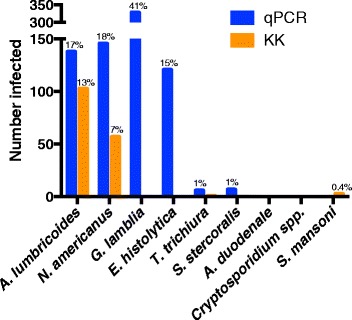
Fig. 1
Fig. 1
Baseline parasite prevalence by qPCR and KK. Number of people determined to be infected with each of the 8 parasites by qPCR (blue) or KK (orange) with the percentages listed above the bars
Fig. 2
Fig. 2
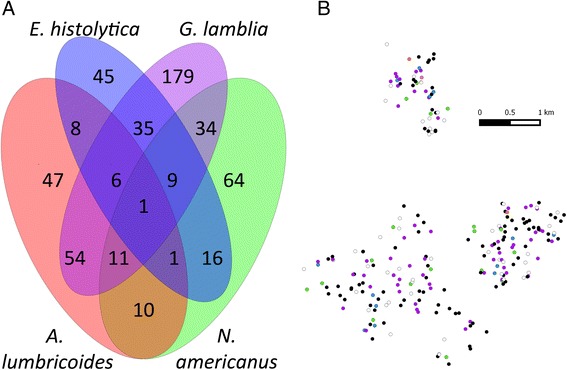
Polyparasitism is common among the study population. Panel A shows a Venn diagram related to infection with at least one of A. lumbricoides, N. americanus, G. lamblia and/or E. histolytica parasites. Panel B shows the household locations of those with single infections with N. americanus (green), S. stercoralis (pink), T. trichiura (orange), G. lamblia (purple) and E. histolytica (blue) or those households with more than one of these infections (black). Distance is depicted by the scaling ruler
Fig. 3
Fig. 3
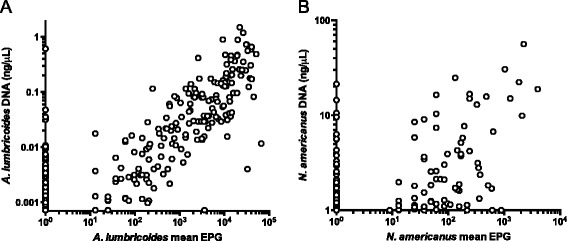
Relationship between qPCR and KK results for A. lumbricoides and N. americanus. Panel A shows the A. lumbricoides DNA concentration by qPCR as a function of the mean EPG measured by KK from the same stool across all time points (n = 1869). Panel B shows the N. americanus DNA concentration by qPCR as a function of the mean EPG measured by KK from the same stool
Fig. 4
Fig. 4
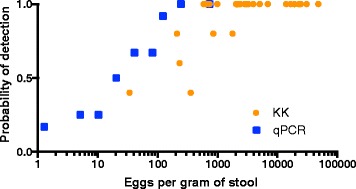
Parallel experiments calculate probability of A. lumbricoides detection by EPG. The probability that A. lumbricoides eggs will be detected by qPCR (in blue) or KK (in orange) is shown at different EPG values
Fig. 5
Fig. 5
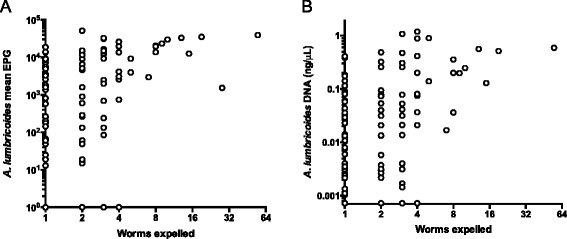
Relationship between KK and qPCR measurements and the number of A. lumbricoides worms expelled. For the set of 159 individuals who were part of the worm expulsion at baseline, their baseline average 2-stool duplicate KK result is plotted against the number of worms eventually collected from that person (Panel A). Points on the x-axis represent people who expelled worms but were negative for A. lumbricoides by KK, and points on the y-axis represent people who were positive for A. lumbricoides by KK but in whose stool worms were not found. Panel B shows the relationship between the A. lumbricoides DNA concentration calculated by qPCR and the number of expelled worms for the same set of 159 individuals
Fig. 6
Fig. 6
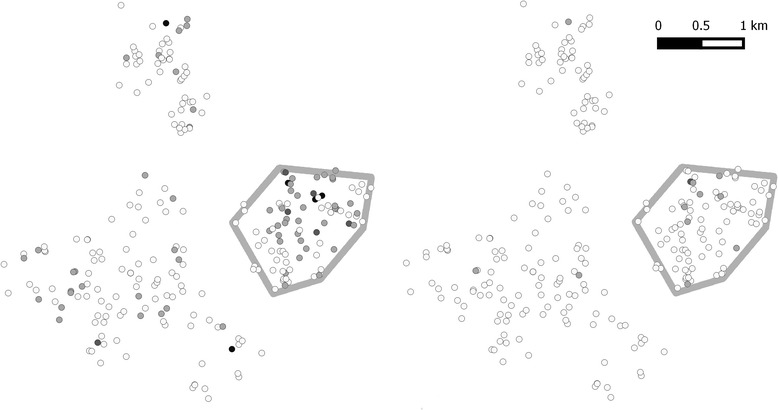
Intensity of A. lumbricoides infection by household at baseline and at follow-up three months after albendazole therapy. Households with A. lumbricoides DNA concentration (ng/μL) at baseline (left) and three months post-treatment (right). Households with no A. lumbricoides (white circles), light infections (<0.1 ng/μL, light gray circles), medium infections (0.1–0.2 ng/μL, dark gray circles) and heavy infections (>0.2 ng/μL, black circles) are shown. The village with the highest prevalence of individuals infected with A. lumbricoides at baseline and follow-up is outlined in gray
Fig. 7
Fig. 7
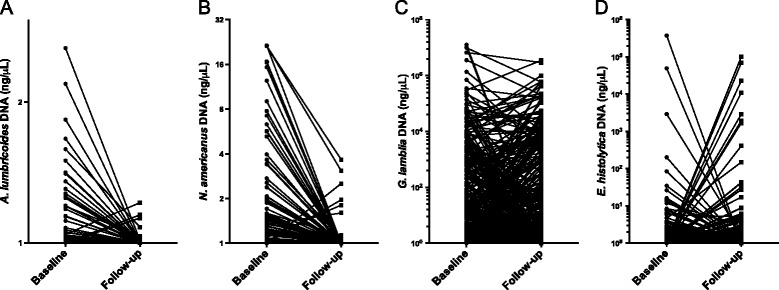
Infection intensities of individuals at baseline and at follow-up three months after albendazole therapy. Mean DNA concentrations, calculated from qPCR results, are shown for A. lumbricoides (Panel A), N. americanus (Panel B), G. lamblia (Panel C) and E. histolytica (Panel D) at baseline for 633 participants for whom paired samples were available. Each line represents a single individual before and three months after albendazole therapy

References

    1. Webster JP, Molyneux DH, Hotez PJ, Fenwick A. The contribution of mass drug administration to global health: past, present and future. Philos Trans R Soc Lond B Biol Sci. 2014;369(1645):20130434. doi: 10.1098/rstb.2013.0434. - DOI - PMC - PubMed
    1. Pullan RL, Brooker SJ. The global limits and population at risk of soil-transmitted helminth infections in 2010. Parasit Vectors. 2012;5:81. doi: 10.1186/1756-3305-5-81. - DOI - PMC - PubMed
    1. WHO . Soil-transmitted helminthiases: number of children treated in 2013: World Health Organization. 2015. - PubMed
    1. Croce D, Porazzi E, Foglia E, Restelli U, Sinuon M, Socheat D, et al. Cost-effectiveness of a successful schistosomiasis control programme in Cambodia (1995–2006) Acta Trop. 2010;113(3):279–84. doi: 10.1016/j.actatropica.2009.11.011. - DOI - PMC - PubMed
    1. Lustigman S, Prichard RK, Gazzinelli A, Grant WN, Boatin BA, McCarthy JS, et al. A research agenda for helminth diseases of humans: the problem of helminthiases. PLoS Negl Trop Dis. 2012;6(4):e1582. doi: 10.1371/journal.pntd.0001582. - DOI - PMC - PubMed

Publication types

MeSH terms