


Gender expression associated with BMI in a prospective cohort study of US adolescents
- PMID: 26813530
- PMCID: PMC4730912
- DOI: 10.1002/oby.21338
Gender expression associated with BMI in a prospective cohort study of US adolescents
Abstract
Objective: To examine the relationship between gender expression (GE) and BMI in adolescence.
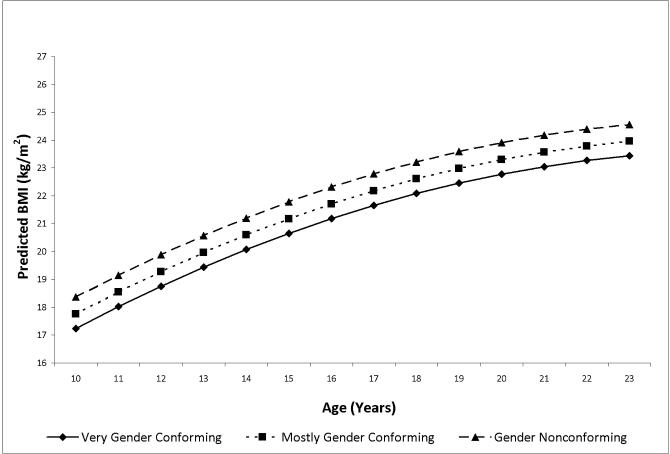
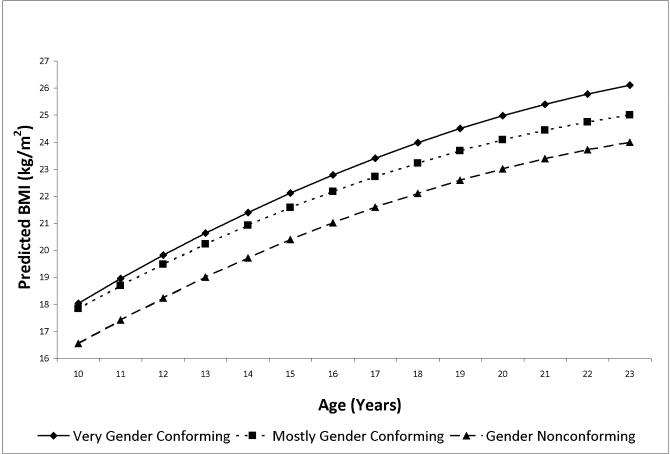
Methods: Repeated measures of weight-related behaviors and BMI were collected from 1996 to 2011 via annual/biennial self-report surveys from youth aged 10 to 23 years (6,693 females, 2,978 males) in the longitudinal Growing Up Today Study. GE (very conforming [referent], mostly conforming, nonconforming) was assessed in 2010/11. Sex-stratified, multivariable linear models estimated GE group differences in BMI and the contribution of sexual orientation and weight-related exposures to group differences. Models for males included interaction terms for GE with age.
Results: In females, mostly conforming youth had 0.53 kg m(-2) and nonconforming had 1.23 kg m(-2) higher BMI; when adding adjustment for sexual orientation and weight-related exposures, GE group estimates were attenuated up to 8% and remained statistically significant. In males, mostly conforming youth had -0.67 kg m(-2) and nonconforming had -1.99 kg m(-2) lower BMI (age [in years]) interactions were between -0.09 and -0.14 kg m(-2) ; when adding adjustment for sexual orientation and weight-related exposures, GE group estimates were attenuated up to 11% and remained statistically significant.
Conclusions: GE is a strong independent predictor of BMI in adolescence. Obesity prevention and treatment interventions with youth must address ways that gender norms may reinforce or undermine healthful behaviors.
© 2016 The Obesity Society.
Figures
Comment in
-
Gender Norms and Obesity: Incorporating Gender Norms Change Into Clinical Interventions.Obesity (Silver Spring). 2016 Feb;24(2):280. doi: 10.1002/oby.21407. Obesity (Silver Spring). 2016. PMID: 26813521 Free PMC article. No abstract available.
References
-
- Bordo S. Unbearable weight: Feminism, Western culture and the body. University of California Press; Berkeley, CA: 1993.
-
- Pope H, Phillips KA, Olivardia R. The Adonis complex: The secret crisis of male body obsession. Free Press; New York: 2000. Free. New York.
-
- May AL, Kim J-Y, McHale SM, Crouter AC. Parent-adolescent relationships and the development of weight concerns from early to late adolescence. Int J Eat Disord. 2006;39:729–40. - PubMed
Publication types
MeSH terms
Grants and funding
LinkOut - more resources
Full Text Sources
Other Literature Sources
