Determinants of doctors' decisions to inquire about sexual dysfunction in Malaysian primary care settings
- PMID: 26816741
- PMCID: PMC4708114
- DOI: 10.3978/j.issn.2223-4683.2013.09.14
Determinants of doctors' decisions to inquire about sexual dysfunction in Malaysian primary care settings
Abstract
Background: Perceptions of how receptive men are to sexual health inquiry may affect Malaysian primary care doctors' decisions to initiate such a discussion with their male patients. This paper quantifies the impact of doctors' perceptions of men's receptivity on male sexual health inquiry. Sexual health inquiry is one of the five areas in a study on determinants of offering preventive health checks to Malaysian men.
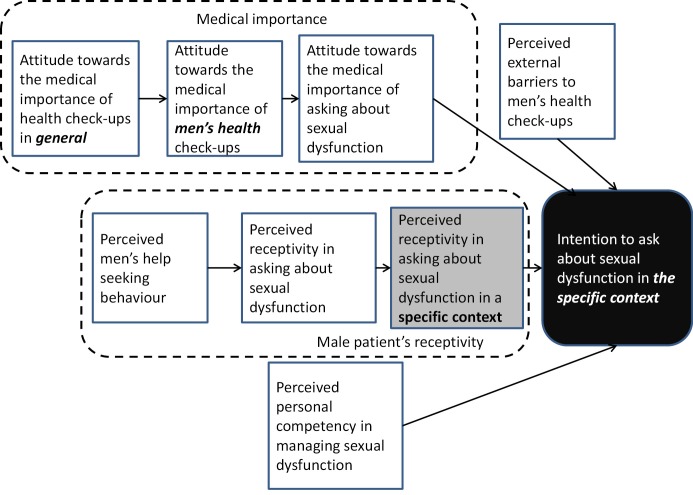
Methods: This was a cross sectional survey among primary care doctors in Malaysia. The questionnaire was based on an empirical model defining the determinants of primary care doctors' intention to offer health checks. The questionnaire measured: (I) perceived receptivity of male patients to sexual health inquiry; (II) doctors' attitudes towards the importance of sexual health inquiries; (III) perceived competence and, (IV) perceived external barriers. The outcome variable was doctors' intention in asking about sexual dysfunction in three different contexts (minor complaints visits, follow-up visits and health checks visits). All items were measured on the Likert scale of 1 to 5 (strongly disagree/unlikely to strongly agree/likely) and internally validated.
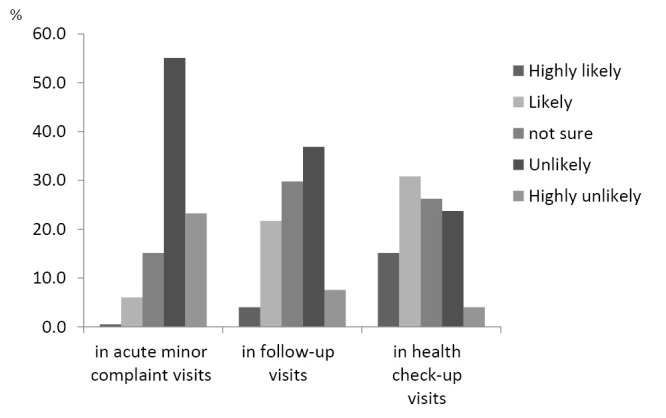
Results: 198 doctors participated (response rate 70.4%). Female primary care doctors constituted 54.5%. 78% of respondents were unlikely to ask about sexual dysfunction in visits for minor complaints to their male patients, 43.6% in follow up visits and 28.2% in health checks visits. In ordinal regression analysis, positive perception of men's receptivity to sexual health inquiry significantly predicted the doctors' intention in asking sexual dysfunction in all three contexts; i.e., minor complaints visits (P=0.013), follow-up visits (P<0.0001) and health checks visits (P=0.002). Perceived competence in sexual health inquiry predicted their intention in the follow-up visits (P=0.006) and health checks visits (P<0.001). Lower cost to health checks only predicted their intention in the follow-up visits (P=0.010).
Conclusions: Whilst sexual health inquiry should be initiated in an appropriate context, 'perceived receptivity' to sexual health inquiry significantly affected doctors' intention in initiating sexual health inquiry to their male patients. Malaysian men's health may be substantially improved by strategies that assist doctors to identify patient 'receptivity'.
Keywords: Health check; decision making; men’s health; primary care physicians; sexual dysfunction.
Conflict of interest statement
Figures
References
-
- Quek KF, Sallam AA, Ng CH, et al. Prevalence of sexual problems and its association with social, psychological and physical factors among men in a Malaysian population: a cross-sectional study. J Sex Med 2008;5:70-6. - PubMed
-
- Khoo EM, Tan HM, Low WY. Erectile dysfunction and comorbidities in aging men: an urban cross-sectional study in Malaysia. J Sex Med 2008;5:2925-34. - PubMed
-
- Mariappan P, Chong WL. Prevalence and correlations of lower urinary tract symptoms, erectile dysfunction and incontinence in men from a multiethnic Asian population: Results of a regional population-based survey and comparison with industrialized nations. BJU Int 2006;98:1264-8. - PubMed
-
- Prins J, Blanker MH, Bohnen AM, et al. Prevalence of erectile dysfunction: a systematic review of population-based studies. Int J Impot Res 2002;14:422-32. - PubMed
-
- Rosen RC, Fisher WA, Eardley I, et al. The multinational Men’s Attitudes to Life Events and Sexuality (MALES) study: I. Prevalence of erectile dysfunction and related health concerns in the general population. Curr Med Res Opin 2004;20:607-17. - PubMed
LinkOut - more resources
Full Text Sources