


Makorin Ring Finger Protein 1 as Adjunctive Marker in Liquid-based Cervical Cytology
- PMID: 26817873
- PMCID: PMC4998247
- DOI: 10.1097/MD.0000000000002425
Makorin Ring Finger Protein 1 as Adjunctive Marker in Liquid-based Cervical Cytology
Abstract
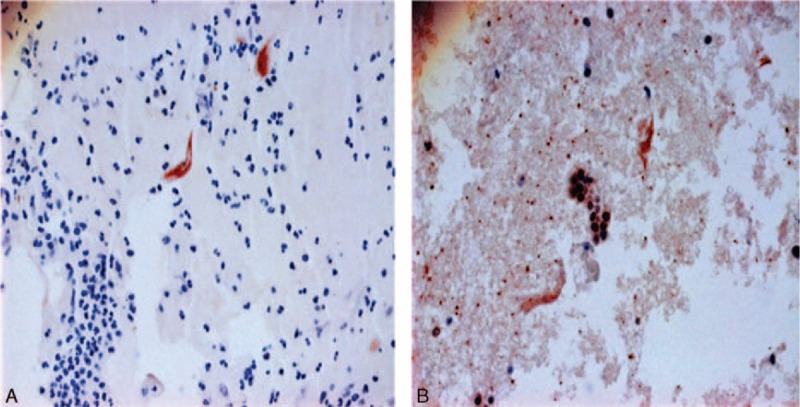
To assess the utility of makorin ring finger protein 1 (MKRN1) as a marker of cervical pathology.A PROspective specimen collection and retrospective Blinded Evaluation study was conducted. Liquid-based cytology samples were collected from 187 women, embedding all residuals as cell blocks for immunohistochemical staining of MKRN1 and P16 . Results of liquid-based cervical cytology, immunostained cell block sections, and human papillomavirus (HPV) hybrid capture (with real-time polymerase chain reaction) were analyzed. Clinical outcomes were analyzed overall and in subsets of specimens yielding atypical squamous cells of undetermined significance or low-grade squamous intraepithelial lesions.Makorin ring finger protein 1 positivity and grades (1-3) of cervical intraepithelial neoplasia (CIN) increased in tandem (CIN1, 32.4%; CIN2, 60.0%; and CIN3, 80.0%), reaching 92.3% in invasive cancer. Sensitivity, specificity, positive predictive value, and negative predictive value in detecting CIN2+ via MKRN1 were 73.8%, 76.8%, 75.6%, and 75.0%, respectively. The performance of liquid-based cytology was poorer by comparison (61.3%, 69.5%, 66.2%, and 64.8%, respectively), and HPV assay (versus MKRN1 immunohistochemical staining) displayed lower specificity (67.7%). Combined HPV + MKRN1 testing proved highest in sensitivity, specificity, positive predictive value, and negative predictive value (71.8%, 85.5%, 82.3%, and 76.5%, respectively), whereas corresponding values for cytology + HPV (60.6%, 81.8%, 75.4%, and 69.2%) and cytology + MKRN1 (58.8%, 84.1%, 78.3%, and 67.7%) were all similar. In instances of atypical squamous cells of undetermined significance or low-grade squamous intraepithelial lesions, the HPV + MKRN1 combination performed best by above measures (100%, 72.7%, 73.9%, and 100%), followed by cytology + MKRN1 (100%, 50.0%, 60.7%, and 100%).Makorin ring finger protein 1 displayed greater sensitivity and specificity than liquid-based cytology and proved more specific than HPV assay. In combination testing, MKRN1 + HPV showed the highest sensitivity and specificity levels. The MKRN1 biomarker may be a useful adjunct in primary cervical cytology screening.
Conflict of interest statement
The authors have no conflicts of interest to disclose.
Figures
References
-
- Arbyn M, Rebolj M, De Kok IM, et al. The challenges of organising cervical screening programmes in the 15 old member states of the European Union. Eur J Cancer 2009; 45:2671–2678. - PubMed
-
- Boyko EJ. Meta-analysis of Pap test accuracy. Am J Epidemiol 1996; 143:406–407. - PubMed
-
- Waldstrom M, Christensen RK, Ornskov D. Evaluation of p16(INK4a)/Ki-67 dual stain in comparison with an mRNA human papillomavirus test on liquid-based cytology samples with low-grade squamous intraepithelial lesion. Cancer Cytopathol 2013; 121:136–145. - PubMed
Publication types
MeSH terms
Substances
LinkOut - more resources
Full Text Sources
Other Literature Sources
Medical
Research Materials
Miscellaneous
