


Genetic determinants of CYP2A6 activity across racial/ethnic groups with different risks of lung cancer and effect on their smoking intensity
- PMID: 26818358
- PMCID: PMC5014092
- DOI: 10.1093/carcin/bgw012
Genetic determinants of CYP2A6 activity across racial/ethnic groups with different risks of lung cancer and effect on their smoking intensity
Abstract
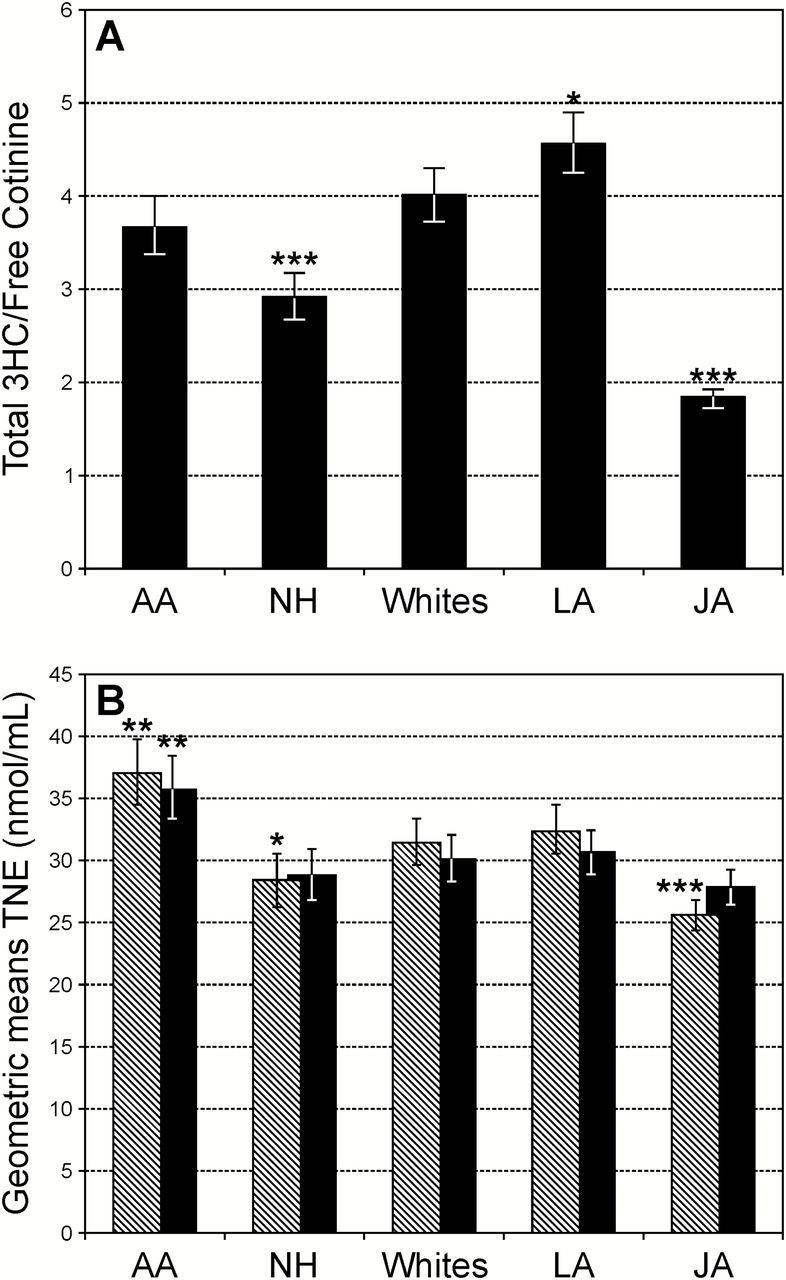
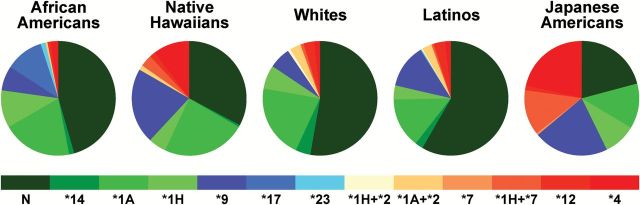
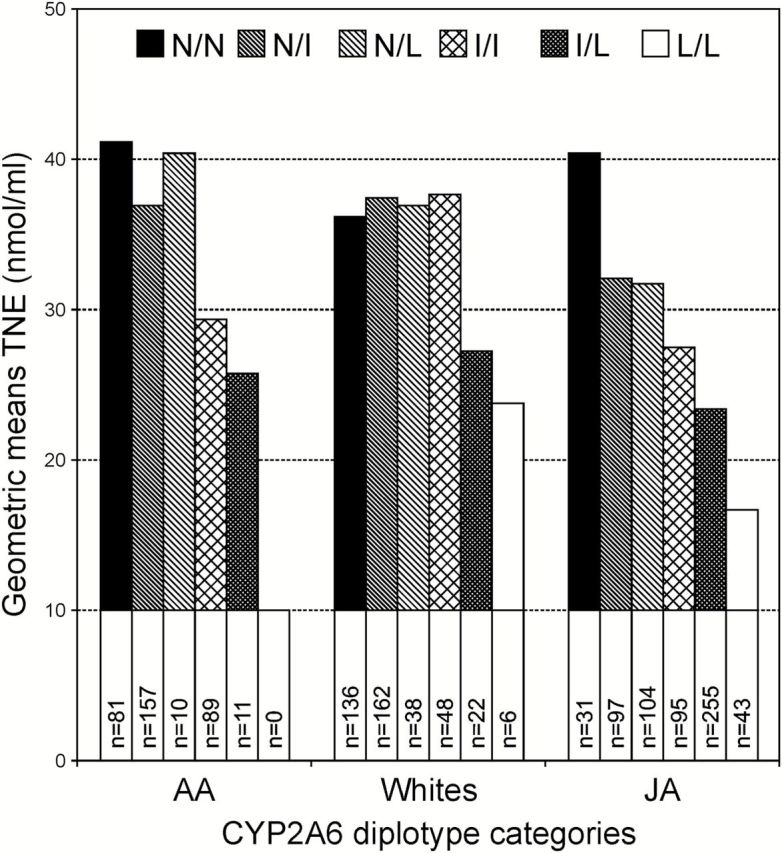
Genetic variation in cytochrome P450 2A6 (CYP2A6) gene is the primary contributor to the intraindividual and interindividual differences in nicotine metabolism and has been found to influence smoking intensity. However, no study has evaluated the relationship between CYP2A6 genetic variants and the CYP2A6 activity ratio (total 3-hydroxycotinine/cotinine) and their influence on smoking intensity [total nicotine equivalents (TNE)], across five racial/ethnic groups found to have disparate rates of lung cancer. This study genotyped 10 known functional CYP2A6 genetic or copy number variants in 2115 current smokers from the multiethnic cohort study [African Americans (AA) = 350, Native Hawaiians (NH) = 288, Whites = 413, Latinos (LA) = 437 and Japanese Americans (JA) = 627] to conduct such an investigation. Here, we found that LA had the highest CYP2A6 activity followed by Whites, AA, NH and JA, who had the lowest levels. Adjusting for age, sex, race/ethnicity and body mass index, we found that CYP2A6 diplotypes were predictive of TNE levels, particularly in AA and JA (P trend < 0.0001). However, only in JA did the association remain after accounting for cigarettes per day. Also, it is only in this population that the lower activity ratio supports lower TNE levels, carcinogen exposure and thereby lower risk of lung cancer. Despite the association between nicotine metabolism (CYP2A6 activity phenotype and diplotypes) and smoking intensity (TNE), CYP2A6 levels did not correlate with the higher TNE levels found in AA nor the lower TNE levels found in LA, suggesting that other factors may influence smoking dose in these populations. Therefore, further study in these populations is recommended.
© The Author 2016. Published by Oxford University Press. All rights reserved. For Permissions, please email: journals.permissions@oup.com.
Figures
References
-
- Torre L.A., et al. (2015) Global cancer statistics, 2012. CA Cancer J. Clin., 65, 87–108. - PubMed
-
- Haiman C.A., et al. (2006) Ethnic and racial differences in the smoking-related risk of lung cancer. N. Engl. J. Med., 354, 333–342. - PubMed
-
- Hukkanen J., et al. (2005) Metabolism and disposition kinetics of nicotine. Pharmacol. Rev., 57, 79–115. - PubMed
-
- Scherer G., et al. (2007) Relationship between machine-derived smoke yields and biomarkers in cigarette smokers in Germany. Regul. Toxicol. Pharmacol., 47, 171–183. - PubMed
-
- Wang J., et al. (2011) Is 24h nicotine equivalents a surrogate for smoke exposure based on its relationship with other biomarkers of exposure? Biomarkers, 16, 144–154. - PubMed
Publication types
MeSH terms
Substances
Grants and funding
- UM1 CA164973/CA/NCI NIH HHS/United States
- P30 CA077598/CA/NCI NIH HHS/United States
- R01CA63464/CA/NCI NIH HHS/United States
- CA138338/CA/NCI NIH HHS/United States
- CA77598/CA/NCI NIH HHS/United States
- UM1CA164973/CA/NCI NIH HHS/United States
- R37CA54281/CA/NCI NIH HHS/United States
- P01CA33619/CA/NCI NIH HHS/United States
- P01 CA138338/CA/NCI NIH HHS/United States
- R01 CA063464/CA/NCI NIH HHS/United States
- P01 CA033619/CA/NCI NIH HHS/United States
- P30 CA071789/CA/NCI NIH HHS/United States
- U01 CA164973/CA/NCI NIH HHS/United States
- R37 CA054281/CA/NCI NIH HHS/United States
LinkOut - more resources
Full Text Sources
Other Literature Sources
Medical
