Helicobacter pylori Eradication Reduces the Metachronous Recurrence of Gastric Neoplasms by Attenuating the Precancerous Process
- PMID: 26819804
- PMCID: PMC4722992
- DOI: 10.5230/jgc.2015.15.4.246
Helicobacter pylori Eradication Reduces the Metachronous Recurrence of Gastric Neoplasms by Attenuating the Precancerous Process
Abstract
Purpose: The importance of Helicobacter pylori eradication after endoscopic resection (ER) of gastric neoplasms remains controversial. In this study, we clarified the importance of H. pylori eradication for metachronous lesions after ER.
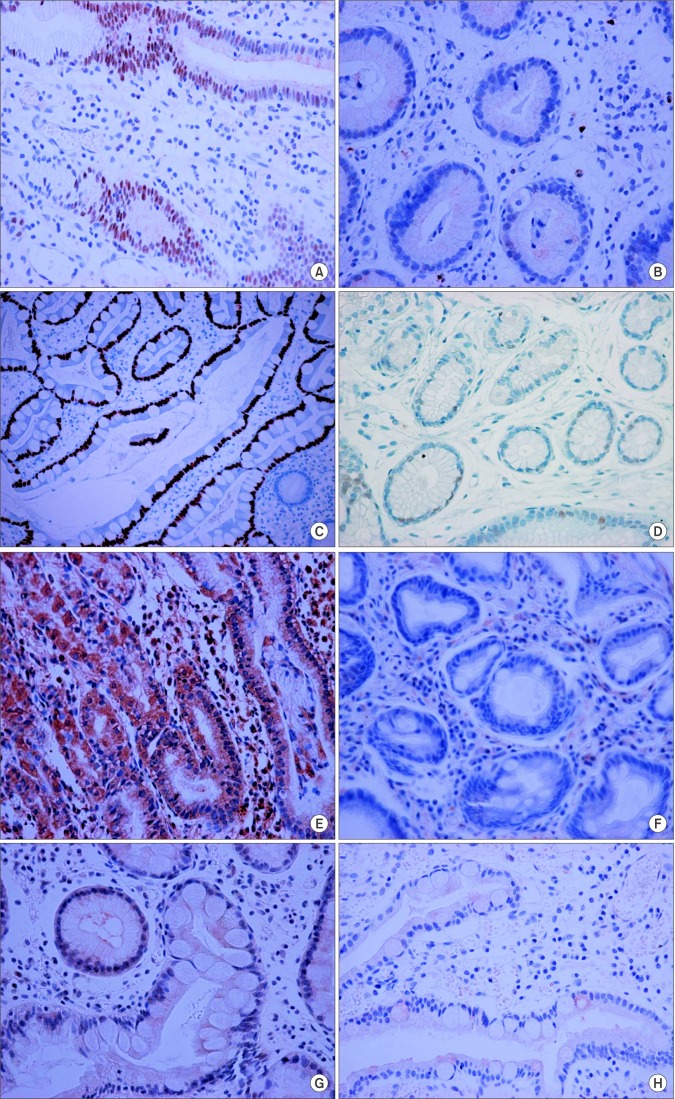
Materials and methods: This study included 3,882 patients with gastric neoplasms who underwent ER. We included patients infected with H. pylori who received eradication therapy. Among them, 34 patients with metachronous lesions after ER and 102 age- and sex-matched patients (nonmetachronous group) were enrolled. Background mucosal pathologies such as atrophy and intestinal metaplasia (IM) were evaluated endoscopically. The expression levels of CDX1, CDX2, Sonic hedgehog (SHH), and SOX2 were evaluated based on H. pylori eradication and the development of metachronous lesions.
Results: The eradication failure rate was higher in the metachronous group than in the nonmetachronous group (P=0.036). Open-type atrophy (P=0.003) and moderate-to-severe IM (P=0.001) occurred more frequently in the metachronous group. In patients with an initial diagnosis of dysplasia, the eradication failure rate was higher in the metachronous group than in the nonmetachronous group (P=0.002). In addition, open-type atrophy was more frequent in the metachronous group (P=0.047). In patients with an initial diagnosis of carcinoma, moderate-to-severe IM occurred more frequently in the metachronous group (P=0.003); however, the eradication failure rate was not significantly different between the two groups. SHH and SOX2 expression was increased, and CDX2 expression was decreased in the nonmetachronous group after eradication (P<0.05).
Conclusions: Open-type atrophy, moderate-to-severe IM, and H. pylori eradication failure were significantly associated with metachronous lesions. However, eradication failure was significantly associated with dysplasia, but not carcinoma, in the metachronous group. Thus, H. pylori eradication may play an important role in preventing metachronous lesions after ER for precancerous lesions before carcinomatous transformation.
Keywords: Endoscopic resection; Helicobacter pylori; Metachronous; Stomach neoplasms.
Conflict of interest statement
Figures
References
-
- Correa P, Houghton J. Carcinogenesis of Helicobacter pylori. Gastroenterology. 2007;133:659–672. - PubMed
-
- Wong BC, Lam SK, Wong WM, Chen JS, Zheng TT, Feng RE, et al. China Gastric Cancer Study Group. Helicobacter pylori eradication to prevent gastric cancer in a high-risk region of China: a randomized controlled trial. JAMA. 2004;291:187–194. - PubMed
-
- Fukase K, Kato M, Kikuchi S, Inoue K, Uemura N, Okamoto S, et al. Japan Gast Study Group. Effect of eradication of Helicobacter pylori on incidence of metachronous gastric carcinoma after endoscopic resection of early gastric cancer: an openlabel, randomised controlled trial. Lancet. 2008;372:392–397. - PubMed
-
- Bae SE, Jung HY, Kang J, Park YS, Baek S, Jung JH, et al. Effect of Helicobacter pylori eradication on metachronous recurrence after endoscopic resection of gastric neoplasm. Am J Gastroenterol. 2014;109:60–67. - PubMed
-
- Choi J, Kim SG, Yoon H, Im JP, Kim JS, Kim WH, et al. Eradication of Helicobacter pylori after endoscopic resection of gastric tumors does not reduce incidence of metachronous gastric carcinoma. Clin Gastroenterol Hepatol. 2014;12:793–800. - PubMed
LinkOut - more resources
Full Text Sources
Other Literature Sources