. 2016 Jan 26;21(2):152.
doi: 10.3390/molecules21020152.

Design of a MCoTI-Based Cyclotide with Angiotensin (1-7)-Like Activity

Affiliations

Design of a MCoTI-Based Cyclotide with Angiotensin (1-7)-Like Activity

Teshome Aboye et al. Molecules. .

Abstract

We report for the first time the design and synthesis of a novel cyclotide able to activate the unique receptor of angiotensin (1-7) (AT1-7), the MAS1 receptor. This was accomplished by grafting an AT1-7 peptide analog onto loop 6 of cyclotide MCoTI-I using isopeptide bonds to preserve the α-amino and C-terminal carboxylate groups of AT1-7, which are required for activity. The resulting cyclotide construct was able to adopt a cyclotide-like conformation and showed similar activity to that of AT1-7. This cyclotide also showed high stability in human serum thereby providing a promising lead compound for the design of a novel type of peptide-based in the treatment of cancer and myocardial infarction.

Keywords: MAS1 receptor; angiotensin; cyclotide.


Conflict of interest statement

The authors declare no conflict of interest.

Figures
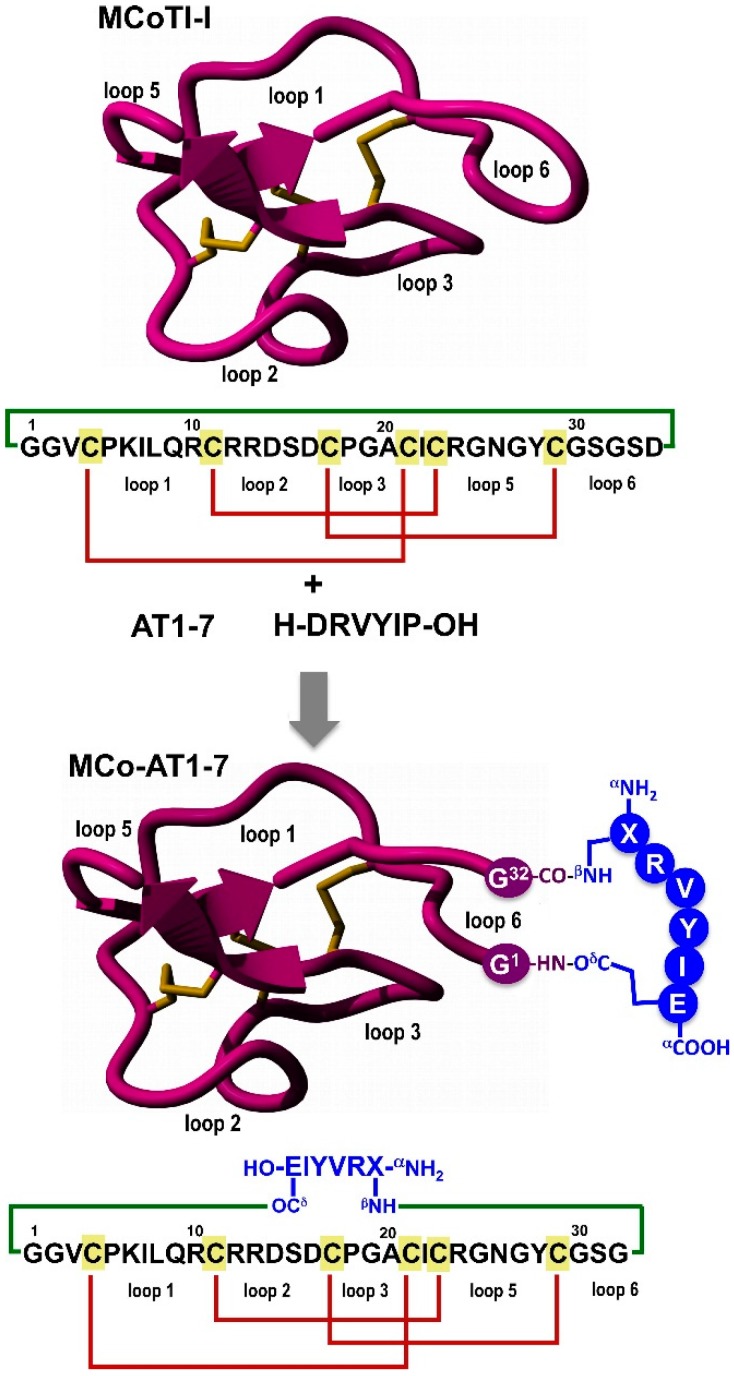
Figure 1
Figure 1
Design of grafted cyclotide MCo-AT1-7 to activate the receptor MAS1. The upper part of the panel shows the primary and tertiary structures of the cyclotide MCoTI-I (structure is based on a homology model using the solution structure of MCoTI-II as template (PDB: 1IB9) [14]), and the primary structure of peptide angiotensin 1-7 (AT1-7). The cyclized polypeptide is stabilized by the three-disulfide bonds (shown in red). The lower part of the figure shows the strategy used to graft an AT1-7-derived peptide onto the loop 6 of cyclotide MCoTI-I. The AT1-7-derived peptide was linked to the cyclotide backbone through the side-side chains of the N- and C-terminal residues forming two isopeptide bonds. The sequence corresponding to the AT1-7-derived peptides is shown in blue. Residue X represents l-2,3-diaminopropionic acid. Molecular graphics were built with Yasara (www.yasara.org).
Figure 2
Figure 2
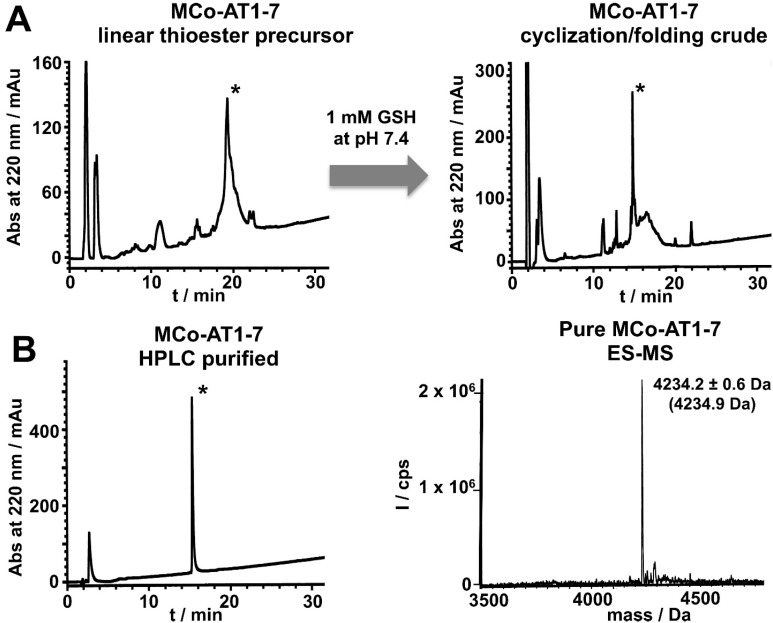
Chemical synthesis and characterization of cyclotide MCo-AT1-7. (A) Analytical HPLC traces of for the linear thioester precursor, GSH-induced cyclization/folding crude after 24 h and purified cyclotide. An asterisk indicates the desired peptide; (B) Analytical HPLC trace and ES-MS characterization of pure MCo-AT1-7. The expected average molecular weight is shown in parenthesis.
Figure 3
Figure 3
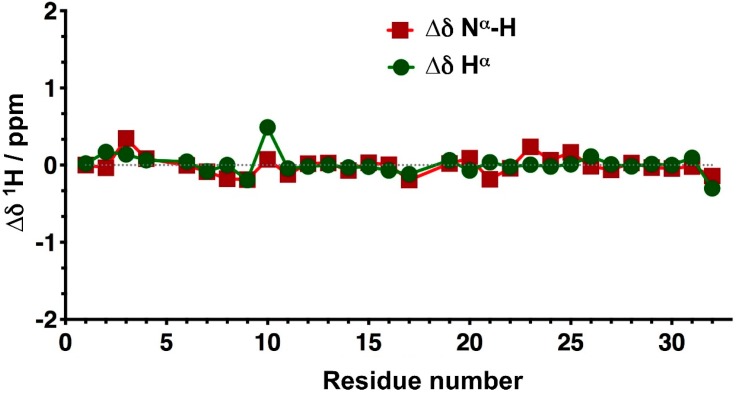
1H-NMR characterization of folded cyclotide MCo-AT1-7. Chemical shifts differences of the backbone, Nα-H and Hα protons between the common sequence (residues 1 through 32) of MCoTI-I and MCo-AT1-7 (Table S1).
Figure 4
Figure 4
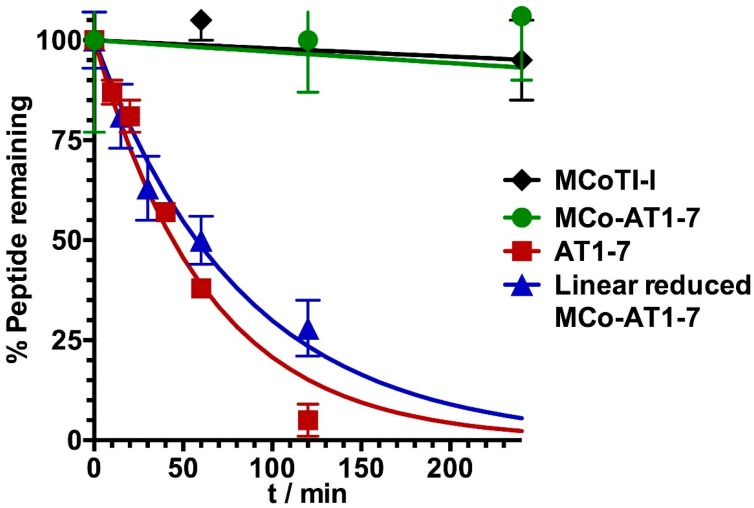
Stability of cyclotides MCo-AT1-7 and MCoTI-I, and peptide AT1-7 and reduced linear MCo-AT1-7 precursor to human serum at 37 °C. Undigested peptides were quantified by HPLC-MS/MS.
Figure 5
Figure 5
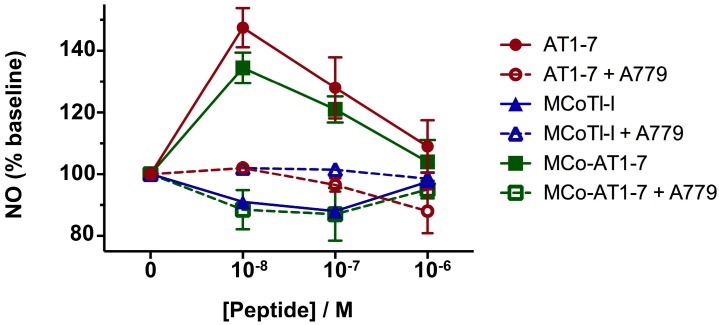
Biological activity of cyclotide MCo-AT1-7. MAS1 stably transfected CHO cells were tested using different concentrations of cyclotide MCo-AT1-7 and peptide AT1-7 in the absence or presence of MAS1 antagonist A779. The amount of intracellular NO was measured by fluorescence as described in the experimental section. Cyclotide MCoTI-I was used as negative control. The average of standard deviation of two experiments is shown.

References

    1. Gallagher P.E., Cook K., Soto-Pantoja D., Menon J., Tallant E.A. Angiotensin peptides and lung cancer. Curr. Cancer Drug Targets. 2011;11:394–404. doi: 10.2174/156800911795538048. - DOI - PMC - PubMed
    1. Menon J., Soto-Pantoja D.R., Callahan M.F., Cline J.M., Ferrario C.M., Tallant E.A., Gallagher P.E. Angiotensin-(1–7) inhibits growth of human lung adenocarcinoma xenografts in nude mice through a reduction in Cyclooxygenase-2. Cancer Res. 2007;67:2809–2815. doi: 10.1158/0008-5472.CAN-06-3614. - DOI - PubMed
    1. Gallagher P.E., Tallant E.A. Inhibition of human lung cancer cell growth by Angiotensin-(1–7) Carcinogenesis. 2004;25:2045–2052. doi: 10.1093/carcin/bgh236. - DOI - PubMed
    1. Tallant E.A., Clark M.A. Molecular mechanisms of inhibition of vascular growth by Angiotensin-(1–7) Hypertension. 2003;42:574–579. doi: 10.1161/01.HYP.0000090322.55782.30. - DOI - PubMed
    1. Tallant E.A., Diz D.I., Ferrario C.M. State-of-the-art lecture. Antiproliferative actions of Angiotensin-(1–7) in vascular smooth muscle. Hypertension. 1999;34:950–957. doi: 10.1161/01.HYP.34.4.950. - DOI - PubMed

Publication types

MeSH terms