


Factors Associated With High-Grade Lachman, Pivot Shift, and Anterior Drawer at the Time of Anterior Cruciate Ligament Reconstruction
- PMID: 26821957
- PMCID: PMC4899260
- DOI: 10.1016/j.arthro.2015.11.018
Factors Associated With High-Grade Lachman, Pivot Shift, and Anterior Drawer at the Time of Anterior Cruciate Ligament Reconstruction
Abstract
Purpose: To determine which patient and injury factors are associated with the detection of high-grade laxity on examination under anesthesia before anterior cruciate ligament (ACL) reconstruction.
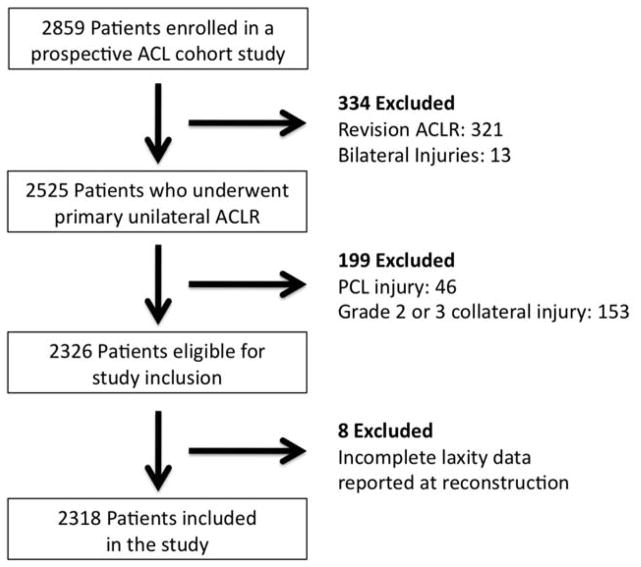
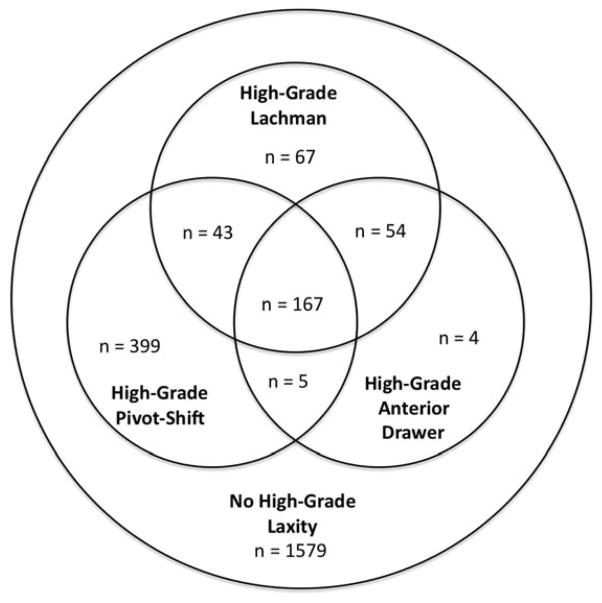
Methods: We identified 2,318 patients who underwent primary ACL reconstruction without associated ligament injuries. Demographic data and information regarding meniscal tears were collected. Patients with high-grade Lachman (difference from contralateral side >10 mm), pivot-shift (International Knee Documentation Committee grade 3+), or anterior drawer (difference from contralateral side >10 mm) tests were identified by physical examination under anesthesia before ACL reconstruction. Logistic regression modeling was used to evaluate whether chronicity of the ACL injury, patient age, sex, body mass index, generalized ligamentous laxity, and presence of meniscal tears were associated with increased odds of high-grade laxity, while we controlled for examining surgeon.
Results: Patients with chronic tears (>6 months from injury) had greater than twice the odds of having high-grade Lachman, pivot-shift, and anterior drawer tests (all P < .001) relative to patients with acute tears (<3 months from injury). Generalized ligamentous laxity (odds ratio [OR], 2.33; P < .001) and the presence of medial (OR, 1.63; P < .001) or lateral (OR, 1.41; P = .013) meniscus tears were associated with increased odds of a high-grade Lachman test. Age younger than 20 years (OR, 1.34; P = .023), female sex (OR, 1.49; P = .001), generalized ligamentous laxity (OR, 3.46; P < .001), and the presence of a medial (OR, 1.53; P < .001) or lateral (OR, 1.27; P = .041) meniscus tear were associated with increased odds of a high-grade pivot-shift test. Generalized ligamentous laxity (OR, 2.27; P < .001) and the presence of a medial (OR, 1.73; P = .001) or lateral (OR, 1.50; P = .010) meniscus tear were associated with increased odds of a high-grade anterior drawer test.
Conclusions: Chronic ACL tears, generalized ligamentous laxity, and meniscus tears are associated with increased odds of high-grade laxity with all 3 tests. Female patients and age younger than 20 years are associated with increased odds of a high-grade pivot-shift test.
Level of evidence: Level II, lesser-quality prospective study.
Copyright © 2016 Arthroscopy Association of North America. Published by Elsevier Inc. All rights reserved.
Figures
References
-
- Torg JS, Conrad W, Kalen V. Clinical diagnosis of anterior cruciate ligament instability in the athlete. Am J Sports Med. 1976;4:84–93. - PubMed
-
- Galway HR, MacIntosh DL. The lateral pivot shift: a symptom and sign of anterior cruciate ligament insufficiency. Clin Orthop Relat Res. 1980:45–50. - PubMed
-
- Larson RL. Physical examination in the diagnosis of rotatory instability. Clin Orthop Relat Res. 1983:38–44. - PubMed
-
- Malanga GA, Andrus S, Nadler SF, McLean J. Physical examination of the knee: a review of the original test description and scientific validity of common orthopedic tests. Arch Phys Med Rehabil. 2003;84:592–603. - PubMed
-
- Heijne A, Ang BO, Werner S. Predictive factors for 12-month outcome after anterior cruciate ligament reconstruction. Scand J Med Sci Sports. 2009;19:842–849. - PubMed
MeSH terms
Grants and funding
LinkOut - more resources
Full Text Sources
Other Literature Sources
Medical
Research Materials
