


Revisiting typhoid fever surveillance in low and middle income countries: lessons from systematic literature review of population-based longitudinal studies
- PMID: 26822522
- PMCID: PMC4731936
- DOI: 10.1186/s12879-016-1351-3
Revisiting typhoid fever surveillance in low and middle income countries: lessons from systematic literature review of population-based longitudinal studies
Abstract
Background: The control of typhoid fever being an important public health concern in low and middle income countries, improving typhoid surveillance will help in planning and implementing typhoid control activities such as deployment of new generation Vi conjugate typhoid vaccines.
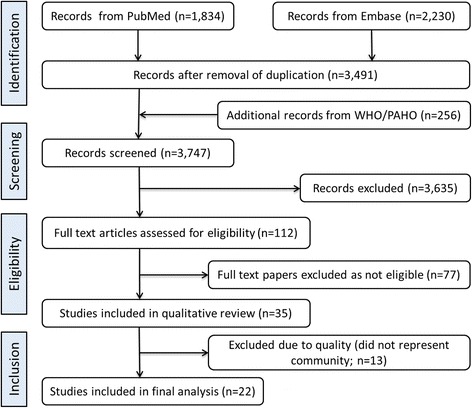
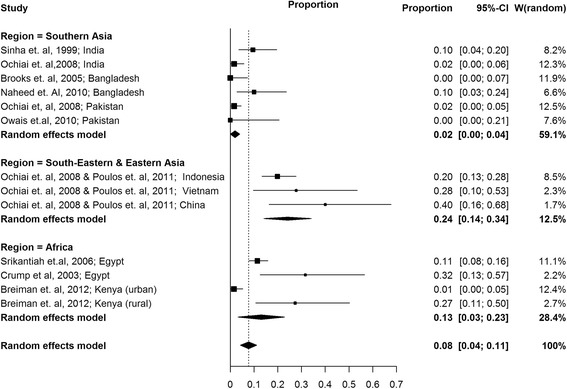
Methods: We conducted a systematic literature review of longitudinal population-based blood culture-confirmed typhoid fever studies from low and middle income countries published from 1(st) January 1990 to 31(st) December 2013. We quantitatively summarized typhoid fever incidence rates and qualitatively reviewed study methodology that could have influenced rate estimates. We used meta-analysis approach based on random effects model in summarizing the hospitalization rates.
Results: Twenty-two papers presented longitudinal population-based and blood culture-confirmed typhoid fever incidence estimates from 20 distinct sites in low and middle income countries. The reported incidence and hospitalizations rates were heterogeneous as well as the study methodology across the sites. We elucidated how the incidence rates were underestimated in published studies. We summarized six categories of under-estimation biases observed in these studies and presented potential solutions.
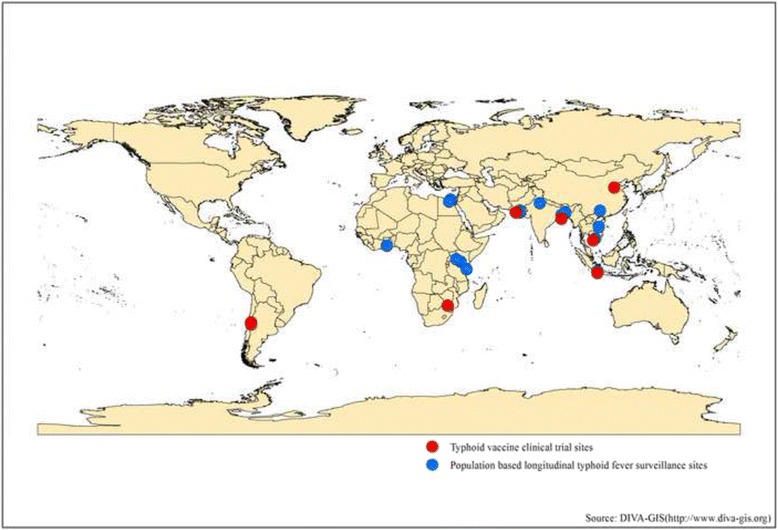
Conclusions: Published longitudinal typhoid fever studies in low and middle income countries are geographically clustered and the methodology employed has a potential for underestimation. Future studies should account for these limitations.
Figures
References
-
- WHO Typhoid vaccines: WHO position paper. Wkly Epidemiol Rec. 2008;83(6):49–59. - PubMed
-
- WHO . Background document: the diagnosis, treatment and prevention of typhoid fever. Geneva, Switzerland: World Health Organization; 2003.
Publication types
MeSH terms
LinkOut - more resources
Full Text Sources
Other Literature Sources
