Population Care Management and Team-Based Approach to Reduce Racial Disparities among African Americans/Blacks with Hypertension
- PMID: 26824963
- PMCID: PMC4732795
- DOI: 10.7812/TPP/15-052
Population Care Management and Team-Based Approach to Reduce Racial Disparities among African Americans/Blacks with Hypertension
Abstract
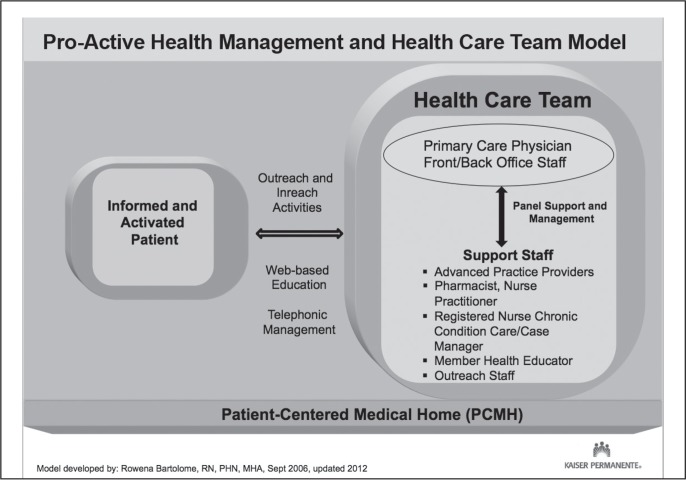
Objectives: At Kaiser Permanente, national Equitable Care Health Outcomes (ECHO) Reports with a baseline measurement of 16 Healthcare Effectiveness Data and Information Set measures stratified by race and ethnicity showed a disparity of 8.1 percentage points in blood pressure (BP) control rates between African- American/black (black) and white members. The aims of this study were to describe a population care management team-based approach to improve BP control for large populations and to explain how a culturally tailored, patient-centered approach can address this racial disparity.
Methods: These strategies were implemented through: 1) physician-led educational programs on treatment intensification, medication adherence, and consistent use of clinical practice guidelines; 2) building strong care teams by defining individual roles and responsibilities in hypertension management; 3) redesign of the care delivery system to expand access; and 4) programs on culturally tailored communication tools and self-management.
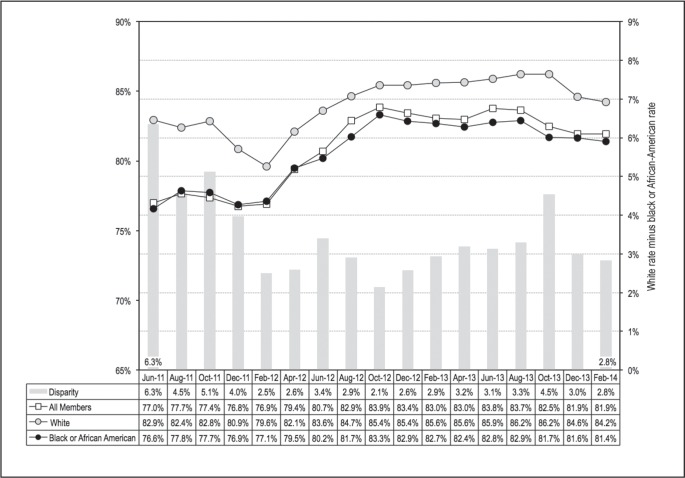
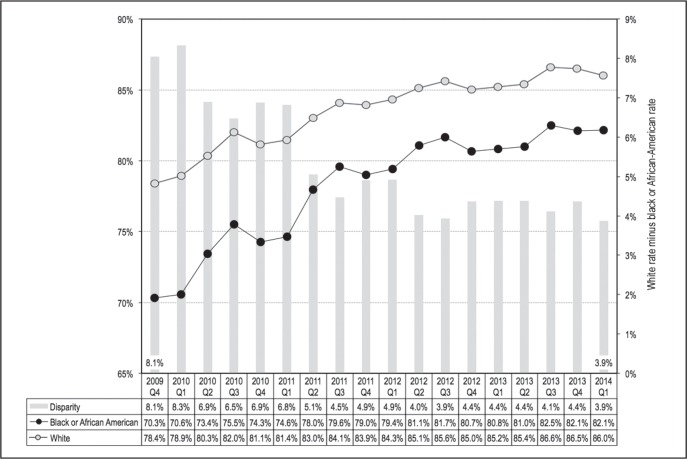
Results: At a physician practice level where 65% of patients with hypertension were black, BP control rates (< 140/90 mmHg) for blacks improved from 76.6% to 81.4%, and control rates for whites increased from 82.9% to 84.2%. The racial gap narrowed from 6.3% to 2.8%. As these successful practices continue to spread throughout the program, the health disparity gap in BP control has decreased by 50%, from 8.1% to 3.9%.
Conclusion: A sustainable program to collect self-reported race, ethnicity, and language preference data integrated with successful population care management programs provided the foundation for addressing health disparities. Cultural tailoring of a multilevel team-based approach closed the gap for blacks with hypertension.
Figures
References
-
- Centers for Disease Control and Prevention (CDC) Vital signs: awareness and treatment of uncontrolled hypertension among adults—United States, 2003–2010. MMWR Morb Mortal Wkly Rep. 2012 Sep 7;61:703–9. - PubMed
-
- Heidenreich PA, Trogdon JG, Khavjou OA, et al. American Heart Association Advocacy Coordinating Committee. Stroke Council. Council on Cardiovascular Radiology and Intervention Forecasting the future of cardiovascular disease in the United States: a policy statement from the American Heart Association. Circulation. 2011 Mar 1;123(8):933–44. DOI: http://dx.doi.org/10.1161/CIR.0b013e31820a55f5. - DOI - PubMed
-
- Nwankwo T, Yoon SS, Burt V, Gu Q. Hypertension among adults in the United States: National Health and Nutrition Examination Survey, 2011–2012. NCHS Data Brief. 2013 Oct;(133):1–8. - PubMed
-
- Yoon PW, Gillespie CD, George MG, Wall HK, Centers for Disease Control and Prevention (CDC) Control of hypertension among adults— National Health and Nutrition Examination Survey, United States, 2005–2008. MMWR Morb Mortal Wkly Rep. 2012 Jun 15;61(Suppl):19–25. - PubMed
-
- Go AS, Mozaffarian D, Roger VL, et al. American Heart Association Statistics Committee and Stroke Statistics Subcommittee Heart disease and stroke statistics—2014 update: a report from the American Heart Association. Circulation. 2014 Jan 21;129(3):e28–e292. DOI: http://dx.doi.org/10.1161/01.cir.0000441139.02102.80. - DOI - PMC - PubMed
Publication types
MeSH terms
LinkOut - more resources
Full Text Sources
Medical
Research Materials
Miscellaneous