


Characterising resting-state functional connectivity in a large sample of adults with ADHD
- PMID: 26825495
- PMCID: PMC4788977
- DOI: 10.1016/j.pnpbp.2016.01.011
Characterising resting-state functional connectivity in a large sample of adults with ADHD
Abstract
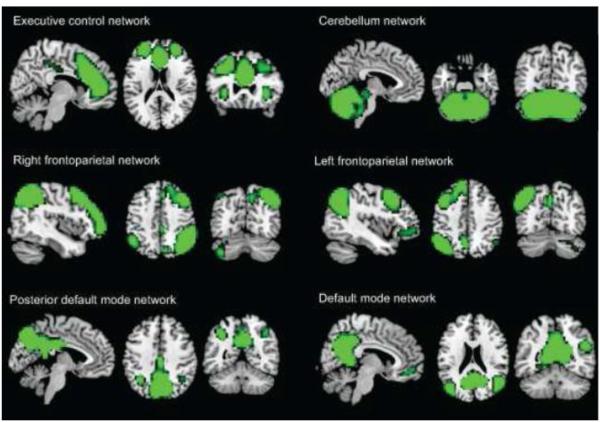
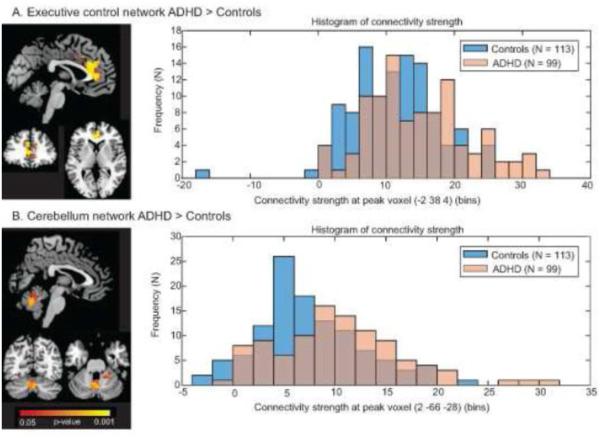
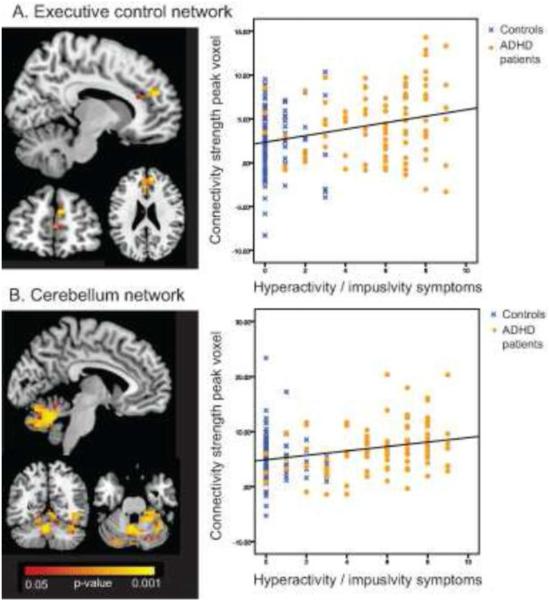
Attention-deficit/hyperactivity disorder (ADHD) is a common childhood psychiatric disorder that often persists into adulthood. While several studies have identified altered functional connectivity in brain networks during rest in children with ADHD, few studies have been performed on adults with ADHD. Existing studies have generally investigated small samples. We therefore investigated aberrant functional connectivity in a large sample of adult patients with childhood-onset ADHD, using a data-driven, whole-brain approach. Adults with a clinical ADHD diagnosis (N=99) and healthy, adult comparison subjects (N=113) underwent a 9-minute resting-state fMRI session in a 1.5T MRI scanner. After elaborate preprocessing including a thorough head-motion correction procedure, group independent component analysis (ICA) was applied from which we identified six networks of interest: cerebellum, executive control, left and right frontoparietal and two default-mode networks. Participant-level network maps were obtained using dual-regression and tested for differences between patients with ADHD and controls using permutation testing. Patients showed significantly stronger connectivity in the anterior cingulate gyrus of the executive control network. Trends were also observed for stronger connectivity in the cerebellum network in ADHD patients compared to controls. However, there was considerable overlap in connectivity values between patients and controls, leading to relatively low effect sizes despite the large sample size. These effect sizes were slightly larger when testing for correlations between hyperactivity/impulsivity symptoms and connectivity strength in the executive control and cerebellum networks. This study provides important insights for studies on the neurobiology of adult ADHD; it shows that resting-state functional connectivity differences between adult patients and controls exist, but have smaller effect sizes than existing literature suggested.
Keywords: Adult ADHD; Cerebellum; Executive control network; Independent component analysis; Resting-state functional connectivity.
Copyright © 2016 The Authors. Published by Elsevier Inc. All rights reserved.
Figures
References
-
- American Psychiatric Organisation . Diagnostic and Statistical Manual of Mental Disorders. 5th. American Psychiatric Association; Arlington, VA: 2013. doi:10.1176/appi.books.9780890425596.
-
- American Psychiatric Organisation . Diagnostic and Statistical Manual of Mental Disorders. Fourth. American Psychiatric Association; Arlington, VA: 2000. Text Revision (DSM-IV-TR), 4th ed. doi:10.1176/appi.books.9780890423349.
-
- Bari A, Robbins TW. Inhibition and impulsivity: behavioral and neural basis of response control. Prog. Neurobiol. 2013;108:44–79. doi:10.1016/j.pneurobio.2013.06.005. - PubMed
-
- Beckmann CF, Mackay CE, Filippini N, Smith SM. Group comparison of resting-state FMRI data using multi-subject ICA and dual regression. Hum. Brain Mapp. Conf. 2009;181
Publication types
MeSH terms
Substances
Grants and funding
LinkOut - more resources
Full Text Sources
Other Literature Sources
Medical
Miscellaneous
